Notice: تابع WP_Block_Type_Registry::register به طورنادرست فراخوانی شد. نامهای نوع بلوک نباید حروف بزرگ داشته باشند. لطفاً برای اطلاعات بیشتر، اشکال زدایی در وردپرس را مشاهده کنید. (این پیام در نگارش 5.0.0 افزوده شده است.) in /home/ethicsho/public_html/wp-includes/functions.php on line 5313
Warning: Use of undefined constant TDC_PATH_LEGACY - assumed 'TDC_PATH_LEGACY' (this will throw an Error in a future version of PHP) in /home/ethicsho/public_html/wp-content/plugins/td-composer/td-composer.php on line 109
Warning: Use of undefined constant TDSP_THEME_PATH - assumed 'TDSP_THEME_PATH' (this will throw an Error in a future version of PHP) in /home/ethicsho/public_html/wp-content/plugins/td-composer/td-composer.php on line 113 بایگانیهای Power (Social Sciences) In Literature - خانه اخلاق پژوهان جوان Notice: Trying to access array offset on value of type bool in /home/ethicsho/public_html/wp-content/plugins/wp-ulike/inc/general-functions.php on line 807
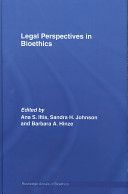
Issues in bioethics often turn, at least in part, on the law and regulatory requirements. Consisting of chapters that address particular bioethics topics from the lawa?s perspective, this fascinating book includes: an introduction to the American legal system papers identifying the principal ways in which the law influences discussions and decisions concerning each of the topics highlighted supplemental papers on certain areas that address the influence and status of the law in countries other than the United States. Covering traditional topics in bioethics, such as determinations of death and health care decisions for vulnerable groups, the text also explores emerging areas such as conflicts of interest in research, genetics, and privacy and confidentiality in the electronic age. Incisive and thought-provoking, this volume provides readers with a rich context for understanding the intersection between the law on bioethicsand the central issues in bioethics.
Is medical ethics in times of armed conflict identical to medical ethics in times of peace, as the World Medical Association declares? In Bioethics and Armed Conflict, the first comprehensive study of medical ethics in conventional, unconventional, and low-intensity war, Michael Gross examines the dilemmas that arise when bioethical principles clash with military necessity—when physicians try to save lives during an endeavor dedicated to taking them—and describes both the conflicts and congruencies of military and medical ethics.Gross describes how the principles of contemporary just war, unlike those of medical ethics, often go beyond the welfare of the individual to consider the collective interests of combatants and noncombatants and the general interests of the state. Military necessity plays havoc with such patients’ rights as the right to life, the right to medical care, informed consent, confidentiality, and the right to die. The principles of triage in battle conditions dictate not need-based treatment but the distribution of resources that will return the greatest number of soldiers to active duty. And unconventional warfare, including current “wars” on terrorism, challenges the traditional concept of medical neutrality as physicians who have sworn to “do no harm” are called upon to lend their expertise to “interrogational” torture or to the development of biological or chemical weapons. Difficult dilemmas inevitably arise during armed conflict, and medicine, Gross concludes, is not above the fray. Medical ethics in time of war cannot be identical to medical ethics in peacetime.
Philippa Foot has for many years been one of the most distinctive and influential thinkers in moral philosophy. Long dissatisfied with the moral theories of her contemporaries, she has gradually evolved a theory of her own that is radically opposed not only to emotivism and prescriptivism but also to the whole subjectivist, anti-naturalist movement deriving from David Hume. Dissatisfied with both Kantian and utilitarian ethics, she claims to have isolated a special form of evaluation that predicates goodness and defect only to living things considered as such; she finds this form of evaluation in moral judgements. Her vivid discussion covers topics such as practical rationality, erring conscience, and the relation between virtue and happiness, ending with a critique of Nietzsche’s immoralism. This long-awaited book exposes a highly original approach to moral philosophy and represents a fundamental break from the assumptions of recent debates. Foot challenges many prominent philosophical arguments and attitudes; but hers is a work full of life and feeling, written for anyone intrigued by the deepest questions about goodness and human.
ما از اخلاق چه انتظاری داریم؟ این سوال شاید تاحدودی برای عموم مردم و یا متخصصان این رشته قابل پاسخ باشد؛ اینکه خوب بودن را به ما بیاموزد و در تنظیم روابط فردی م...

جشن کتاب تهران به ایستگاه سی و یکم رسیده است. حال و احوال نشر کتاب خوب نیست و باید فرهنگدوستان را به خرید و هدیه دادن کتاب ترغیب نمود. خانه اخلاقپژوهان جوان ب...

بنیاد کتابهای اخلاق اسلامی عمدتا پالایش جان از آلودگیها و آراستن آن به زیباییها است. اندیشه محوری این قبیل کتابها آن است که انسان فعلی آنی نیست که باید باشد...

-
0 Comments