Notice: تابع WP_Block_Type_Registry::register به طورنادرست فراخوانی شد. نامهای نوع بلوک نباید حروف بزرگ داشته باشند. لطفاً برای اطلاعات بیشتر، اشکال زدایی در وردپرس را مشاهده کنید. (این پیام در نگارش 5.0.0 افزوده شده است.) in /home/ethicsho/public_html/wp-includes/functions.php on line 5313
Warning: Use of undefined constant TDC_PATH_LEGACY - assumed 'TDC_PATH_LEGACY' (this will throw an Error in a future version of PHP) in /home/ethicsho/public_html/wp-content/plugins/td-composer/td-composer.php on line 109
Warning: Use of undefined constant TDSP_THEME_PATH - assumed 'TDSP_THEME_PATH' (this will throw an Error in a future version of PHP) in /home/ethicsho/public_html/wp-content/plugins/td-composer/td-composer.php on line 113 بایگانیهای Medical Laws And Legislation - United States - خانه اخلاق پژوهان جوان Notice: Trying to access array offset on value of type bool in /home/ethicsho/public_html/wp-content/plugins/wp-ulike/inc/general-functions.php on line 807
Distributive justice in its modern sense calls on the state to guarantee that everyone is supplied with a certain level of material means. Samuel Fleischacker argues that guaranteeing aid to the poor is a modern idea, developed only in the last two centuries. Earlier notions of justice, including Aristotle’s, were concerned with the distribution of political office, not of property. It was only in the eighteenth century, in the work of philosophers such as Adam Smith and Immanuel Kant, that justice began to be applied to the problem of poverty. To attribute a longer pedigree to distributive justice is to fail to distinguish between justice and charity. Fleischacker explains how confusing these principles has created misconceptions about the historical development of the welfare state. Socialists, for instance, often claim that modern economics obliterated ancient ideals of equality and social justice. Free-market promoters agree but applaud the apparent triumph of skepticism and social-scientific rigor. Both interpretations overlook the gradual changes in thinking that yielded our current assumption that justice calls for everyone, if possible, to be lifted out of poverty. By examining major writings in ancient, medieval, and modern political philosophy, Fleischacker shows how we arrived at the contemporary meaning of distributive justice.
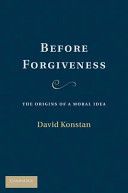
“In this book, David Konstan argues that the modern concept of interpersonal forgiveness, in the full sense of the term, did not exist in ancient Greece and Rome. Even more startlingly, it is not fully present in the Hebrew Bible, nor again in the New Testament, or in the early Jewish and Christian commentaries on the Holy Scriptures. It would still be centuries– many centuries– before the idea of interpersonal forgiveness, with its accompanying ideas of apology, remorse, and a change of heart on thepart of the wrongdoer, would emerge. For all its vast importance today in religion, law, politics, and psychotherapy, interpersonal forgiveness is creation of the 18th and 19th centuries, when the Christian concept of divine forgiveness was finally secularized. Forgiveness was God’s province, and it took a revolution in thought to bring it to earth and make it a human trait”–
Kant is generally conceived to have offered little attention to the fact that we experience the world in and through our bodies. This book argues that this standard image of the great German philosopher is radically wrong. Not only does Kant – throughout his career and in works published before and after the Critique of pure reason – reflect constantly upon the fact that human life is embodied, but the Critique of pure reason itself may be read as a critical reflection aimed at exploring some significant philosophical implications of this fact. Bringing this aspect of Kant’s philosophy into focus is important, not only because it sheds new light on our understanding of Kant’s work, but also because it is relevant to contemporary discussions in philosophy about embodiment, learning and practice. By taking his philosophy of embodiment into account, the author makes Kant stand out as a true contemporary in new and unexpected ways.
Deletelooks at the surprising phenomenon of perfect remembering in the digital age, and reveals why we must reintroduce our capacity to forget. Digital technology empowers us as never before, yet it has unforeseen consequences as well. Potentially humiliating content on Facebook is enshrined in cyberspace for future employers to see. Google remembers everything we’ve searched for and when. The digital realm remembers what is sometimes better forgotten, and this has profound implications for us all.InDelete, Viktor Mayer-Schouml;nberger traces the important role that forgetting has played throughout human history, from the ability to make sound decisions unencumbered by the past to the possibility of second chances. The written word made it possible for humans to remember across generations and time, yet now digital technology and global networks are overriding our natural ability to forget–the past is ever present, ready to be called up at the click of a mouse. Mayer-Schouml;nberger examines the technology that’s facilitating the end of forgetting–digitization, cheap storage and easy retrieval, global access, and increasingly powerful software–and describes the dangers of everlasting digital memory, whether it’s outdated information taken out of context or compromising photos the Web won’t let us forget. He explains why information privacy rights and other fixes can’t help us, and proposes an ingeniously simple solution–expiration dates on information–that may.Deleteis an eye-opening book that will help us remember how to forget in the digital age.
ما از اخلاق چه انتظاری داریم؟ این سوال شاید تاحدودی برای عموم مردم و یا متخصصان این رشته قابل پاسخ باشد؛ اینکه خوب بودن را به ما بیاموزد و در تنظیم روابط فردی م...

جشن کتاب تهران به ایستگاه سی و یکم رسیده است. حال و احوال نشر کتاب خوب نیست و باید فرهنگدوستان را به خرید و هدیه دادن کتاب ترغیب نمود. خانه اخلاقپژوهان جوان ب...

بنیاد کتابهای اخلاق اسلامی عمدتا پالایش جان از آلودگیها و آراستن آن به زیباییها است. اندیشه محوری این قبیل کتابها آن است که انسان فعلی آنی نیست که باید باشد...

-
0 Comments