Notice: تابع WP_Block_Type_Registry::register به طورنادرست فراخوانی شد. نامهای نوع بلوک نباید حروف بزرگ داشته باشند. لطفاً برای اطلاعات بیشتر، اشکال زدایی در وردپرس را مشاهده کنید. (این پیام در نگارش 5.0.0 افزوده شده است.) in /home/ethicsho/public_html/wp-includes/functions.php on line 5313
Warning: Use of undefined constant TDC_PATH_LEGACY - assumed 'TDC_PATH_LEGACY' (this will throw an Error in a future version of PHP) in /home/ethicsho/public_html/wp-content/plugins/td-composer/td-composer.php on line 109
Warning: Use of undefined constant TDSP_THEME_PATH - assumed 'TDSP_THEME_PATH' (this will throw an Error in a future version of PHP) in /home/ethicsho/public_html/wp-content/plugins/td-composer/td-composer.php on line 113 بایگانیهای BL65.W2 .W68 2009 - خانه اخلاق پژوهان جوان Notice: Trying to access array offset on value of type bool in /home/ethicsho/public_html/wp-content/plugins/wp-ulike/inc/general-functions.php on line 807
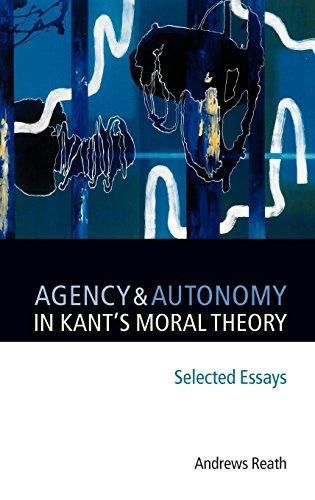
Andrews Reath presents a selection of his best essays on various features of Kant’s moral psychology and moral theory, with particular emphasis on his conception of rational agency and his conception of autonomy. Together the essays articulate Reath’s original approach to Kant’s views about human autonomy, which explains Kant’s belief that objective moral requirements are based on principles we choose for ourselves. With two new papers, and revised versions of several others, the volume will be of great interest to all students and scholars of Kant and of moral philosophy.
Outside Ethicsbrings together some of the most important and provocative works by one of the most creative philosophers writing today. Seeking to expand the scope of contemporary moral and political philosophy, Raymond Geuss here presents essays bound by a shared skepticism about a particular way of thinking about what is important in human life–a way of thinking that, in his view, is characteristic of contemporary Western societies and isolates three broad categories of things as important: subjective individual preferences, knowledge, and restrictions on actions that affect other people (restrictions often construed as ahistorical laws). He sets these categories in a wider context and explores various human phenomena–including poetry, art, religion, and certain kinds of history and social criticism–that do not fit easily into these categories. As its title suggests, this book seeks a place outside conventional ethics. Following a brief introduction, Geuss sets out his main concerns with a focus on ethics and politics. He then expands these themes by discussing freedom, virtue, the good life, and happiness. Next he examines Theodor Adorno’s views on the relation between suffering and knowledge, the nature of religion, and the role of history in giving us critical distances from existing identities. From here he moves to aesthetic concerns. The volume closes by looking at what it is for a human life to have “gaps”–to be incomplete, radically unsatisfactory, or a failure.
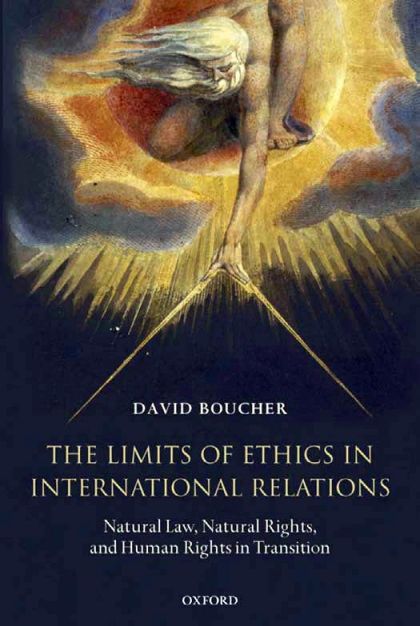
Ethical constraints on relations among individuals within and between societies have always reflected or invoked a higher authority than the caprices of human will. For over two thousand years Natural Law and Natural Rights were the constellations of ideas and presuppositions that fulfilled this role in the west, and exhibited far greater similarities than most commentators want to admit. Such ideas were the lens through which Europeans evaluated the rest of the world. In his major new book David Boucher rejects the view that Natural Rights constituted a secularisation of Natural Law ideas by showing that most of the significant thinkers in the field, in their various ways, believed that reason leads you to the discovery of your obligations, while God provides the ground for discharging them. Furthermore, the book maintains that Natural Rights and Human Rights are far less closely related than is often asserted because Natural Rights never cast adrift the religious foundationalism, whereas Human Rights, for the most part, have jettisoned the Christian metaphysics upon which both Natural Law and Natural Rights depended. Human Rights theories, on the whole, present us with foundationless universal constraints on the actions of individuals, both domestically and internationally. Finally, one of the principal contentions of the book is that these purportedly universal rights and duties almost invariably turn out to be conditional, and upon close scrutiny end up being ‘special’ rights and privileges as the examples of multicultural encounters, slavery and racism, and women’s rights demonstrate.
ما از اخلاق چه انتظاری داریم؟ این سوال شاید تاحدودی برای عموم مردم و یا متخصصان این رشته قابل پاسخ باشد؛ اینکه خوب بودن را به ما بیاموزد و در تنظیم روابط فردی م...

جشن کتاب تهران به ایستگاه سی و یکم رسیده است. حال و احوال نشر کتاب خوب نیست و باید فرهنگدوستان را به خرید و هدیه دادن کتاب ترغیب نمود. خانه اخلاقپژوهان جوان ب...

بنیاد کتابهای اخلاق اسلامی عمدتا پالایش جان از آلودگیها و آراستن آن به زیباییها است. اندیشه محوری این قبیل کتابها آن است که انسان فعلی آنی نیست که باید باشد...

-
0 Comments