Notice: تابع WP_Block_Type_Registry::register به طورنادرست فراخوانی شد. نامهای نوع بلوک نباید حروف بزرگ داشته باشند. لطفاً برای اطلاعات بیشتر، اشکال زدایی در وردپرس را مشاهده کنید. (این پیام در نگارش 5.0.0 افزوده شده است.) in /home/ethicsho/public_html/wp-includes/functions.php on line 5313
Warning: Use of undefined constant TDC_PATH_LEGACY - assumed 'TDC_PATH_LEGACY' (this will throw an Error in a future version of PHP) in /home/ethicsho/public_html/wp-content/plugins/td-composer/td-composer.php on line 109
Warning: Use of undefined constant TDSP_THEME_PATH - assumed 'TDSP_THEME_PATH' (this will throw an Error in a future version of PHP) in /home/ethicsho/public_html/wp-content/plugins/td-composer/td-composer.php on line 113 بایگانیهای Religion / Buddhism / General - خانه اخلاق پژوهان جوان Notice: Trying to access array offset on value of type bool in /home/ethicsho/public_html/wp-content/plugins/wp-ulike/inc/general-functions.php on line 807
What does it mean to lead a moral life? In her first extended study of moral philosophy, Judith Butler offers aprovocative outline for a new ethical practice–one responsive to the need for critical autonomy and grounded in a new sense of the human subject. Butler takes as her starting point one’s ability to answer the questions ocirc;What have I done?ouml; and ocirc;What ought I to do?ouml; She shows that these question can be answered only by asking a prior question, ocirc;Who is this aelig;I’ who is under an obligation to give an account of itself and to act in certain ways?ouml; Because I find that I cannot give an account of myself without accounting for the social conditions under which I emerge, ethical reflection requires a turn to social theory. In three powerfully crafted and lucidly written chapters, Butler demonstrates how difficult it is to give an account of oneself, and how this lack of self-transparency and narratibility is crucial to an ethical understanding of the human. In brilliant dialogue with Adorno, Levinas, Foucault, and other thinkers, she eloquently argues the limits, possibilities, and dangers of contemporary ethical thought. Butler offers a critique of the moral self, arguing that the transparent, rational, and continuous ethical subject is an impossible construct that seeks to deny the specificity of what it is to be human. We can know ourselves only incompletely, and only in relation to a broader social world that has always preceded us and already shaped us in ways we cannot grasp. If inevitably we are partially opaque to ourselves, how can giving an account of ourselves define the ethical act? And doesn’t an ethical system that holds us impossibly accountable for full self-knowledge and self-consistency inflict a kind of psychic violence, leading to a culture of self-beratement and cruelty? How does the turn to social theory offer us a chance to understand the specifically social character of our own unknowingness about ourselves? In this invaluable book, by recasting ethics as a project in which being ethical means becoming critical of norms under which we are asked to act, but which we can never fully choose, Butler illuminates what it means for us as ocirc;fallible creaturesouml; to create and share an ethics of vulnerability, humility, and ethical responsiveness.
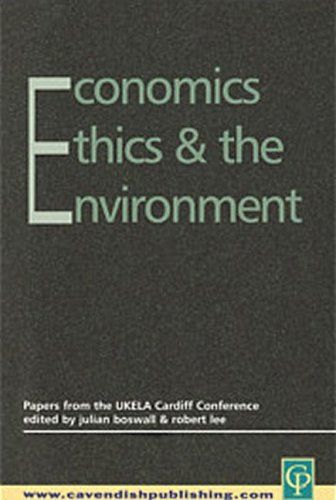
The UK Environmental Law Association (UKELA) holds a conference each year to bring together academics and practitioners,lawyers and environmental experts from other disciplines – within both science and social science. It is a unique event providing a forum for discussion of the most pressing issues of environmental regulation, and provides a unique combination of analysis and practical application. These articles, presented as papers at the Cardiff Conference in 2001, provide an accessible and informative collection addressing the conference theme of economics, ethics and the environment, including such issues as: how we can use traditional economic devices such as taxation, trading and insurance to assist in environmental regulation; how we treat and protect the natural world; how we might cope with the growing problem of waste; and how we should react to safeguard the environment in the face of risks and scientific uncertainties. The collection forms a topical and wide ranging discussion of key issues for legal practitioners, academics and students and will also be of great interest to a wider range of disciplines relating to the environment.
Few areas have witnessed the type of growth we have seen in the affective sciences in the past decades. Across psychology, philosophy, economics, and neuroscience, there has been an explosion of interest in the topic of emotion and affect. Comprehensive, authoritative, up-to-date, and easy-to-use, the new Oxford Companion to Emotion and the Affective Sciences is an indispensable resource for all who wish to find out about theories, concepts, methods, and research findings in this rapidly growing interdisciplinary field – one that brings together, amongst others, psychologists, neuroscientists, social scientists, philosophers, and historians. Organized by alphabetical entries, and presenting brief definitions, conciseoverviews, and encyclopaedic articles (all with extensive references to relevant publications), this Companion lends itself to casual browsing by non-specialists interested in the fascinating phenomena of emotions, moods, affect disorders, and personality as well as to focused search for pertinent information bystudents and established scholars in the field.Not only does the book provide entries on affective phenomena, but also on their neural underpinnings, their cognitive antecedents and the associated responses in physiological systems, facial, vocal, and bodily expressions, and action tendencies. Numerous entries also consider the role of emotion in society and social behavior, as well as in cognitive processes such as those critical for perception, attention, memory, judgement and decision-making.The volume has been edited by a group of internationally leading authorities in the respective disciplines consisting of two editors (David Sander and Klaus Scherer) as well as group of 11 associate editors (John T. Cacioppo, Tim Dalgleish, Robert Dantzer, Richard J. Davidson, Ronald B. de Sousa, Phoebe C. Ellsworth, Nico Frijda, George Loewenstein, Paula M. Niedenthal, Peter Salovey, and Richard A. Shweder). The members of the editorial board have commissioned and reviewed contributions frommajor experts on specific topics.In addition to comprehensive coverage of technical terms and fundamental issues, the volume also highlights current debates that inform the ongoing research process. In addition, the Companion contains a wealth of material on the role of emotion in applied domains such as economic behaviour, music and arts, work and organizational behaviour, family interactions and group dynamics, religion, law and justice, and societal change.Highly accessible and wide-ranging, this book is a vital resource for scientists, students, and professionals eager to obtain a rapid, conclusive overview on central terms and topics and anyone wanting to learn more about the mechanisms underlying the emotions dominating many aspects of our lives.
ما از اخلاق چه انتظاری داریم؟ این سوال شاید تاحدودی برای عموم مردم و یا متخصصان این رشته قابل پاسخ باشد؛ اینکه خوب بودن را به ما بیاموزد و در تنظیم روابط فردی م...

جشن کتاب تهران به ایستگاه سی و یکم رسیده است. حال و احوال نشر کتاب خوب نیست و باید فرهنگدوستان را به خرید و هدیه دادن کتاب ترغیب نمود. خانه اخلاقپژوهان جوان ب...

بنیاد کتابهای اخلاق اسلامی عمدتا پالایش جان از آلودگیها و آراستن آن به زیباییها است. اندیشه محوری این قبیل کتابها آن است که انسان فعلی آنی نیست که باید باشد...

-
0 Comments