Notice: تابع WP_Block_Type_Registry::register به طورنادرست فراخوانی شد. نامهای نوع بلوک نباید حروف بزرگ داشته باشند. لطفاً برای اطلاعات بیشتر، اشکال زدایی در وردپرس را مشاهده کنید. (این پیام در نگارش 5.0.0 افزوده شده است.) in /home/ethicsho/public_html/wp-includes/functions.php on line 5313
Warning: Use of undefined constant TDC_PATH_LEGACY - assumed 'TDC_PATH_LEGACY' (this will throw an Error in a future version of PHP) in /home/ethicsho/public_html/wp-content/plugins/td-composer/td-composer.php on line 109
Warning: Use of undefined constant TDSP_THEME_PATH - assumed 'TDSP_THEME_PATH' (this will throw an Error in a future version of PHP) in /home/ethicsho/public_html/wp-content/plugins/td-composer/td-composer.php on line 113 بایگانیهای Affective Neuroscience - Encyclopedias - خانه اخلاق پژوهان جوان Notice: Trying to access array offset on value of type bool in /home/ethicsho/public_html/wp-content/plugins/wp-ulike/inc/general-functions.php on line 807
“Organ shortage is an ongoing problem in many countries. The needless death and suffering which have resulted necessitate an investigation into potential solutions. This examination of contemporary ethical means, both practical and policy-oriented, of reducing the shortfall in organs draws on the experiences of a range of countries. The authors focus on the resolution and negotiation of ethical conflict, examine systems approaches such as the ‘Spanish model’ and the US Breakthrough Collaboratives, evaluate policy proposals relating to incentives, presumed consent, and modifications regarding end-of-life care, and evaluate the greatly increased use of (non-heart-beating) donors suffering circulatory death, as well as living donors. The proposed strategies and solutions are not only capable of resolving the UK’s own organ-shortage crisis, but also of being implemented in other countries grappling with how to address the growing gap between supply and demand for organs”–
Here at last is a coherent, unintimidating introduction to the challenging and fascinating landscape of Western philosophy. Written expressly for “anyone who believes there are big questions out there, but does not know how to approach them,” Think provides a sound framework for exploring the most basic themes of philosophy, and for understanding how major philosophers have tackled the questions that have pressed themselves most forcefully on human consciousness. Simon Blackburn, author of the best-selling Oxford Dictionary of Philosophy, begins by making a convincing case for the relevance of philosophy and goes on to give the reader a sense of how the great historical figures such as Plato, Hume, Kant, Descartes, and others have approached its central themes. In a lively and accessible style, Blackburn approaches the nature of human reflection and how we think, or can think, about knowledge, fate, ethics, identity, God, reason, and truth. Each chapter explains a major issue, and gives the reader a self-contained guide through the problems that the philosophers have studied. Because the text approaches these issues from the gound up, the untrained reader will emerge from its pages able to explore other philosophies with greater pleasure and understanding and be able to think–philosophically–for him or herself. Philosophy is often dismissed as a purely academic discipline with no relation to the “real” world non-philosophers are compelled to inhabit. Think dispels this myth and offers a springboard for all those who want to learn how the basic techniques of thinking shape our virtually every aspect of our existence.
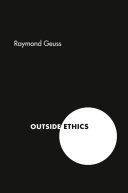
Outside Ethicsbrings together some of the most important and provocative works by one of the most creative philosophers writing today. Seeking to expand the scope of contemporary moral and political philosophy, Raymond Geuss here presents essays bound by a shared skepticism about a particular way of thinking about what is important in human life–a way of thinking that, in his view, is characteristic of contemporary Western societies and isolates three broad categories of things as important: subjective individual preferences, knowledge, and restrictions on actions that affect other people (restrictions often construed as ahistorical laws). He sets these categories in a wider context and explores various human phenomena–including poetry, art, religion, and certain kinds of history and social criticism–that do not fit easily into these categories. As its title suggests, this book seeks a place outside conventional ethics. Following a brief introduction, Geuss sets out his main concerns with a focus on ethics and politics. He then expands these themes by discussing freedom, virtue, the good life, and happiness. Next he examines Theodor Adorno’s views on the relation between suffering and knowledge, the nature of religion, and the role of history in giving us critical distances from existing identities. From here he moves to aesthetic concerns. The volume closes by looking at what it is for a human life to have “gaps”–to be incomplete, radically unsatisfactory, or a failure.
ما از اخلاق چه انتظاری داریم؟ این سوال شاید تاحدودی برای عموم مردم و یا متخصصان این رشته قابل پاسخ باشد؛ اینکه خوب بودن را به ما بیاموزد و در تنظیم روابط فردی م...

جشن کتاب تهران به ایستگاه سی و یکم رسیده است. حال و احوال نشر کتاب خوب نیست و باید فرهنگدوستان را به خرید و هدیه دادن کتاب ترغیب نمود. خانه اخلاقپژوهان جوان ب...

بنیاد کتابهای اخلاق اسلامی عمدتا پالایش جان از آلودگیها و آراستن آن به زیباییها است. اندیشه محوری این قبیل کتابها آن است که انسان فعلی آنی نیست که باید باشد...

-
0 Comments