Notice: تابع WP_Block_Type_Registry::register به طورنادرست فراخوانی شد. نامهای نوع بلوک نباید حروف بزرگ داشته باشند. لطفاً برای اطلاعات بیشتر، اشکال زدایی در وردپرس را مشاهده کنید. (این پیام در نگارش 5.0.0 افزوده شده است.) in /home/ethicsho/public_html/wp-includes/functions.php on line 5313
Warning: Use of undefined constant TDC_PATH_LEGACY - assumed 'TDC_PATH_LEGACY' (this will throw an Error in a future version of PHP) in /home/ethicsho/public_html/wp-content/plugins/td-composer/td-composer.php on line 109
Warning: Use of undefined constant TDSP_THEME_PATH - assumed 'TDSP_THEME_PATH' (this will throw an Error in a future version of PHP) in /home/ethicsho/public_html/wp-content/plugins/td-composer/td-composer.php on line 113 بایگانیهای Newly Independent States - خانه اخلاق پژوهان جوان Notice: Trying to access array offset on value of type bool in /home/ethicsho/public_html/wp-content/plugins/wp-ulike/inc/general-functions.php on line 807
R. Jay Wallace argues in this book that moral accountability hinges on questions of fairness: When is it fair to hold people morally responsible for what they do? Would it be fair to do so even in a deterministic world? To answer these questions, we need to understand what we are doing when we hold people morally responsible, a stance that Wallace connects with a central class of moral sentiments, those of resentment, indignation, and guilt. To hold someone responsible, he argues, is to be subject to these reactive emotions in one’s dealings with that person. Developing this theme with unusual sophistication, he offers a new interpretation of the reactive emotions and traces their role in our practices of blame and moral sanction. With this account in place, Wallace advances a powerful and sustained argument against the common view that accountability requires freedom of will. Instead, he maintains, the fairness of holding people responsible depends on their rational competence: the power to grasp moral reasons and to control their behavior accordingly. He shows how these forms of rational competence are compatible with determinism. At the same time, giving serious consideration to incompatibilist concerns, Wallace develops a compelling diagnosis of the common assumption that freedom is necessary for responsibility. Rigorously argued, eminently readable, this book touches on issues of broad concern to philosophers, legal theorists, political scientists, and anyone with an interest in the nature and limits of responsibility.
Philippa Foot has for many years been one of the most distinctive and influential thinkers in moral philosophy. Long dissatisfied with the moral theories of her contemporaries, she has gradually evolved a theory of her own that is radically opposed not only to emotivism and prescriptivism but also to the whole subjectivist, anti-naturalist movement deriving from David Hume. Dissatisfied with both Kantian and utilitarian ethics, she claims to have isolated a special form of evaluation that predicates goodness and defect only to living things considered as such; she finds this form of evaluation in moral judgements. Her vivid discussion covers topics such as practical rationality, erring conscience, and the relation between virtue and happiness, ending with a critique of Nietzsche’s immoralism. This long-awaited book exposes a highly original approach to moral philosophy and represents a fundamental break from the assumptions of recent debates. Foot challenges many prominent philosophical arguments and attitudes; but hers is a work full of life and feeling, written for anyone intrigued by the deepest questions about goodness and human.
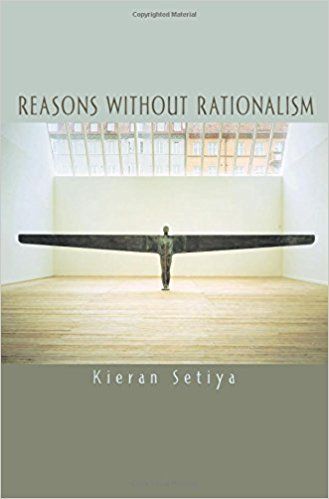
Modern philosophy has been vexed by the question “Why should I be moral?” and by doubts about the rational authority of moral virtue. In Reasons without Rationalism, Kieran Setiya shows that these doubts rest on a mistake. The “should” of practical reason cannot be understood apart from the virtues of character, including such moral virtues as justice and benevolence, and the considerations to which the virtues make one sensitive thereby count as reasons to act. Proposing a new framework for debates about practical reason, Setiya argues that the only alternative to this “virtue theory” is a form of ethical rationalism in which reasons derive from the nature of intentional action. Despite its recent popularity, however, ethical rationalism is false. It wrongly assumes that we act “under the guise of the good,” or it relies on dubious views about intention and motivation. It follows from the failure of rationalism that the virtue theory is true: we cannot be fully good without the perfection of practical reason, or have that perfection without being good. Addressing such topics as the psychology of virtue and the explanation of action, Reasons without Rationalism is essential reading for philosophers interested in ethics, rationality, or the philosophy of mind.
A revised, expanded and updated edition with contributions by 325 renowned authorities in the field of ethics. All of the original articles have been newly peer-reviewed and revised, bibliographies have been updated throughout, and the overall design of the work has been enhanced for easier access to cross-references and other reference features.
ما از اخلاق چه انتظاری داریم؟ این سوال شاید تاحدودی برای عموم مردم و یا متخصصان این رشته قابل پاسخ باشد؛ اینکه خوب بودن را به ما بیاموزد و در تنظیم روابط فردی م...

جشن کتاب تهران به ایستگاه سی و یکم رسیده است. حال و احوال نشر کتاب خوب نیست و باید فرهنگدوستان را به خرید و هدیه دادن کتاب ترغیب نمود. خانه اخلاقپژوهان جوان ب...

بنیاد کتابهای اخلاق اسلامی عمدتا پالایش جان از آلودگیها و آراستن آن به زیباییها است. اندیشه محوری این قبیل کتابها آن است که انسان فعلی آنی نیست که باید باشد...

-
0 Comments