Notice: تابع WP_Block_Type_Registry::register به طورنادرست فراخوانی شد. نامهای نوع بلوک نباید حروف بزرگ داشته باشند. لطفاً برای اطلاعات بیشتر، اشکال زدایی در وردپرس را مشاهده کنید. (این پیام در نگارش 5.0.0 افزوده شده است.) in /home/ethicsho/public_html/wp-includes/functions.php on line 5313
Warning: Use of undefined constant TDC_PATH_LEGACY - assumed 'TDC_PATH_LEGACY' (this will throw an Error in a future version of PHP) in /home/ethicsho/public_html/wp-content/plugins/td-composer/td-composer.php on line 109
Warning: Use of undefined constant TDSP_THEME_PATH - assumed 'TDSP_THEME_PATH' (this will throw an Error in a future version of PHP) in /home/ethicsho/public_html/wp-content/plugins/td-composer/td-composer.php on line 113 بایگانیهای God/ Proof - خانه اخلاق پژوهان جوان Notice: Trying to access array offset on value of type bool in /home/ethicsho/public_html/wp-content/plugins/wp-ulike/inc/general-functions.php on line 807
If there is such a thing as reason, it has to be universal. Reason must reflect objective principles whose validity is independent of our point of view–principles that anyone with enough intelligence ought to be able to recognize as correct. But this generality of reason is what relativists and subjectivists deny in ever-increasing numbers. And such subjectivism is not just an inconsequential intellectual flourish or badge of theoretical chic. It is exploited to deflect argument and to belittle the pretensions of the arguments of others. The continuing spread of this relativistic way of thinking threatens to make public discourse increasingly difficult and to exacerbate the deep divisions of our society. In The Last Word, Thomas Nagel, one of the most influential philosophers writing in English, presents a sustained defense of reason against the attacks of subjectivism, delivering systematic rebuttals of relativistic claims with respect to language, logic, science, and ethics. He shows that the last word in disputes about the objective validity of any form of thought must lie in some unqualified thoughts about how things are–thoughts that we cannot regard from outside as mere psychological dispositions.
A disquieting suggestion — The nature of moral disagreement today and the claims of emotivism — Emotivism: social content and social context — The predecessor culture and the enlightenment project of justifying morality — Why the enlightenment project of justifying morality had to fail — Some consequences of the failure of the enlightenment project — “Fact”, explanation and expertise — The character of generalizations in social science and their lack of predictive power — Nietzsche or Aristotle? — The virtues in heroic societies — The virtues at Athens — Aristotle’s account of the virtues — Medieval aspects and occasions — The nature of the virtues — The virtues, the unity of a human life and the concept of a tradition — From the virtues to virtue and after virtue — Justice as a virtue: changing conceptions — After virtue: Nietzsche or Aristotle, Trotsky and St. Benedict — Postscript to the second edition.
In THE CRITIQUE OF JUDGMENT (1790), Immanuel Kant (1724-1804) seeks to establish the a priori principles underlying the faculty of judgement, just as he did in his previous critiques of pure and practical reason. The first part deals with the subject of our aesthetic sensibility; we respond to certain natural phenomena as beautiful, says Kant, when we recognise in nature a harmonious order that satisfies the mind’s own need for order. The second half of the critique concentrates on the apparent teleology in nature’s design of organisms. Kant argues that our minds are inclined to see purpose and order in nature and this is the main principle underlying all of our judgements. Although this might imply a super sensible Designer, Kant insists that we cannot prove a supernatural dimension or the existence of God. Such considerations are beyond reason and are solely the province of faith.
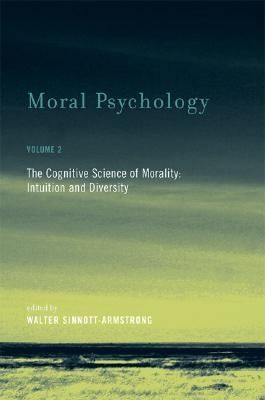
For much of the twentieth century, philosophy and science went their separate ways. In moral philosophy, fear of the so-called naturalistic fallacy kept moral philosophers from incorporating developments in biology and psychology. Since the 1990s, however, many philosophers have drawn on recent advances in cognitive psychology, brain science, and evolutionary psychology to inform their work. This collaborative trend is especially strong in moral philosophy, and these three volumes bring together some of the most innovative work by both philosophers and psychologists in this emerging interdisciplinary field.Contributors to Volume 2:Fredrik Bjorklund (University of Lund), James Blair (National Institute of Mental Health), Paul Bloomfield (University of Connecticut), Fiery Cushman (Harvard University), Justin D’Arms (Ohio State University), John Deigh (University of Texas at Austin), John Doris (Washington University), Julia Driver (Dartmouth College), Ben Fraser (Australian National University Research School of Social Science), Gerd Gigerenzer (Max Plank Institute), Michael Gill (University of Arizona), Jonathan Haidt (University of Virginia) Marc Hauser (Harvard University), Daniel Jacobson (Bowling Green State University), Joshua Knobe (University of North Carolina at Chapel Hill), Brian Leiter (University of Texas at Austin), Don Loeb (University of Vermont), Ron Mallon (University of Utah), Darcia Narvaez (University of Notre Dame), Shaun Nichols (University of Arizona), Alexandra Plakias (University of Michigan), Jesse Prinz (University of North Carolina at Chapel Hill), Geoffrey Sayre-McCord (University of North Carolina, Chapel Hill), Russ Shafer-Landau (University of Wisconsin), Walter Sinnott-Armstrong (Dartmouth College), Cass Sunstein (University of Chicago), William Tolhurst (University of Northern Illinois), Liane Young (Harvard University).
ما از اخلاق چه انتظاری داریم؟ این سوال شاید تاحدودی برای عموم مردم و یا متخصصان این رشته قابل پاسخ باشد؛ اینکه خوب بودن را به ما بیاموزد و در تنظیم روابط فردی م...

جشن کتاب تهران به ایستگاه سی و یکم رسیده است. حال و احوال نشر کتاب خوب نیست و باید فرهنگدوستان را به خرید و هدیه دادن کتاب ترغیب نمود. خانه اخلاقپژوهان جوان ب...

بنیاد کتابهای اخلاق اسلامی عمدتا پالایش جان از آلودگیها و آراستن آن به زیباییها است. اندیشه محوری این قبیل کتابها آن است که انسان فعلی آنی نیست که باید باشد...

-
0 Comments