Notice: تابع WP_Block_Type_Registry::register به طورنادرست فراخوانی شد. نامهای نوع بلوک نباید حروف بزرگ داشته باشند. لطفاً برای اطلاعات بیشتر، اشکال زدایی در وردپرس را مشاهده کنید. (این پیام در نگارش 5.0.0 افزوده شده است.) in /home/ethicsho/public_html/wp-includes/functions.php on line 5313
Warning: Use of undefined constant TDC_PATH_LEGACY - assumed 'TDC_PATH_LEGACY' (this will throw an Error in a future version of PHP) in /home/ethicsho/public_html/wp-content/plugins/td-composer/td-composer.php on line 109
Warning: Use of undefined constant TDSP_THEME_PATH - assumed 'TDSP_THEME_PATH' (this will throw an Error in a future version of PHP) in /home/ethicsho/public_html/wp-content/plugins/td-composer/td-composer.php on line 113 بایگانیهای Critical Discourse Analysis - خانه اخلاق پژوهان جوان Notice: Trying to access array offset on value of type bool in /home/ethicsho/public_html/wp-content/plugins/wp-ulike/inc/general-functions.php on line 807
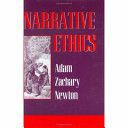
The ethics of literature, formalists have insisted, resides in the moral quality of a character, a story, perhaps the relation between author and reader. But in the wake of deconstruction and various forms of criticism focusing on difference, the ethical question has been freshly negotiated by literary studies, and to this approach Adam Newton brings a startling new thrust. His book makes a compelling case for understanding narrative as ethics. Assuming an intrinsic and necessary connection between the two, Newton explores the ethical consequences of telling stories and fictionalizing character, and the reciprocal claims binding teller, listener, witness, and reader in the process. He treats these relations as defining properties of prose fiction, of particular import in nineteenth- and twentieth-century texts.Newton’s fresh and nuanced readings cover a wide range of authors and periods, from Charles Dickens to Kazuo Ishiguro and Julian Barnes, from Herman Melville to Richard Wright, from Joseph Conrad and Henry James to Sherwood Anderson and Stephen Crane. An original work of theory as well as a deft critical performance, Narrative Ethics also stakes a claim for itself as moral inquiry. To that end, Newton braids together the ethical-philosophical projects of Emmanuel Levinas, Stanley Cavell, and Mikhail Bakhtin as a kind of chorus for his textual analyses–an elegant bridge between philosophy’s ear and literary criticism’s voice. His work will generate enormous interest among scholars and students of English and American literature, as well as specialists in narrative and literary theory, hermeneutics, and contemporary philosophy.
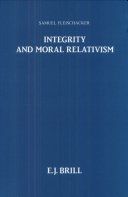
Programs of ethical relativism notoriously face two great difficulties: 1) how can they account for our need to make ethical judgements about other groups and individuals with whom we come into conflict? and 2) how can they allow for us to criticize the group, set of desires, etc. to which our ethical norms are said to be relative? “Integrity and Moral Relativism develops a moderate version of cultural relativism that can answer these questions. After examining and defending the notion of a “world-picture,” and of incommensurable differences across world-pictures, the book brings its theoretical framework together with the history of anthropology to argue that a culture is indeed the appropriate expression of a world picture. It then draws on literary, philosophical and historical resources to illustrate the way in which Western society, specifically, contains traditions distinguishing legitimate cross-cultural judgment, and legitimate from illegitimate cultural self-criticism. As long as there is a language for these possibilities, an individual can see ethics as culturally based without compromising his or her integrity.
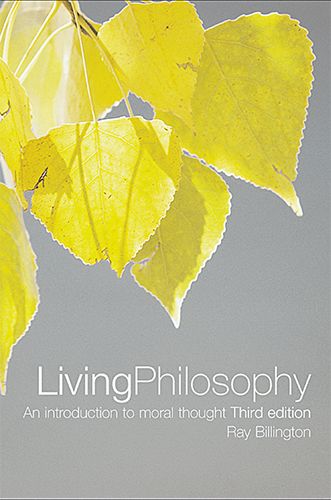
Living Philosophy: An Introduction to Moral Thought, third editionis a thoroughly revised and updated version of its highly successful and popular predecessor. Incorporating several brand new case studies and discussion points, the book introduces central questions in ethical theory to the student and assumes no previous knowledge of philosophy. Each chapter deals with a particular ethical issue and has an accompanying case study designed to encourage discussion. New topics raised include genetically modified organisms (GMO), environmental ethics, bioethics and the human genome, as well as a new chapter on religious and cultural relativism in the light of September 11th. Ray Billington’s style is at once refreshing and honest and his approach to the subject is always clear. The coverage of the book is tailored for any introductory course in ethics.
ما از اخلاق چه انتظاری داریم؟ این سوال شاید تاحدودی برای عموم مردم و یا متخصصان این رشته قابل پاسخ باشد؛ اینکه خوب بودن را به ما بیاموزد و در تنظیم روابط فردی م...

جشن کتاب تهران به ایستگاه سی و یکم رسیده است. حال و احوال نشر کتاب خوب نیست و باید فرهنگدوستان را به خرید و هدیه دادن کتاب ترغیب نمود. خانه اخلاقپژوهان جوان ب...

بنیاد کتابهای اخلاق اسلامی عمدتا پالایش جان از آلودگیها و آراستن آن به زیباییها است. اندیشه محوری این قبیل کتابها آن است که انسان فعلی آنی نیست که باید باشد...

-
0 Comments