Notice: تابع WP_Block_Type_Registry::register به طورنادرست فراخوانی شد. نامهای نوع بلوک نباید حروف بزرگ داشته باشند. لطفاً برای اطلاعات بیشتر، اشکال زدایی در وردپرس را مشاهده کنید. (این پیام در نگارش 5.0.0 افزوده شده است.) in /home/ethicsho/public_html/wp-includes/functions.php on line 5313
Warning: Use of undefined constant TDC_PATH_LEGACY - assumed 'TDC_PATH_LEGACY' (this will throw an Error in a future version of PHP) in /home/ethicsho/public_html/wp-content/plugins/td-composer/td-composer.php on line 109
Warning: Use of undefined constant TDSP_THEME_PATH - assumed 'TDSP_THEME_PATH' (this will throw an Error in a future version of PHP) in /home/ethicsho/public_html/wp-content/plugins/td-composer/td-composer.php on line 113 بایگانیهای B4377 .E84 2008 - خانه اخلاق پژوهان جوان Notice: Trying to access array offset on value of type bool in /home/ethicsho/public_html/wp-content/plugins/wp-ulike/inc/general-functions.php on line 807
Essays on Aristotle’s Rhetoric offers a fresh and comprehensive assessment of a classic work. Aristotle’s influence on the practice and theory of rhetoric, as it affects political and legal argumentation, has been continuous and far-reaching. This anthology presents Aristotle’s Rhetoric in its original context, providing examples of the kind of oratory whose success Aristotle explains and analyzes.The contributors–eminent philosophers, classicists, and critics–assess the role and the techniques of rhetorical persuasion in philosophic discourse and in the public sphere. They connect Aristotle’s Rhetoric to his other work on ethics and politics, as well as to his ideas on logic, psychology, and philosophy of language. The collection as a whole invites us to reassess the place of rhetoric in intellectual and political life. Essays on Aristotle’s Rhetoric offers a fresh and comprehensive assessment of a classic work. Aristotle’s influence on the practice and theory of rhetoric, as it affects political and legal argumentation, has been continuous and far-reaching. This anthology presents Aristotle’s Rhetoric in its original context, providing examples of the kind of oratory whose success Aristotle explains and analyzes.The contributors–eminent philosophers, classicists, and critics–assess the role and the techniques of rhetorical persuasion in philosophic discourse and in the public sphere. They connect Aristotle’s Rhetoric to his other work on ethics and politics, as well as to his ideas on logic, psychology, and philosophy of language. The collection as a whole invites us to reassess the place of rhetoric in intellectual and political life.
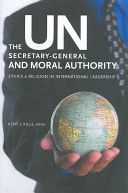
In The UN Secretary-General and Moral Authority, contributors provide case studies of all seven former secretaries-general, establishing a much-needed comparative survey of each office-holder’s personal religious and moral values. From Trygve Lie’s forbearance during the UN’s turbulent formative years to the Nobel committee’s awarding Kofi Annan and the United Nations the prize for peace in 2001, the case studies all follow the same format, first detailing the environmental and experiential factors that forged these men’s ethical frameworks, then analyzing how their “inner code” engaged with the duties of office and the global events particular to their terms. Balanced and unbiased in its approach, this study provides valuable insight into how religious and moral leadership functions in the realm of international relations, and how the promotion of ethical values works to diffuse international tensions and improve the quality of human life around the world.
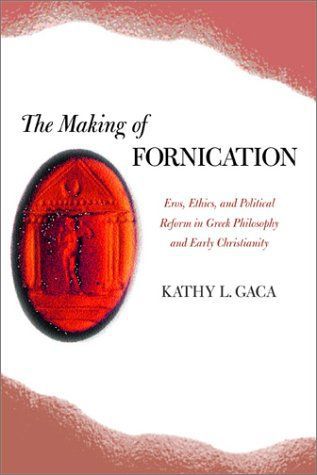
This provocative work provides a radical reassessment of the emergence and nature of Christian sexual morality, the dominant moral paradigm in Western society since late antiquity. While many scholars, including Michel Foucault, have found the basis of early Christian sexual restrictions in Greek ethics and political philosophy, Kathy L. Gaca demonstrates on compelling new grounds that it is misguided to regard Greek ethics and political theory—with their proposed reforms of eroticism, the family, and civic order—as the foundation of Christian sexual austerity. Rather, in this thoroughly informed and wide-ranging study, Gaca shows that early Christian goals to eradicate fornication were derived from the sexual rules and poetic norms of the Septuagint, or Greek Bible, and that early Christian writers adapted these rules and norms in ways that reveal fascinating insights into the distinctive and largely non-philosophical character of Christian sexual morality.Writing with an authoritative command of both Greek philosophy and early Christian writings, Gaca investigates Plato, the Stoics, the Pythagoreans, Philo of Alexandria, the apostle Paul, and the patristic Christians Clement of Alexandria, Tatian, and Epiphanes, freshly elucidating their ideas on sexual reform with precision, depth, and originality. Early Christian writers, she demonstrates, transformed all that they borrowed from Greek ethics and political philosophy to launch innovative programs against fornication that were inimical to Greek cultural mores, popular and philosophical alike. The Septuagint’s mandate to worship the Lord alone among all gods led to a Christian program to revolutionize Gentile sexual practices, only for early Christians to find this virtually impossible to carry out without going to extremes of sexual renunciation.Knowledgeable and wide-ranging, this work of intellectual history and ethics cogently demonstrates why early Christian sexual restrictions took such repressive ascetic forms, and casts sobering light on what Christian sexual morality has meant for religious pluralism in Western culture, especially among women as its bearers.
The Oxford Handbook of Epistemology contains 19 previously unpublished chapters by today’s leading figures in the field. These chapters function not only as a survey of key areas, but as original scholarship on a range of vital topics. Written accessibly for advanced undergraduates, graduate students, and professional philosophers, the Handbook explains the main ideas and problems of contemporary epistemology while avoiding overly technical detail.
ما از اخلاق چه انتظاری داریم؟ این سوال شاید تاحدودی برای عموم مردم و یا متخصصان این رشته قابل پاسخ باشد؛ اینکه خوب بودن را به ما بیاموزد و در تنظیم روابط فردی م...

جشن کتاب تهران به ایستگاه سی و یکم رسیده است. حال و احوال نشر کتاب خوب نیست و باید فرهنگدوستان را به خرید و هدیه دادن کتاب ترغیب نمود. خانه اخلاقپژوهان جوان ب...

بنیاد کتابهای اخلاق اسلامی عمدتا پالایش جان از آلودگیها و آراستن آن به زیباییها است. اندیشه محوری این قبیل کتابها آن است که انسان فعلی آنی نیست که باید باشد...

-
0 Comments