Notice: تابع WP_Block_Type_Registry::register به طورنادرست فراخوانی شد. نامهای نوع بلوک نباید حروف بزرگ داشته باشند. لطفاً برای اطلاعات بیشتر، اشکال زدایی در وردپرس را مشاهده کنید. (این پیام در نگارش 5.0.0 افزوده شده است.) in /home/ethicsho/public_html/wp-includes/functions.php on line 5313
Warning: Use of undefined constant TDC_PATH_LEGACY - assumed 'TDC_PATH_LEGACY' (this will throw an Error in a future version of PHP) in /home/ethicsho/public_html/wp-content/plugins/td-composer/td-composer.php on line 109
Warning: Use of undefined constant TDSP_THEME_PATH - assumed 'TDSP_THEME_PATH' (this will throw an Error in a future version of PHP) in /home/ethicsho/public_html/wp-content/plugins/td-composer/td-composer.php on line 113 بایگانیهای Advertising - Lawyers - United States - خانه اخلاق پژوهان جوان Notice: Trying to access array offset on value of type bool in /home/ethicsho/public_html/wp-content/plugins/wp-ulike/inc/general-functions.php on line 807
This book examines the depiction of the social construction of male homosexuality, lesbianism, and women’s role in “The Bell”, “A Fairly Honourable Defeat”, “An Accidental Man”, “The Philosopher’s Pupil”, and “The Green Knight”. It also explores the representation of power dynamics in the portrayal of homosexuality in Murdoch’s fiction and takes a detailed look at the illustration of power-knowledge vis-a-vis incest in “A Severed Head and The Time of the Angels”. Murdoch’s representation of Platonic “bisexuality” in “Henry and Cato” and “The Book and the Brotherhood” is examined in depth, and is followed by an analysis of the representation of transvestism in “The Philosopher’s Pupil”, “The Green Knight”, and “The Black Prince”. The study finds that it is generally difficult to classify the genders and sexualities to Murdoch’s characters, and that Murdoch’s narrative style also evades classification under traditional rubrics of gender or artistic achievement. Tammy Grimshaw teaches at the University of Leeds.
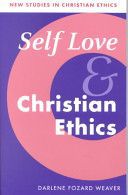
Self love is an inescapable problem for ethics, yet much of contemporary ethics is reluctant to offer any normative moral anthropologies. Instead, secular ethics and contemporary culture promote a norm of self-realization which is subjective and uncritical. Christian ethics also fails to address this problem directly, because it tends to investigate self love within the context of conflicts between the self’s interests and those of her neighbors. Self Love and Christian Ethics argues for right self love as the solution of proper self-relation that intersects with love for God and love for neighbor. Darlene Fozard Weaver explains that right self love entails a true self-understanding that is embodied in the person’s concrete acts and relations. In making this argument, she calls upon ethicists to revisit ontological accounts of the self and to devote more attention to particular moral acts.
As the first book to explore the confluence of three emerging yet critical fields of study, this work sets an exacting standard. The editors’ aim was to produce the most authoritative guide for ecojustice, place-based education, and indigenous knowledge in education. Aimed at a wide audience that includes, but is not restricted to, science educators and policymakers, Cultural Studies and Environmentalism starts from the premise that schooling is a small part of the larger educational domain in which we live and learn. Informed by this overarching notion, the book opens up ways in which home-grown talents, narratives, and knowledge can be developed, and eco-region awareness and global relationships can be facilitated. Incorporating a diversity of perspectives that include photography, poetry and visual art, the work provides a nuanced lens for evaluating educational problems and community conditions while protecting and conserving the most threatened and vulnerable narratives. Editors and contributors share the view that the impending loss of these narratives should be discussed much more widely than is currently the case, and that both teachers and children can take on some of the responsibility for their preservation. The relevance of ecojustice to this process is clear. Ecojustice philosophy is a way of learning about how we frame, or perceive, the world around us—and why that matters. Although it is not synonymous with social or environmental justice, the priorities of ecojustice span the globe in the same way. It incorporates a deep recognition of the appropriateness and significance of learning from place-based experiences and indigenous knowledge systems rather than depending on some urgent (3)4z(Becological crises(3)4y (Bto advocate for school and societal change. With a multiplicity of diverse voices coming together to explore its key themes, this book is an important starting point for educators in many arenas. It brings into better focus a vital role for the Earth’s ecosystems in the context of ecosociocultural theory and participatory democracy alike. (3)4z(BEncompassing theoretical, empirical, and experiential standpoints concerning place-based knowledge systems, this unique book argues for a transformation of (science) education’s intellectual tradition of thinking that emphasizes individual cognition. In its place, the book offers a wisdom tradition of thinking, living, and being that emphasizes community survival in harmony within itself and with Mother Earth.(3)4y (BGlen Aikenhead.
What are the resources and needs, the strengths and the vulnerabilities of patients, of society, or of nature? How do we evaluate the societal potential of scientific discovery? It is fairly well assured that we are influencing the terms of existence of many inhabitants of this planet, from flora to fauna to humans. Moreover, history has shown that while technologies can be used neutrally, they can be (and have been) used to the great benefit – or the great detriment – of human life and the fate of the world as a whole. How various types of knowledge and technological ability will be deployed is up to us, individually and collectively. How such information and ability should be deployed, and for what reasons, are questions at the core of bioethical inquiry. These are the “expanding horizons in bioethics” to which this volume refers. This volume is comprised of fourteen essays. It is a rare gathering of scholarly opinion, featuring well-known experts from a diversity of disciplines. The topics addressed are of immediate concern to the public. The essays ask questions about human nature, genetic technologies, reproductive rights, human subjects research, and environmental issues – all in provocative and challenging new ways. Yet the themes that emerge throughout the volume are of enduring interest to anyone concerned about the interactions of scientific development, ethics, and society. This volume is of interest to students and teachers of bioethics and related topics, as well as to professionals working in these disciplines. “The collection of essays makes an original contribution through the generally very high standard of scholarship of the papers, and through the engagement by those authors with very contemporary issues in bioethics… It is rare that so many highly original views are collected in one volume.” Quote from a pre-publication review.
ما از اخلاق چه انتظاری داریم؟ این سوال شاید تاحدودی برای عموم مردم و یا متخصصان این رشته قابل پاسخ باشد؛ اینکه خوب بودن را به ما بیاموزد و در تنظیم روابط فردی م...

جشن کتاب تهران به ایستگاه سی و یکم رسیده است. حال و احوال نشر کتاب خوب نیست و باید فرهنگدوستان را به خرید و هدیه دادن کتاب ترغیب نمود. خانه اخلاقپژوهان جوان ب...

بنیاد کتابهای اخلاق اسلامی عمدتا پالایش جان از آلودگیها و آراستن آن به زیباییها است. اندیشه محوری این قبیل کتابها آن است که انسان فعلی آنی نیست که باید باشد...

-
0 Comments