
Notice: تابع WP_Block_Type_Registry::register به طورنادرست فراخوانی شد. نامهای نوع بلوک نباید حروف بزرگ داشته باشند. لطفاً برای اطلاعات بیشتر، اشکال زدایی در وردپرس را مشاهده کنید. (این پیام در نگارش 5.0.0 افزوده شده است.) in /home/ethicsho/public_html/wp-includes/functions.php on line 5313
Warning: Use of undefined constant TDC_PATH_LEGACY - assumed 'TDC_PATH_LEGACY' (this will throw an Error in a future version of PHP) in /home/ethicsho/public_html/wp-content/plugins/td-composer/td-composer.php on line 109
Warning: Use of undefined constant TDSP_THEME_PATH - assumed 'TDSP_THEME_PATH' (this will throw an Error in a future version of PHP) in /home/ethicsho/public_html/wp-content/plugins/td-composer/td-composer.php on line 113 بایگانیهای Springer Science & Business Media - خانه اخلاق پژوهان جوان Notice: Trying to access array offset on value of type bool in /home/ethicsho/public_html/wp-content/plugins/wp-ulike/inc/general-functions.php on line 807
The aim of this series is to bring together important recent writings in major areas of philosophical inquiry, selected from a variety of sources, mostly periodicals, which may not be conveniently available to the university student or the general reader. The editors of each volume contribute an introductory essay on the items chosen and on the questions with which they deal. A selective bibliography is appended as a guide to further reading. The philosophy of biology today is one of the most exciting areas in philosophical inquiry. Drawing on work of the past decade, this volume brings together articles from the philosophy, history, and sociology of science, as well as many branches of the biological sciences, to consider issues including the nature of evolutionary theory, biology and ethics, the challenge from religion, and the social implications of biology today (in particular the Human Genome Project). The 36 articles in this collection are divided into 10 parts, each with an introduction by the editors. Spanning issues from epistemology across to ethics, the volume delves into the latest theoretical controversies as well as burning questions of contemporary social importance. Throughout the volume an attempt is made to offer positions from different perspectives, so that the reader will be challenged as well as informed. The Philosophy of Biology will be essential and fascinating reading for students of philosophy and biology as well as the general reader with an interest in the natural sciences and evolution.
Comprised of eighteen chapters contributed by experts in the fields of biology, computer science, information technology, law, and philosophy, Ethics, Computing, and Genomics provides instructors with a flexible resource for undergraduate and graduate courses in an exciting new field of applied ethics: computational genomics. the chapters are organized in a way that takes the reader from a discussion of conceptual frameworks and methodological perspectives, including ethical theory, To an in-depth analysis of controversial issues involving privacy and confidentiality, information consent, and intellectual property. the volume concludes with some predictions about the future of computational genomics, including the role that nanotechnology will likely play as biotechnologies and information technologies continue to converge.
Anita Superson challenges the traditional picture of the skeptic who asks, “Why be moral?” While holding that the skeptic’s position is important, she builds an argument against it by understanding it more deeply, and then shows what it would take to successfully defeat it. Superson argues that we must defeat not only the action skeptic, but the disposition skeptic, who denies that being morally disposed is rationally required, and the motive skeptic, who believes that merely going through the motions in acting morally is rationally permissible. We also have to address the amoralist, who is not moved by moral reasons he recognizes. Superson argues for expanding the skeptic’s position from self-interest to privilege to include morally unjustified behavior targeting disenfranchised social groups, as well as revising the traditional expected utility model to exclude desires deformed by patriarchy as irrational. Lastly she argues that the challenge can be answered if it can be shown that it is, in an important way, inconsistent and therefore irrational to privilege oneself over others. The Moral Skeptic makes an important contribution to both metaethics/moral theory and feminist philosophy, and brings feminist thinking into the larger discussion of the skeptical challenge.
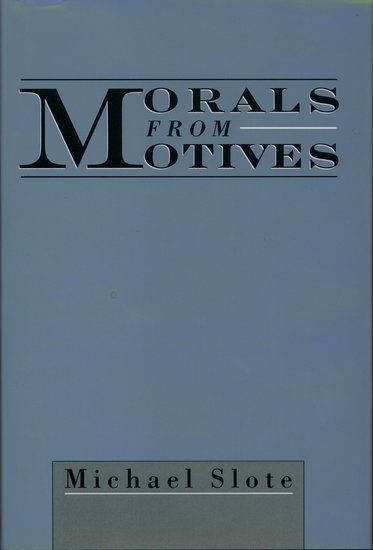
Morals from Motives develops a virtue ethics inspired more by Hume and Hutcheson’s moral sentimentalism than by recently-influential Aristotelianism. It argues that a reconfigured and expanded “morality of caring” can offer a general account of right and wrong action as well as social justice. Expanding the frontiers of ethics, it goes on to show how a motive-based “pure” virtue theory can also help us to understand the nature of human well-being and practical reason.
Moral Dilemmas in Real Life purports to supply ways of thinking of, perhaps even dealing with, the ins and outs of ethical argument.such argument. The world today presents both individuals and communities with situations, which demand moral and ethical deliberations. From the more general issues of universal globalization to the very specific problems of every-day existence encountered by active agents, contemporary life is replete with moral and ethical conundrums. Any thinking person is required, so it seems, to be concerned, involved, or – at the very least – conversant with these issues and this book supplies the wherewithal needed. Applied ethics is that intellectual locale where theory meets praxis. Moral Dilemmas in Real Life is designed to make that meeting point explicit, by presenting a series of issues in well-grounded philosophical formulations. The book begins with the general relation between the individual and society – instilling ethical tension, and even clashes, between the private and the public in our discourse. Going on, from general to specific, it gradually narrows the ethical playing field to touch on medical ethics, the family, and the practice of punishment. In all cases, the book addresses both consensual and conventional social institutions and distortions thereof.
ما از اخلاق چه انتظاری داریم؟ این سوال شاید تاحدودی برای عموم مردم و یا متخصصان این رشته قابل پاسخ باشد؛ اینکه خوب بودن را به ما بیاموزد و در تنظیم روابط فردی م...

جشن کتاب تهران به ایستگاه سی و یکم رسیده است. حال و احوال نشر کتاب خوب نیست و باید فرهنگدوستان را به خرید و هدیه دادن کتاب ترغیب نمود. خانه اخلاقپژوهان جوان ب...

بنیاد کتابهای اخلاق اسلامی عمدتا پالایش جان از آلودگیها و آراستن آن به زیباییها است. اندیشه محوری این قبیل کتابها آن است که انسان فعلی آنی نیست که باید باشد...

-
0 Comments