

Notice: تابع WP_Block_Type_Registry::register به طورنادرست فراخوانی شد. نامهای نوع بلوک نباید حروف بزرگ داشته باشند. لطفاً برای اطلاعات بیشتر، اشکال زدایی در وردپرس را مشاهده کنید. (این پیام در نگارش 5.0.0 افزوده شده است.) in /home/ethicsho/public_html/wp-includes/functions.php on line 5313
Warning: Use of undefined constant TDC_PATH_LEGACY - assumed 'TDC_PATH_LEGACY' (this will throw an Error in a future version of PHP) in /home/ethicsho/public_html/wp-content/plugins/td-composer/td-composer.php on line 109
Warning: Use of undefined constant TDSP_THEME_PATH - assumed 'TDSP_THEME_PATH' (this will throw an Error in a future version of PHP) in /home/ethicsho/public_html/wp-content/plugins/td-composer/td-composer.php on line 113 بایگانیهای Oxford University Press - صفحه 4 از 36 - خانه اخلاق پژوهان جوان Notice: Trying to access array offset on value of type bool in /home/ethicsho/public_html/wp-content/plugins/wp-ulike/inc/general-functions.php on line 807
This lecture is MacIntyre’s most explicit defense of his approach to Thomistic metaphysics. This lecture follows MacIntyre’s argument in After Virtue that modern philosophy has very literally lost its way, and the problems it faces are insoluble. The difficulties are twofold, and stem from the Cartesian turn to the self in the XVith century. Modern philosophy cannot reestablish contact with the outside world when our starting point is self-knowledge, and modern philosophy also cannot accept that any principle could be ‘first’ in any absolute sense of the word, because final causality has been rejected. MacIntyre claims that Thomism does not suffer these defects, but he cautions against a premature victory, because Thomism has been decisively rejected by modern philosophy and modern science, so that there is no chance of effective dialogue between Thomism and other traditions. The very vocabulary of Thomism is a stumbling block. However, modern philosophy has not been able to completely eliminate the Aristotelian roots of all philosophy and science, and so keeps returning to themes that it cannot adequately address. Thus MacIntyre proposes to use the tools of modern philosophies, such as the genealogical narrative, to help reconnect modern philosophy and Thomism. A historical approach might make the rejection, and the reasons for it, evident, and allow fruitful dialogue by allowing for the fruits of modern philosophy to be discussed in a context that will allow them to finally flourish. Essentially, the goal is to enable contemporary philosophy to become more itself by freeing it from the tension created by the premises that cast doubt upon the philosophical enterprise.
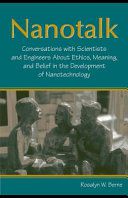
No one really knows where nanotechnology is leading, what its pursuit will mean, and how it may affect human and other forms of life. Nevertheless, its research and development are moving briskly into that unknown. It has been suggested that rapid movement towards ‘who knows where’ is endemic to all technological development; that its researchers pursue it for curiosity and enjoyment, without knowing the consequences, believing that their efforts will be beneficial. Further, that the enthusiasm for development comes with no malicious intent but rather from simple ignorance. Contrary to that commonly held perception about the collective pursuit of technological development, there are individual research scientists and engineers who are quite willing to reflect on the meaning of their work in nanotechnology.Nanotalk is a book of conversations and explorations with thirty five such nano-research scientists and engineers who share their ideas, experiences, perceptions, and beliefs about their work, humanity, nature, change, and the future of the world with nanotechnology. Precisely because of the unknowable nature of nanotechnology research and development, conscientious foresight and ethical reflection are warranted every step of the way. Not only do nanotechnology research and development represent enormous financial commitments, but they also require a profound leap of faith regarding its possible outcomes. Using these conversations as the basis of reflection and deliberation, the author explores the possible significance of nanotechnology to humanity and how it might be pursued conscientiously and ethically.
Antirealist views about morality claim that moral facts or truths do not exist. Does this imply that other types of normative facts, such as epistemic facts, do not exist? The Normative Web develops a positive answer to this question. Terence Cuneo argues that moral and epistemic facts are sufficiently similar so that, if moral facts do not exist, then epistemic facts do not exist. But epistemic facts do exist: to deny their existence would commit us to an extreme version of epistemological scepticism. Therefore, Cuneo concludes, moral facts do exist. And if moral facts exist, then moral realism is true. It is sometimes said that moral realists rarely offer arguments for their position, settling instead for mere defenses of a view they find intuitively plausible. By contrast, The Normative Web provides not merely a defense of robust realism in ethics, but a positive argument for this position. In so doing, it engages with a range of antirealist positions in epistemology such as error theories, expressivist views, and reductionist views of epistemic reasons. These positions, Cuneo claims, come at a prohibitively high theoretical cost. Given this cost, it follows that realism about both epistemic and moral facts is a position that we should find highly attractive.
ما از اخلاق چه انتظاری داریم؟ این سوال شاید تاحدودی برای عموم مردم و یا متخصصان این رشته قابل پاسخ باشد؛ اینکه خوب بودن را به ما بیاموزد و در تنظیم روابط فردی م...

جشن کتاب تهران به ایستگاه سی و یکم رسیده است. حال و احوال نشر کتاب خوب نیست و باید فرهنگدوستان را به خرید و هدیه دادن کتاب ترغیب نمود. خانه اخلاقپژوهان جوان ب...

بنیاد کتابهای اخلاق اسلامی عمدتا پالایش جان از آلودگیها و آراستن آن به زیباییها است. اندیشه محوری این قبیل کتابها آن است که انسان فعلی آنی نیست که باید باشد...

-
0 Comments