

Notice: تابع WP_Block_Type_Registry::register به طورنادرست فراخوانی شد. نامهای نوع بلوک نباید حروف بزرگ داشته باشند. لطفاً برای اطلاعات بیشتر، اشکال زدایی در وردپرس را مشاهده کنید. (این پیام در نگارش 5.0.0 افزوده شده است.) in /home/ethicsho/public_html/wp-includes/functions.php on line 5313
Warning: Use of undefined constant TDC_PATH_LEGACY - assumed 'TDC_PATH_LEGACY' (this will throw an Error in a future version of PHP) in /home/ethicsho/public_html/wp-content/plugins/td-composer/td-composer.php on line 109
Warning: Use of undefined constant TDSP_THEME_PATH - assumed 'TDSP_THEME_PATH' (this will throw an Error in a future version of PHP) in /home/ethicsho/public_html/wp-content/plugins/td-composer/td-composer.php on line 113 بایگانیهای Oxford University Press - خانه اخلاق پژوهان جوان Notice: Trying to access array offset on value of type bool in /home/ethicsho/public_html/wp-content/plugins/wp-ulike/inc/general-functions.php on line 807
Technological developments have shaped copyright law’s development, and now the prospect of endless, effortless digital copying poses a significant challenge to modern copyright law. Many complain that copyright protection has burgeoned wildly, far beyond its original boundaries. Some have questioned whether copyright can survive the digital age. From a historical perspective, however, many of these ‘new’ challenges are simply fresh presentations of familiar dilemmas. This book explores the history of international copyright law, and looks at how this history is relevant today. It focuses on international copyright during the nineteenth century, as it affected Europe, the British colonies (particularly Canada), America, and the UK. As we consider the reform of modern copyright law, nineteenth-century experiences offer highly relevant empirical evidence. Copyright law has proved itself robust and flexible over several centuries. If directed with vision, Seville argues, it can negotiate cyberspace.
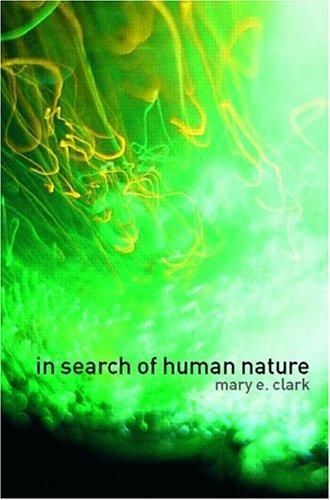
What are the roots of human nature and what is wrong with the scientific picture of what and who we are? Was Thomas Hobbes right to say that human life is “solitary, poor, nasty, brutish, and short?” In this new work, biologist Mary Clark argues that the Western view of human nature is built around a highly atomistic and ideological framework that encourages us to think about the world and ourselves in the wrong way. Beginning with some of the problems that emerge from building “laws” of human nature upon “laws” of physics, Mary Clark tackles an astonishing array of problems: what role genes play in the development of the brain, how we generated the concepts of mind and meaning we accept today and what is wrong with them, to the way we think about the formation of individual and group identity, conflict resolution and the environment. Throughout the book, she critically scrutinizes many widely-held views, whether it is what Darwin actually said about adaptive fitness and survival, received models of human nature such as man the “warrior” or “hunter,” or whether it is right to think of emotions as an unfortunate legacy of our evolutionary heritage. Arguing for a more expansive view of science and human nature, she makes a strong case for the role of culture in constructing what and who we are without falling into the trap of relativism.
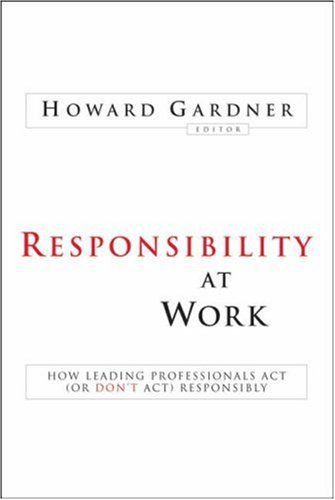
Responsibilityat WorkMost persons strive to produce work that is of excellent technical quality, is pursued in an ethical and socially responsible way, and has the qualities of being engaging and meaningful. How can we attain this ideal of good work in a world that changes so rapidly and all too often features an ethically compromised milieu? Filled with original essays by Howard Gardner, William Damon, Mihaly Csikszentmihalyi, and Jeanne Nakamura and based on a large-scale research project, the GoodWork(R) Project, Responsibility at Work reflects the information gleaned from in-depth interviews with more than 1,200 people from nine different professions–journalism, genetics, theatre, higher education, philanthropy, law, medicine, business, and precollegiate education. The book reveals how motivation, culture, and professional norms can intersect to produce work that is personally, socially, and economically beneficial.?At the heart of the study is the revelation that the key to good work is responsibilty–taking ownership for one’s work and its wider impact.The authors examine how responsibility for work is shaped by both personal and professional components and explore the factors that cause a sense of responsibility, the obstacles that lead to compromised work, and the educational interventions that can lead to a greater sense of responsibility. Most important, this volume provides strategies for cultivating greater responsibility in both seasoned workers as well as the young people who will one day enter the workplace.?
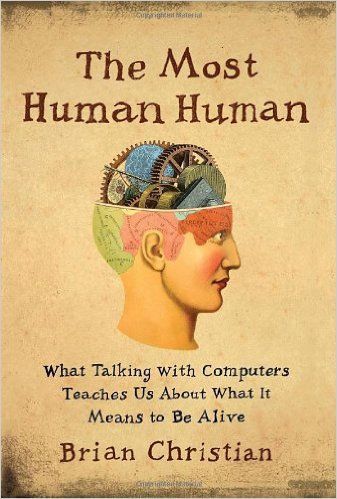
For the first time in history, we are interacting with computer programmes so sophisticated that we think they’re human beings . . .This is a remarkable feat of human ingenuity, but what does it say about our humanity? Are we really no better at being human than the machines we’ve created? In this brilliantly witty and inspiring investigation, Brian Christian explores first-hand the urgent moral and practical implications of this remarkable development. Drawing on science, philosophy, literature and the arts, and touching on aspects of life as diverse as language, work, school, chess, speed-dating, art, video games, psychiatry and the law, The Most Human Human shows that far from being a threat to our humanity, computers provide a better means than ever before of understanding what it is.In this book, you will discover . . . Why computers can fly planes but can’t ride bikes How Deep Blue beat Gary Kasparov but why it didn’t count Why arguments have in common with amnesia Why speaking to a computer is like a bad date What life is all about and how to live it better’A lively personable read and an empowering affirmation of our species.’ 4* Time Out ‘A fast-paced, witty and thoroughly winning style . . . fabulous.’ Publishers Weekly’An eye-opening inquest.’ David Eagleman, author’Strange, fertile and sometimes beautiful.’ Matthew Crawford, author
Utilitarianism, by British philosopher John Stuart Mill, is one of his most influential works and is a philosophical defense of utilitarian ethical theory. This publication remained a relevant publication since its original publication in the mid 19th century, as is still relevant in the application of utility in regard to social policy. This is an important work for those studying the concept of utilitarianism, or those who are interested in the writings of John Stuart Mill.
ما از اخلاق چه انتظاری داریم؟ این سوال شاید تاحدودی برای عموم مردم و یا متخصصان این رشته قابل پاسخ باشد؛ اینکه خوب بودن را به ما بیاموزد و در تنظیم روابط فردی م...

جشن کتاب تهران به ایستگاه سی و یکم رسیده است. حال و احوال نشر کتاب خوب نیست و باید فرهنگدوستان را به خرید و هدیه دادن کتاب ترغیب نمود. خانه اخلاقپژوهان جوان ب...

بنیاد کتابهای اخلاق اسلامی عمدتا پالایش جان از آلودگیها و آراستن آن به زیباییها است. اندیشه محوری این قبیل کتابها آن است که انسان فعلی آنی نیست که باید باشد...

-
0 Comments