Notice: تابع WP_Block_Type_Registry::register به طورنادرست فراخوانی شد. نامهای نوع بلوک نباید حروف بزرگ داشته باشند. لطفاً برای اطلاعات بیشتر، اشکال زدایی در وردپرس را مشاهده کنید. (این پیام در نگارش 5.0.0 افزوده شده است.) in /home/ethicsho/public_html/wp-includes/functions.php on line 5313
Warning: Use of undefined constant TDC_PATH_LEGACY - assumed 'TDC_PATH_LEGACY' (this will throw an Error in a future version of PHP) in /home/ethicsho/public_html/wp-content/plugins/td-composer/td-composer.php on line 109
Warning: Use of undefined constant TDSP_THEME_PATH - assumed 'TDSP_THEME_PATH' (this will throw an Error in a future version of PHP) in /home/ethicsho/public_html/wp-content/plugins/td-composer/td-composer.php on line 113 بایگانیهای Mowbray - خانه اخلاق پژوهان جوان Notice: Trying to access array offset on value of type bool in /home/ethicsho/public_html/wp-content/plugins/wp-ulike/inc/general-functions.php on line 807
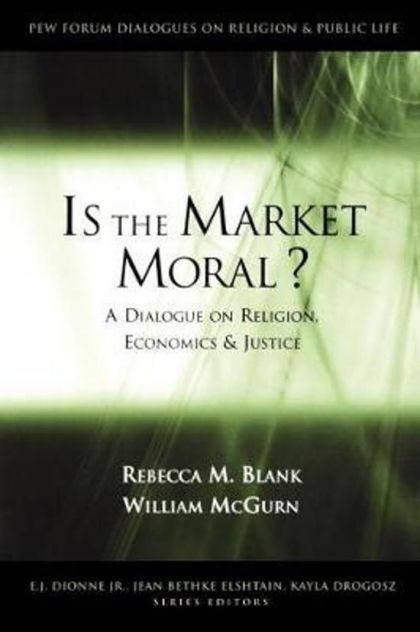
In the great tradition of moral argument about the nature of the economic market, Rebecca Blank and William McGurn join to debate the fundamental questionsequality and efficiency, productivity and social justice, individual achievement and personal rights in the workplace, the costs and benefits of corporate and entrepreneurial capitalism. And they do so grounded in both economic sophistication and religious commitment.Rebecca Blank is an economist by training and describes herself as culturally Protestant in the habits of mind and heart. She has also chaired the committee that wrote the statement on Christian faith and economic life adopted by the United Church of Christ. Addressing market failure, for her, requires that sometimes “freedom to choose” give way to other human values.William McGurn, a journalist and a Roman Catholic, uses his expertise in economics to reflect on the teachings of the church concerning the morality of the market. For McGurn, humans reach their fullest potential when they are free from the constraints of others. He writes that “our quarrel is not so much with Adam Smith or Milton Friedman but with the Providence that so clearly designed man to be his most prosperous at his most free.”This book grapples with the new imperatives of a global economy while working in the classic tradition of political economy which always treated seriously the questions of morality, justice, productivity, and freedom.
We are approaching the day when advances in biotechnology will allow parents to “design” a baby with the traits they want. The continuing debate over the possibilities of genetic engineering has been spirited, but so far largely confined to the realms of bioethics and public policy. Design and Destiny approaches the question in religious terms, discussing human germline modification (the genetic modification of the embryonic cells that become the eggs or sperm of a developing organism) from the viewpoints of traditional Christian and Jewish teaching. The contributors, leading religious scholars and writers, call our attention not to technology but to humanity, reflecting upon the meaning and destiny of human life in a technological age.Many of these scholars argue that religious teaching can support human germline modification implemented for therapeutic reasons, although they offer certain moral conditions that must be met. The essays offer a surprising variety of opinions, including a discussion of Judaism’s traditional presumption in favor of medicine, an argument that Catholic doctrine could accept germline modification if it is therapeutic for the embryo, an argument implying that “traditional” Christian teaching permits germline modification whether for therapy or enhancement, and a “classical” Protestant view that germline modification should be categorically opposed.Contributors:Lisa Sowle Cahill, Nigel M. de S. Cameron, Ronald Cole-Turner, Amy Michelle DeBaets, Celia Deane-Drummond, Elliot Dorff, H. Tristram Engelhardt, Jr., Thomas A. Shannon, James J. Walter.
This book shows how torture spiritually assaults the person. The “war on terror” has sparked great debate about torture. What exactly is torture? Should we torture suspected terrorists if they have information about future violent acts? Defining torture carefully, the book defends the idea that all people are valuable, and rejects moral defenses of torture. It focuses particularly on practices like sensory deprivation, which perniciously attack the human psyche. It also calls for an absolute ban on all torture, and urges Americans to repent for the torture the U.S. committed in the “war on terror.”
As the use of human body parts has become increasingly commercialized, a need has arisen for new approaches to regulation that move beyond the paradigm of altruism. In the course of this discussion, the notion of property has become a key concept. This volume focuses on practical and conceptual perspectives to set standards for a detailed and innovative discussion in the regulation of research on human tissue. The authors, a multidisciplinary research group combining specialists from philosophy, law, sociology, biology and medicine have come together with practicing lawyers to consider both legal provisions and patterns of regulation in countries across Europe. The authors identify divergences between the different legal traditions, and explore various conceptual models which could be used to improve and to guide policy making. With this twin focus on practical and conceptual perspectives the volume sets standards for a detailed and innovative discussion of problems in the regulation of research on human tissue.
Every day, people face tough choices in which their basic moral principles seem to be in conflict. Now, the Director of the Institute for Global Ethics offers a clear strategy for solving ethical dilemmas. Rushworth Kidder explains ends-based, rule-based, and care-based decision making–and uses real-life examples to show how these principles can applied to thorny problems.
ما از اخلاق چه انتظاری داریم؟ این سوال شاید تاحدودی برای عموم مردم و یا متخصصان این رشته قابل پاسخ باشد؛ اینکه خوب بودن را به ما بیاموزد و در تنظیم روابط فردی م...

جشن کتاب تهران به ایستگاه سی و یکم رسیده است. حال و احوال نشر کتاب خوب نیست و باید فرهنگدوستان را به خرید و هدیه دادن کتاب ترغیب نمود. خانه اخلاقپژوهان جوان ب...

بنیاد کتابهای اخلاق اسلامی عمدتا پالایش جان از آلودگیها و آراستن آن به زیباییها است. اندیشه محوری این قبیل کتابها آن است که انسان فعلی آنی نیست که باید باشد...

-
0 Comments