Notice: تابع WP_Block_Type_Registry::register به طورنادرست فراخوانی شد. نامهای نوع بلوک نباید حروف بزرگ داشته باشند. لطفاً برای اطلاعات بیشتر، اشکال زدایی در وردپرس را مشاهده کنید. (این پیام در نگارش 5.0.0 افزوده شده است.) in /home/ethicsho/public_html/wp-includes/functions.php on line 5313
Warning: Use of undefined constant TDC_PATH_LEGACY - assumed 'TDC_PATH_LEGACY' (this will throw an Error in a future version of PHP) in /home/ethicsho/public_html/wp-content/plugins/td-composer/td-composer.php on line 109
Warning: Use of undefined constant TDSP_THEME_PATH - assumed 'TDSP_THEME_PATH' (this will throw an Error in a future version of PHP) in /home/ethicsho/public_html/wp-content/plugins/td-composer/td-composer.php on line 113 بایگانیهای MacMillan Publishing Company - خانه اخلاق پژوهان جوان Notice: Trying to access array offset on value of type bool in /home/ethicsho/public_html/wp-content/plugins/wp-ulike/inc/general-functions.php on line 807
Everywhere we hear talk of decline, of a world that was better once, maybe fifty years ago, maybe centuries ago, but certainly before modernity drew us along its dubious path. While some lament the slide of Western culture into relativism and nihilism and others celebrate the trend as a liberating sort of progress, Charles Taylor calls on us to face the moral and political crises of our time, and to make the most of modernity’s challenges.At the heart of the modern malaise, according to most accounts, is the notion of authenticity, of self-fulfillment, which seems to render ineffective the whole tradition of common values and social commitment. Though Taylor recognizes the dangers associated with modernity’s drive toward self realization, he is not as quick as others to dismiss it. He calls for a freeze on cultural pessimism.In a discussion of ideas and ideologies from Friedrich Nietzsche to Gail Sheehy, from Allan Bloom to Michel Foucault, Taylor sorts out the good from the harmful in the modern cultivation of an authentic self. He sets forth the entire network of thought and morals that link our quest for self-creation with our impulse toward self-fashioning, and shows how such efforts must be conducted against an existing set of rules, or a gridwork of moral measurement. Seen against this network, our modern preoccupations with expression, rights, and the subjectivity of human thought reveal themselves as assets, not liabilities.By looking past simplistic, one-sided judgments of modern culture, by distinguishing the good and valuable from the socially and politically perilous, Taylor articulates the promise of our age. His bracing and provocative book gives voice to the challenge of modernity, and calls on all of us to answer it.
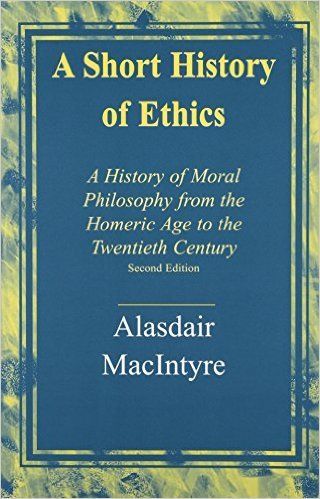
The author writes…’This history of moral philosophy which runs from the Greeks to contemporary Anglo-Saxon discussion is necessarily compressed and selective, but is intended to enable the general reader and the student to place particular texts in moral philosophy in an historical perspective. The function of this perspective is to clarify three kinds of historical and philosophical connection whose importance is often underrated. The first is a matter of the debts which moral philosophers owe to their predecessors; the second concerns the question of the nature of the moral concepts which furnish any moral philosopher with the objects of his enquiry upon moral concepts themselves and the extent to which the philosophical analysis of a concept may play a part in transforming or even discrediting it. A consequence of these preoccupations is that the book contains a higher proportion of purely philosophical enquiry than might be expected in an historical work.’
Medical Law and Moral Rights discusses live issues arising in modern medical practice. Do patients undergoing intolerable irremediable suffering have a moral right to physician-assisted suicide? Ought they to have a comparable legal right? Do the moral duties of a mother to care for and not abuse her child also apply to her fetus? Ought fetuses to be given legal rights requiring pregnant women to submit to medical treatment without their consent? Ought single women, homosexual couples or persons carrying serious genetic defects to have a legal right to procreate? Ought a physician to perform an abortion requested for some frivolous reason? Ought physicians to be permitted to refuse to provide medically futile treatment demanded by their patients? An examination of relevant court cases shows how United States law answers these questions. The author then advocates improvements in the law to make it respect our moral rights more fully. To justify his conclusions, he proposes original conceptions of the human rights to life, procreational autonomy, privacy, equitable treatment and personal security. Thus, these essays test the usefulness of the theory of rights explained and defended in An Approach to Rights and elsewhere.
ما از اخلاق چه انتظاری داریم؟ این سوال شاید تاحدودی برای عموم مردم و یا متخصصان این رشته قابل پاسخ باشد؛ اینکه خوب بودن را به ما بیاموزد و در تنظیم روابط فردی م...

جشن کتاب تهران به ایستگاه سی و یکم رسیده است. حال و احوال نشر کتاب خوب نیست و باید فرهنگدوستان را به خرید و هدیه دادن کتاب ترغیب نمود. خانه اخلاقپژوهان جوان ب...

بنیاد کتابهای اخلاق اسلامی عمدتا پالایش جان از آلودگیها و آراستن آن به زیباییها است. اندیشه محوری این قبیل کتابها آن است که انسان فعلی آنی نیست که باید باشد...

-
0 Comments