Notice: تابع WP_Block_Type_Registry::register به طورنادرست فراخوانی شد. نامهای نوع بلوک نباید حروف بزرگ داشته باشند. لطفاً برای اطلاعات بیشتر، اشکال زدایی در وردپرس را مشاهده کنید. (این پیام در نگارش 5.0.0 افزوده شده است.) in /home/ethicsho/public_html/wp-includes/functions.php on line 5313
Warning: Use of undefined constant TDC_PATH_LEGACY - assumed 'TDC_PATH_LEGACY' (this will throw an Error in a future version of PHP) in /home/ethicsho/public_html/wp-content/plugins/td-composer/td-composer.php on line 109
Warning: Use of undefined constant TDSP_THEME_PATH - assumed 'TDSP_THEME_PATH' (this will throw an Error in a future version of PHP) in /home/ethicsho/public_html/wp-content/plugins/td-composer/td-composer.php on line 113 بایگانیهای Adamant Media Corporation - خانه اخلاق پژوهان جوان Notice: Trying to access array offset on value of type bool in /home/ethicsho/public_html/wp-content/plugins/wp-ulike/inc/general-functions.php on line 807
Adam Smith is best known as the founder of scientific economics and as an early proponent of the modern market economy. Political economy, however, was only one part of Smith’s comprehensive intellectual system. Consisting of a theory of mind and its functions in language, arts, science, and social intercourse, Smith’s system was a towering contribution to the Scottish Enlightenment. His ideas on social intercourse also served as the basis for a moral theory that provided both historical and theoretical accounts of law, politics, and economics. This Companion volume provides an examination of all aspects of Smith’s thought. Collectively, the essays take into account Smith’s multiple contexts – Scottish, British, European, Atlantic; biographical, institutional, political, philosophical – and they draw on all of his works, including student notes from his lectures. Pluralistic in approach, the volume provides a contextualist history of Smith, as well as direct philosophical engagement with his ideas.
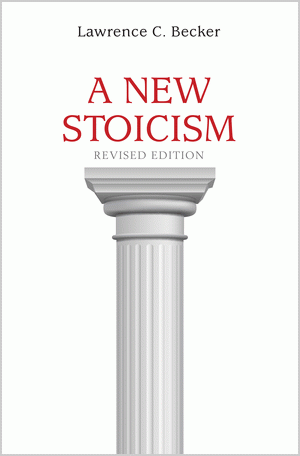
What would stoic ethics be like today if stoicism had survived as a systematic approach to ethical theory, if it had coped successfully with the challenges of modern philosophy and experimental science? A New Stoicism proposes an answer to that question, offered from within the stoic tradition but without the metaphysical and psychological assumptions that modem philosophy and science have abandoned. Lawrence Becker argues that a secular version of the stoic ethical project, based on contemporary cosmology and developmental psychology; provides the basis for a sophisticated form of ethics naturalism, in which virtually all the hard doctrines of the ancient Stoics can be clearly restated and defended.”From the beginning to the end of this compact but lucid book, Becker skillfully brings to life both the arguments and the intuitive appeal of stoicism…. In its essentials (the new stoicism is recognizable, with its particularly astringent rational charm enhanced by Becker’s focused and self-disciplined argumentation.
Why was the great philosopher Spinoza expelled from his Portuguese-Jewish community in Amsterdam? Nadler’s investigation of this simple question gives fascinating new perspectives on Spinoza’s thought and the Jewish religious and philosophical tradition from which it arose.
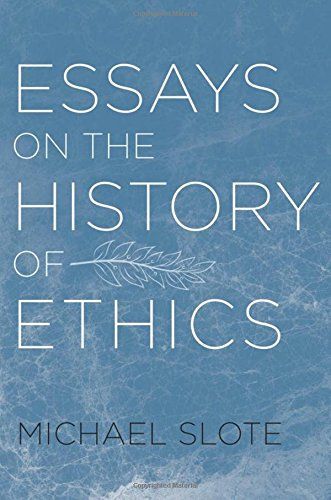
In Essays on the History of Ethics Michael Slote collects his essays that deal with aspects of both ancient and modern ethical thought and seek to point out conceptual/normative comparisons and contrasts among different views. Arranged in chronological order of the philosopher under discussion, the relationship between ancient ethical theory and modern moral philosophy is a major theme of several of the papers and, in particular, Plato, Aristotle, Hume, Kant, and/or utilitarianism feature centrally in (most of) the discussions. One essay seeks to show that there are three main ways to conceive the relationship between human well-being and virtue: one is dualistic a la Kant (they are disparate notions); one is the sort of reductionism familiar from the history of utilitarianismm; and one, not previously named by philosophers, is implicit in the approach the Stoics, Plato, and Aristotle take (in their different ways) to the topic of virtue and well-being. Slote names this third approach “elevationism” and argue that it is more promising than either reductionism or dualism. Two of the essays are narrowly focused on Hume’s ethics, and one seeks to show that even Kant’s opponents have reason to accept a number of important and original Kantian ideas. Finally, the two last essays in the volume talk about ethical thought during the last half of the twentieth century and the first few years of the twenty-first, arguing that the care ethics of Carol Gilligan and Nel Noddings has a distinctive and important contribution to make to ongoing ethical theorizing–and to our understanding of the history of ethics as well.
ما از اخلاق چه انتظاری داریم؟ این سوال شاید تاحدودی برای عموم مردم و یا متخصصان این رشته قابل پاسخ باشد؛ اینکه خوب بودن را به ما بیاموزد و در تنظیم روابط فردی م...

جشن کتاب تهران به ایستگاه سی و یکم رسیده است. حال و احوال نشر کتاب خوب نیست و باید فرهنگدوستان را به خرید و هدیه دادن کتاب ترغیب نمود. خانه اخلاقپژوهان جوان ب...

بنیاد کتابهای اخلاق اسلامی عمدتا پالایش جان از آلودگیها و آراستن آن به زیباییها است. اندیشه محوری این قبیل کتابها آن است که انسان فعلی آنی نیست که باید باشد...

-
0 Comments