
Notice: تابع WP_Block_Type_Registry::register به طورنادرست فراخوانی شد. نامهای نوع بلوک نباید حروف بزرگ داشته باشند. لطفاً برای اطلاعات بیشتر، اشکال زدایی در وردپرس را مشاهده کنید. (این پیام در نگارش 5.0.0 افزوده شده است.) in /home/ethicsho/public_html/wp-includes/functions.php on line 5313
Warning: Use of undefined constant TDC_PATH_LEGACY - assumed 'TDC_PATH_LEGACY' (this will throw an Error in a future version of PHP) in /home/ethicsho/public_html/wp-content/plugins/td-composer/td-composer.php on line 109
Warning: Use of undefined constant TDSP_THEME_PATH - assumed 'TDSP_THEME_PATH' (this will throw an Error in a future version of PHP) in /home/ethicsho/public_html/wp-content/plugins/td-composer/td-composer.php on line 113 بایگانیهای 2010 - صفحه 3 از 15 - خانه اخلاق پژوهان جوان Notice: Trying to access array offset on value of type bool in /home/ethicsho/public_html/wp-content/plugins/wp-ulike/inc/general-functions.php on line 807
Nietzsche’s mature masterpiece, Beyond Good and Evil considers the origins and nature of Judeo-Christian morality; the end of philosophical dogmatism and beginning of perspectivism; the questionable virtues of science and scholarship; liberal democracy, nationalism, and women’s emancipation. A superb new translation by Marion Faber, this highly annotated edition is complemented by a lucid introduction by one of the most eminent of Nietzsche scholars, Robert C. Holub.
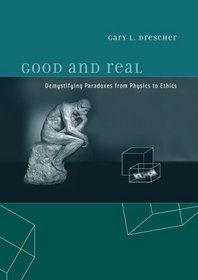
In Good and Real, Gary Drescher examines a series of provocative paradoxes about consciousness, choice, ethics, quantum mechanics, and other topics, in an effort to reconcile a purely mechanical view of the universe with key aspects of our subjective impressions of our own existence.Many scientists suspect that the universe can ultimately be described by a simple (perhaps even deterministic) formalism; all that is real unfolds mechanically according to that formalism. But how, then, is it possible for us to be conscious, or to make genuine choices? And how can there be an ethical dimension to such choices? Drescher sketches computational models of consciousness, choice, and subjunctive reasoning—what would happen if this or that were to occur?—to show how such phenomena are compatible with a mechanical, even deterministic universe. Analyses of Newcomb’s Problem (a paradox about choice) and the Prisoner’s Dilemma (a paradox about self-interest vs. altruism, arguably reducible to Newcomb’s Problem) help bring the problems and proposed solutions into focus. Regarding quantum mechanics, Drescher builds on Everett’s relative-state formulation—but presenting a simplified formalism, accessible to laypersons—to argue that, contrary to some popular impressions, quantum mechanics is compatible with an objective, deterministic physical reality, and that there is no special connection between quantum phenomena and consciousness.In each of several disparate but intertwined topics ranging from physics to ethics, Drescher argues that a missing technical linchpin can make the quest for objectivity seem impossible, until the elusive technical fix is at hand.
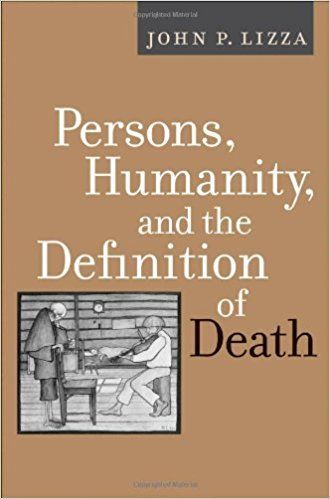
In this riveting and timely work, John P. Lizza presents the first comprehensive analysis of personhood and humanity in the context of defining death. Rejecting the common assumption that human or personal death is simply a biological phenomenon for biologists or physicians to define, Lizza argues that the definition of death is also a matter for metaphysical reflection, moral choice, and cultural acceptance. Lizza maintains that defining death remains problematic because basic ontological, ethical, and cultural issues have never been adequately addressed. Advances in life-sustaining technology and organ transplantation have led to revision of the legal definition of death. It is generally accepted that death occurs when all functions of the brain have ceased. However, legal and clinical cases involving postmortem pregnancy, individuals in permanent vegetative state, those with anencephaly, and those with severe dementia challenge the neurological criteria. Is “brain death” really death? Should the neurological criteria be expanded to include individuals in permanent vegetative state, with anencephaly, and those with severe dementia? What metaphysical, ethical, and cultural considerations are relevant to answering such questions? Although Lizza accepts a pluralistic approach to the legal definition of death, he proposes a nonreductive, substantive view in which persons are understood as “constituted by” human organisms. This view, he argues, provides the best account of human nature as biological, moral, and cultural and supports a consciousness-related formulation of death. Through an analysis of legal and clinical cases and a discussion of alternative concepts of personhood, Lizza casts greater light on the underlying themes of a complex debate.
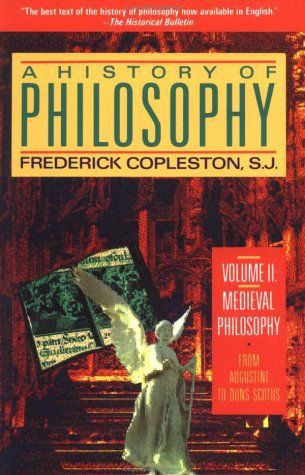
Conceived originally as a serious presentation of the development of philosophy for Catholic seminary students, Frederick Copleston’s nine-volume A History Of Philosophy has journeyed far beyond the modest purpose of its author to universal acclaim as the best history of philosophy in English.Copleston, an Oxford Jesuit of immense erudition who once tangled with A.J. Ayer in a fabled debate about the existence of God and the possibility of metaphysics, knew that seminary students were fed a woefully inadequate diet of theses and proofs, and that their familiarity with most of history’s great thinkers was reduced to simplistic caricatures. Copleston set out to redress the wrong by writing a complete history of Western Philosophy, one crackling with incident and intellectual excitement – and one that gives full place to each thinker, presenting his thought in a beautifully rounded manner and showing his links to those who went before and to those who came after him.
“Ernest Sosa extends his distinctive approach to epistemology, intertwining issues concerning the role of the will in judgment and belief with issues of epistemic evaluation. Questions about skepticism and the nature of knowledge are at the forefront. The answers defended are new in their explicit and sustained focus on judgment and epistemic agency. While noting that human knowledge trades on distinctive psychological capacities, Sosa also emphasizes the role of the social in human knowledge. Basic animal knowledge is supplemented by a level of reflective knowledge focused on judgment, and a level of ‘knowing full well’ that is distinctive of the animal that is rational”–
ما از اخلاق چه انتظاری داریم؟ این سوال شاید تاحدودی برای عموم مردم و یا متخصصان این رشته قابل پاسخ باشد؛ اینکه خوب بودن را به ما بیاموزد و در تنظیم روابط فردی م...

جشن کتاب تهران به ایستگاه سی و یکم رسیده است. حال و احوال نشر کتاب خوب نیست و باید فرهنگدوستان را به خرید و هدیه دادن کتاب ترغیب نمود. خانه اخلاقپژوهان جوان ب...

بنیاد کتابهای اخلاق اسلامی عمدتا پالایش جان از آلودگیها و آراستن آن به زیباییها است. اندیشه محوری این قبیل کتابها آن است که انسان فعلی آنی نیست که باید باشد...

-
0 Comments