
Notice: تابع WP_Block_Type_Registry::register به طورنادرست فراخوانی شد. نامهای نوع بلوک نباید حروف بزرگ داشته باشند. لطفاً برای اطلاعات بیشتر، اشکال زدایی در وردپرس را مشاهده کنید. (این پیام در نگارش 5.0.0 افزوده شده است.) in /home/ethicsho/public_html/wp-includes/functions.php on line 5313
Warning: Use of undefined constant TDC_PATH_LEGACY - assumed 'TDC_PATH_LEGACY' (this will throw an Error in a future version of PHP) in /home/ethicsho/public_html/wp-content/plugins/td-composer/td-composer.php on line 109
Warning: Use of undefined constant TDSP_THEME_PATH - assumed 'TDSP_THEME_PATH' (this will throw an Error in a future version of PHP) in /home/ethicsho/public_html/wp-content/plugins/td-composer/td-composer.php on line 113 بایگانیهای 1982 - خانه اخلاق پژوهان جوان Notice: Trying to access array offset on value of type bool in /home/ethicsho/public_html/wp-content/plugins/wp-ulike/inc/general-functions.php on line 807
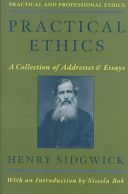
A classic work in the field of practical and professional ethics, this collection of nine essays by English philosopher and educator Henry Sidgwick (1838-1900) was first published in 1898 and forms a vital complement to Sidgwick’s major treatise on moral theory, The Methods of Ethics. Reissued here as Volume One in a new series sponsored by the Association for Practical and Professional Ethics, the book is composed chiefly of addresses to members of two ethical societies that Sidgwick helped to found in Cambridge and London in the 1880s. Clear, taut, and lively, these essays demonstrate the compassion and calm reasonableness that Sidgwick brought to all his writings. As Sidgwick explains in his opening essay, the societies he addressed aimed to allow academics, professionals, and others to pursue joint efforts at reaching “some results of value for practical guidance and life.” Sidgwick hoped that members might discuss such questions as when, if ever, public officials might be justified in lying or in breaking promises, whether scientists could legitimately inflict suffering on animals for research purposes, when nations might have just cause in going to war, and a score of other issues of ethics in public and private life still debated a century later. This valuable reissue returns Practical Ethics to its rightful place in Sidgwick’s oeuvre. Noted ethicist Sissela Bok provides a superb Introduction, ranging over the course of Sidgwick’s life and career and underscoring the relevance of Practical Ethics to contemporary debate. She writes: “Practical Ethics, the last book that Henry Sidgwick published before his death in 1900, contains the distillation of a lifetime of reflection on ethics and on what it would take for ethical debate to be ‘really of use in the solution of practical questions.'” This rich, engaging work is essential reading for all concerned with the relationship between ethical theory and. practice, and with the questions that have driven the study of professional ethics in recent years.
Normative reasons are reasons to do and believe things. Intellectual inquiry seems to presuppose their existence, for we cannot justifiably conclude that we exist; that there is an external world; and that there are better and worse ways of investigating it and behaving in it, unless there are reasons to do and believe such things. But just what in the world are normative reasons? In this book a case will be made for believing normative reasons are favouring relations that have a single, external source, filling this significant gap in the literature in an area within contemporary philosophy that has quickly grown in prominence. Providing a divine command metanormative analysis of normative reasons on entirely non-religious grounds, its arguments will be relevant to both secular and non-secular audiences alike and will address key issues in meta-ethics, evolutionary theory – especially evolutionary debunking threats to moral reasons and the normative more generally – and epistemology. .
One of the most dynamic aspects of the Islamic revival during the past two centuries has been the rethinking of Islamic political thought. A broad range of actors, ideas, and ideologies characterize the debate on how Islamic ethics and law should be manifested in modern institutions. Yet this aspect of the “return to Islam” has been neglected by policymakers, the media, and even many scholars, who equate “political Islam” with merely one strand, labeled “Islamic fundamentalism.” Bringing together ten essays from six volumes of the Ethikon Series in Comparative Ethics, this book gives a rounded treatment to the subject of Islamic political ethics.The authors explore the Islamic ethics of civil society, boundaries, pluralism, and war and peace. They consider questions of diversity, discussing, among other subjects, Islamic regimes’ policies regarding women and religious minorities. The chapters on war and peace take up such crucial and timely issues as the Islamic ethics of jihad, examining both the legitimate conditions for the declaration of war and the proper conduct of war.In their discussions, the contributors analyze the works of classical writers as well as the full range of modern reinterpretations. But beyond these analyses of previous and contemporary thinkers, the essays also reach back to the two fundamental sources of Islamic ethics–the Qur’an and traditions of the Prophet–to develop fresh insights into how Islam and Muslims can contribute to human society in the twenty-first century.The authors are Dale F. Eickelman, Hasan Hanafi, Sohail H. Hashmi, Farhad Kazemi, John Kelsay, Muhammad Khalid Masud, Sulayman Nyang, Bassam Tibi, and M. Raquibuz Zaman.From the foreword by Jack Miles:”Western foreign ministers and secretaries of state may have to learn a little theology if the looming clash between embattled elements both in the West and in the Muslim umma is to yield to disengagement and peaceful coexistence, to say nothing of fruitful collaboration. . . . It is, then, no idle academic exercise that the thinkers whose work is collected here have in hand. The long-term practical importance of their work can scarcely be overstated.”
ما از اخلاق چه انتظاری داریم؟ این سوال شاید تاحدودی برای عموم مردم و یا متخصصان این رشته قابل پاسخ باشد؛ اینکه خوب بودن را به ما بیاموزد و در تنظیم روابط فردی م...

جشن کتاب تهران به ایستگاه سی و یکم رسیده است. حال و احوال نشر کتاب خوب نیست و باید فرهنگدوستان را به خرید و هدیه دادن کتاب ترغیب نمود. خانه اخلاقپژوهان جوان ب...

بنیاد کتابهای اخلاق اسلامی عمدتا پالایش جان از آلودگیها و آراستن آن به زیباییها است. اندیشه محوری این قبیل کتابها آن است که انسان فعلی آنی نیست که باید باشد...

-
0 Comments