
Notice: تابع WP_Block_Type_Registry::register به طورنادرست فراخوانی شد. نامهای نوع بلوک نباید حروف بزرگ داشته باشند. لطفاً برای اطلاعات بیشتر، اشکال زدایی در وردپرس را مشاهده کنید. (این پیام در نگارش 5.0.0 افزوده شده است.) in /home/ethicsho/public_html/wp-includes/functions.php on line 5313
Warning: Use of undefined constant TDC_PATH_LEGACY - assumed 'TDC_PATH_LEGACY' (this will throw an Error in a future version of PHP) in /home/ethicsho/public_html/wp-content/plugins/td-composer/td-composer.php on line 109
Warning: Use of undefined constant TDSP_THEME_PATH - assumed 'TDSP_THEME_PATH' (this will throw an Error in a future version of PHP) in /home/ethicsho/public_html/wp-content/plugins/td-composer/td-composer.php on line 113 بایگانیهای BJ1395 .T73 1999 - خانه اخلاق پژوهان جوان Notice: Trying to access array offset on value of type bool in /home/ethicsho/public_html/wp-content/plugins/wp-ulike/inc/general-functions.php on line 807
The dual-use dilemma arises in the context of research in the biological and other sciences as a consequence of the fact that one and the same piece of scientific research sometimes has the potential to be used for harmful as well as good purposes. Discoveries that may lead to important advances in science and medicine might therefore also facilitate development of biological weapons of mass destruction. Scientists should be aware of the ways in which their well-intentioned research could be misused by others – and they should sometimes avoid research projects when the potential for harmful misuse is great. Policy makers must make tough choices about the extent to which the dual-use nature of research might justify increased oversight, regulation, and perhaps even censorship of science. This book examines the kinds of life-science experiments that give rise to the dual-use dilemma and provides philosophical analysis of the ethical issues and policy options surrounding dual-use research. Though the dual-use dilemma is an ethical issue, the vast majority of literature on the topic thus far has been written by scientists and security experts: this is the first book-length treatment of the topic by professional ethicists. It also challenges, and offers an alternative perspective to, the hugely influential U.S. National Research Council position on the dual-use dilemma.
The quickest way for someone to establish proof of creation of an invention is to file a provisional patent application (PPA), a shortened version of a patent application. This book takes readers step-by-step through the process of drafting and filing a PPA within 24 hours, explaining how to: – search for prior art- organize data- use charts and tables- create illustrations- assemble the PPAPatent Pending in 24 Hours also discusses the advantages and limitations of, and alternatives to, PPAs, and covers what happens after submitting one to the Patent and Trademark Office, including: – what happens if an invention is modified- whether an inventor needs a nondisclosure agreement when pitching a creation- how to mark an invention with “Patent Pending”
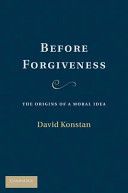
“In this book, David Konstan argues that the modern concept of interpersonal forgiveness, in the full sense of the term, did not exist in ancient Greece and Rome. Even more startlingly, it is not fully present in the Hebrew Bible, nor again in the New Testament, or in the early Jewish and Christian commentaries on the Holy Scriptures. It would still be centuries– many centuries– before the idea of interpersonal forgiveness, with its accompanying ideas of apology, remorse, and a change of heart on thepart of the wrongdoer, would emerge. For all its vast importance today in religion, law, politics, and psychotherapy, interpersonal forgiveness is creation of the 18th and 19th centuries, when the Christian concept of divine forgiveness was finally secularized. Forgiveness was God’s province, and it took a revolution in thought to bring it to earth and make it a human trait”–
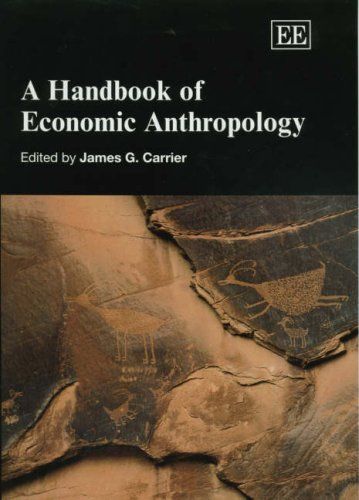
For more than a century, anthropologists have studied the economic lives and institutions of people around the world. The results of their research and reflection on economy have generally stayed within the discipline and have not been available in an accessible form to a broader readership. This major reference book is intended to correct this. This unique Handbook contains substantial and invaluable summary discussions of work on economic processes and issues, and on the relationship between economic and non-economic areas of life. Furthermore it describes conceptual orientations that are important among economic anthropologists, and presents summaries of key issues in the anthropological study of economic life in different regions of the world. Its scope and accessibility make it useful both to those who are interested in a particular topic and to those who want to see the breadth and fruitfulness of an anthropological study of economics. Economists from a wide range of fields and perspectives – from heterodox to classical, and from industrial economics to economic psychology and sociology – will find much to engage them within this exciting Handbook, as will anthropologists drawn to the significant statements by senior figures in the field. Those involved in development projects will find this an invaluable reference work with which to gain greater understanding of and insight into the reasons for people’s economic activities and decisions. The concise treatments of topics will provide invaluable teaching aids and reference for further reading by scholars at all levels of study.
ما از اخلاق چه انتظاری داریم؟ این سوال شاید تاحدودی برای عموم مردم و یا متخصصان این رشته قابل پاسخ باشد؛ اینکه خوب بودن را به ما بیاموزد و در تنظیم روابط فردی م...

جشن کتاب تهران به ایستگاه سی و یکم رسیده است. حال و احوال نشر کتاب خوب نیست و باید فرهنگدوستان را به خرید و هدیه دادن کتاب ترغیب نمود. خانه اخلاقپژوهان جوان ب...

بنیاد کتابهای اخلاق اسلامی عمدتا پالایش جان از آلودگیها و آراستن آن به زیباییها است. اندیشه محوری این قبیل کتابها آن است که انسان فعلی آنی نیست که باید باشد...

-
0 Comments