Notice: تابع WP_Block_Type_Registry::register به طورنادرست فراخوانی شد. نامهای نوع بلوک نباید حروف بزرگ داشته باشند. لطفاً برای اطلاعات بیشتر، اشکال زدایی در وردپرس را مشاهده کنید. (این پیام در نگارش 5.0.0 افزوده شده است.) in /home/ethicsho/public_html/wp-includes/functions.php on line 5313
Warning: Use of undefined constant TDC_PATH_LEGACY - assumed 'TDC_PATH_LEGACY' (this will throw an Error in a future version of PHP) in /home/ethicsho/public_html/wp-content/plugins/td-composer/td-composer.php on line 109
Warning: Use of undefined constant TDSP_THEME_PATH - assumed 'TDSP_THEME_PATH' (this will throw an Error in a future version of PHP) in /home/ethicsho/public_html/wp-content/plugins/td-composer/td-composer.php on line 113 بایگانیهای B20 .T78 1996 - خانه اخلاق پژوهان جوان Notice: Trying to access array offset on value of type bool in /home/ethicsho/public_html/wp-content/plugins/wp-ulike/inc/general-functions.php on line 807
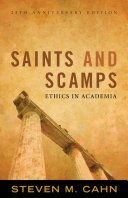
Saints and Scamps has been widely acclaimed as one of the best academic ethics books in print. In its 25th anniversary edition, Steven M. Cahn has updated and expanded upon his critical look at the duties and responsibilities of college professors; presenting us with a masterfully decisive and learned probe into the ethical standards and practices of the academic world and bringing Saints and Scamps to a new generation. Cahn discusses every issue, from grades to degree requirements, from tenure to the ethics of teaching. For Cahn, being a professor is so much more than research and scholarship; it is also about being a good teacher and shepherding in the next generation of students. He shows us what makes a wonderful professor and what constitutes professorial malpractice, and he does so with a wit and charm that is both entertaining and convincing. This is not just a book for college professors, but a book that should be read by parents, students, school administrators, and anyone interested in what teachers do and how they should do it. In this new edition, Cahn continues to do what he has done so brilliantly in the past; he shows us the ethical guidelines that every professor should follow.
The Emotive Theory was theory ahead of its time, and a theory which was, perhaps understandably, misinterpreted, misrepresented, and ridiculed by its critics from the outset. In Emotion, Truth and Meaning, Dr Wilks not only acquaints the reader with what the original emotivists actually claimed (and clarifies what they actually meant when they made some of the more controversial claims), he enriches their claims by psychologically expanding them. Like its predecessor, Dr Wilks’s enriched emotive theory distinguishes between moral conflicts which are rationally resolvable and moral conflicts which are not, but, unlike its predecessor, it traces the irresolvability of the latter to the psychological fact that they are merely symptomatic of more fundamental conflict at the level of world view – the level where questions about the meaning of life are answered, and where the truth of the answers arrived at is emotionally-felt rather than empirically-sensed.
In Taking Morality Seriously: A Defense of Robust Realism David Enoch develops, argues for, and defends a strongly realist and objectivist view of ethics and normativity more broadly. This view–according to which there are perfectly objective, universal, moral and other normative truths that are not in any way reducible to other, natural truths–is familiar, but this book is the first in-detail development of the positive motivations for the view into reasonably precise arguments. And when the book turns defensive–defending Robust Realism against traditional objections–it mobilizes the original positive arguments for the view to help with fending off the objections.The main underlying motivation for Robust Realism developed in the book is that no other metaethical view can vindicate our taking morality seriously. The positive arguments developed here–the argument from the deliberative indispensability of normative truths, and the argument from the moral implications of metaethical objectivity (or its absence)–are thus arguments for Robust Realism that are sensitive to the underlying, pre-theoretical motivations for the view.
ما از اخلاق چه انتظاری داریم؟ این سوال شاید تاحدودی برای عموم مردم و یا متخصصان این رشته قابل پاسخ باشد؛ اینکه خوب بودن را به ما بیاموزد و در تنظیم روابط فردی م...

جشن کتاب تهران به ایستگاه سی و یکم رسیده است. حال و احوال نشر کتاب خوب نیست و باید فرهنگدوستان را به خرید و هدیه دادن کتاب ترغیب نمود. خانه اخلاقپژوهان جوان ب...

بنیاد کتابهای اخلاق اسلامی عمدتا پالایش جان از آلودگیها و آراستن آن به زیباییها است. اندیشه محوری این قبیل کتابها آن است که انسان فعلی آنی نیست که باید باشد...

-
0 Comments