Notice: تابع WP_Block_Type_Registry::register به طورنادرست فراخوانی شد. نامهای نوع بلوک نباید حروف بزرگ داشته باشند. لطفاً برای اطلاعات بیشتر، اشکال زدایی در وردپرس را مشاهده کنید. (این پیام در نگارش 5.0.0 افزوده شده است.) in /home/ethicsho/public_html/wp-includes/functions.php on line 5313
Warning: Use of undefined constant TDC_PATH_LEGACY - assumed 'TDC_PATH_LEGACY' (this will throw an Error in a future version of PHP) in /home/ethicsho/public_html/wp-content/plugins/td-composer/td-composer.php on line 109
Warning: Use of undefined constant TDSP_THEME_PATH - assumed 'TDSP_THEME_PATH' (this will throw an Error in a future version of PHP) in /home/ethicsho/public_html/wp-content/plugins/td-composer/td-composer.php on line 113 بایگانیهای English - صفحه 155 از 155 - خانه اخلاق پژوهان جوان Notice: Trying to access array offset on value of type bool in /home/ethicsho/public_html/wp-content/plugins/wp-ulike/inc/general-functions.php on line 807
Human beings necessarily understand their social worlds in moral terms, orienting their lives, relationships, and activities around socially-produced notions of right and wrong.Morality is sociologically understood as more than simply helping or harming others; it encompasses any way that individuals form understandings of what behaviors are better than others, what goals are most laudable, and what “proper” people believe, feel, and do. Morality involves the explicit and implicit sets of rules and shared understandings that keep human social groups intact. Morality includes both the “shoulds” and “should nots” of human activity, its proactive and inhibitive elements.At one time, sociologists were centrally concerned with morality, issues like social cohesion, values, the goals and norms that structure society, and the ways individuals get socialized to reproduce those concerns. In the last half-century, however, explicit interest in these topics has waned, and modern sociology has become uninterested in these matters and morality has become marginalized within the discipline.But a resurgence in the topic is happening in related disciplines – psychology, neurology, philosophy, and anthropology – and in the wider national discourse. Sociology has much to offer, but is not fully engaged in this conversation. Many scholars work on areas that would fall under the umbrella of a sociology of morality but do not self-identify in such a manner, nor orient their efforts toward conceptualizing what we know, and should know, along these dimensions.The Handbook of the Sociology of Morality fills a niche within sociology making explicit the shared concerns of scholars across the disciplines as they relate to an often-overlooked dimension of human social life. It is unique in social science as it would be the first systematic compilation of the wider social structural, cultural, cross-national, organizational, and interactional dimension of human moral (understood broadly) thought, feeling, and behavior.
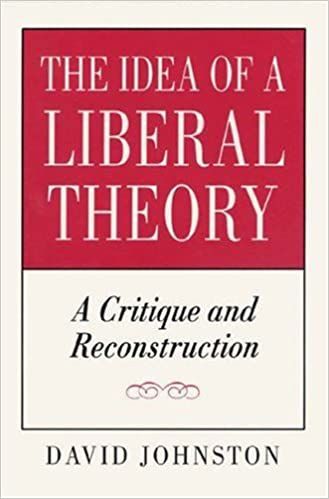
Liberalism, the founding philosophy of many constitutional democracies, has been criticized in recent years from both the left and the right for placing too much faith in individual rights and distributive justice. David Johnston argues for a reinterpretation of liberal principles he contends will restore liberalism to a position of intellectual leadership from which it can guide political and social reforms. He begins by surveying the three major contemporary schools of liberal political thought–rights-based, perfectionist, and political liberalism– and, by weeding out their weaknesses, sketches a new approach he calls humanist liberalism. Valuable not only for its contribution to academic scholarship but also as a means of introducing liberal political thought to serious undergraduate students.–Choice Raises … a tremendous number of criticisms of the standard accounts of liberal politics. The book is novel, built on solid foundations, [and] very powerful, clever, well thought out.–Alan Ryan, Princeton University This clear and useful new work moves through a swift yet thorough critique of three leading liberal philosophies to reach a sketch of a new, improved theory.–Virginia Quarterly Review
This thoroughly revised and expanded fourth edition of the successful Ethical and Social Issues in the Information Age provides an up-to-date examination of the ethical, social, and policy challenges stemming from the emergence of cyberspace, the convergence of telecommunication and computing technologies, and the miniaturization of computing, telecommunication, and information-enabling devices. This accessible textbook/reference broadly surveys thought-provoking questions about the impact of these new technologies, with particular emphasis on the rapid growth of a multitude of computer networks, including the Internet. It assumes only a very modest familiarity with basic computer literacy. Students at all levels who need to learn about computer ethics, the legal aspects of computing, network security, computer crime investigation, and biometrics will find this well-documented work an invaluable resource. The book is also highly useful for practitioners needing such insights for their work.
ما از اخلاق چه انتظاری داریم؟ این سوال شاید تاحدودی برای عموم مردم و یا متخصصان این رشته قابل پاسخ باشد؛ اینکه خوب بودن را به ما بیاموزد و در تنظیم روابط فردی م...

جشن کتاب تهران به ایستگاه سی و یکم رسیده است. حال و احوال نشر کتاب خوب نیست و باید فرهنگدوستان را به خرید و هدیه دادن کتاب ترغیب نمود. خانه اخلاقپژوهان جوان ب...

بنیاد کتابهای اخلاق اسلامی عمدتا پالایش جان از آلودگیها و آراستن آن به زیباییها است. اندیشه محوری این قبیل کتابها آن است که انسان فعلی آنی نیست که باید باشد...

-
0 Comments