





Notice: تابع WP_Block_Type_Registry::register به طورنادرست فراخوانی شد. نامهای نوع بلوک نباید حروف بزرگ داشته باشند. لطفاً برای اطلاعات بیشتر، اشکال زدایی در وردپرس را مشاهده کنید. (این پیام در نگارش 5.0.0 افزوده شده است.) in /home/ethicsho/public_html/wp-includes/functions.php on line 5313
Warning: Use of undefined constant TDC_PATH_LEGACY - assumed 'TDC_PATH_LEGACY' (this will throw an Error in a future version of PHP) in /home/ethicsho/public_html/wp-content/plugins/td-composer/td-composer.php on line 109
Warning: Use of undefined constant TDSP_THEME_PATH - assumed 'TDSP_THEME_PATH' (this will throw an Error in a future version of PHP) in /home/ethicsho/public_html/wp-content/plugins/td-composer/td-composer.php on line 113 بایگانیهای eng English - صفحه 5 از 11 - خانه اخلاق پژوهان جوان Notice: Trying to access array offset on value of type bool in /home/ethicsho/public_html/wp-content/plugins/wp-ulike/inc/general-functions.php on line 807
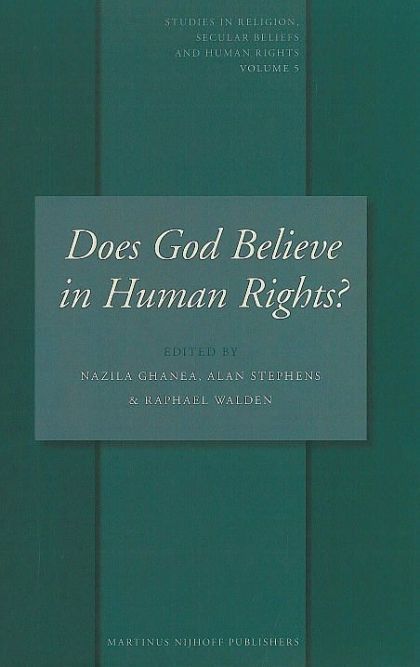
Where can religions find sources of legitimacy for human rights? How do, and how should, religious leaders and communities respond to human rights as defined in modern International Law? When religious precepts contradict human rights standards – for example in relation to freedom of expression or in relation to punishments – which should trump the other, and why? Can human rights and religious teachings be interpreted in a manner which brings reconciliation closer? Do the modern concept and system of human rights undermine the very vision of society that religions aim to impart? Is a reference to God in the discussion of human rights misplaced? Do human fallibilities with respect to interpretation, judicial reasoning and the understanding of human oneness and dignity provide the key to the undeniable and sometimes devastating conflicts that have arisen between, and within, religions and the human rights movement? In this volume, academics and lawyers tackle these most difficult questions head-on, with candour and creativity, and the collection is rendered unique by the further contributions of a remarkable range of other professionals, including senior religious leaders and representatives, journalists, diplomats and civil servants, both national and international. Most notably, the contributors do not shy away from the boldest question of all – summed up in the book’s title. The thoroughly edited and revised papers which make up this collection were originally prepared for a ground-breaking conference organised by the Clemens Nathan Research Centre, the University of London Institute of Commonwealth Studies and Martinus Nijhoff/Brill.
Excerpts from Robert Nozick’s “Invariances” Necessary truths are invariant across all possible worlds, contingent ones across only some. No wonder necessity lures philosophers. It is the flame, the philosopher the moth. Our intuitions that certain statements are necessary do not powerfully support this claim when natural selection would produce strong intuitions of their self-evidence, even were these statements (only) contingently true. Contemporary philosophers who give great weight to intuitions need to offer some account of why such intuitions are reliable and are to be trusted. Of course, if the purpose of such philosophy is merely to codify and systematize the intuitions that (for whatever reason) are held, then a philosophy built upon intuitions will need no further basis. And it will have no further validity. You might think that an insight into metaphysical impossibility could save the physicists much useless work by thereby excluding something as physically possible. Things seem to have worked in the opposite direction, though. Driven by a need to explain strange data, physicists formulate theories that countenance what previously was held to be metaphysically impossible. . . The physical tail wags the metaphysical dog. Why is there an objective world? Within evolutionary cosmology scientific laws might be viewed as the heritable structure of a universe, akin to what in biology would be an organism’s genetic endowment. . . Suppose that the reproductive process of a universe produces transformed offspring universes that differ from their parent. The greater the transformations that a law is invariant under, and the wider their number, the greater is that law’s heritability. The vast majority of the universes that exist through the processes of evolutionary cosmology, therefore, will exhibit laws that are invariant under a wide range of significant transformations. Such invariance, we have seen, is exactly what constitutes objectiveness. Evolutionary cosmology gives us objective worlds.
Conceived originally as a serious presentation of the development of philosophy for Catholic seminary students, Frederick Copleston’s nine-volumeA History Of Philosophyhas journeyed far beyond the modest purpose of its author to universal acclaim as the best history of philosophy in English.
Few areas have witnessed the type of growth we have seen in the affective sciences in the past decades. Across psychology, philosophy, economics, and neuroscience, there has been an explosion of interest in the topic of emotion and affect. Comprehensive, authoritative, up-to-date, and easy-to-use, the new Oxford Companion to Emotion and the Affective Sciences is an indispensable resource for all who wish to find out about theories, concepts, methods, and research findings in this rapidly growing interdisciplinary field – one that brings together, amongst others, psychologists, neuroscientists, social scientists, philosophers, and historians. Organized by alphabetical entries, and presenting brief definitions, conciseoverviews, and encyclopaedic articles (all with extensive references to relevant publications), this Companion lends itself to casual browsing by non-specialists interested in the fascinating phenomena of emotions, moods, affect disorders, and personality as well as to focused search for pertinent information bystudents and established scholars in the field.Not only does the book provide entries on affective phenomena, but also on their neural underpinnings, their cognitive antecedents and the associated responses in physiological systems, facial, vocal, and bodily expressions, and action tendencies. Numerous entries also consider the role of emotion in society and social behavior, as well as in cognitive processes such as those critical for perception, attention, memory, judgement and decision-making.The volume has been edited by a group of internationally leading authorities in the respective disciplines consisting of two editors (David Sander and Klaus Scherer) as well as group of 11 associate editors (John T. Cacioppo, Tim Dalgleish, Robert Dantzer, Richard J. Davidson, Ronald B. de Sousa, Phoebe C. Ellsworth, Nico Frijda, George Loewenstein, Paula M. Niedenthal, Peter Salovey, and Richard A. Shweder). The members of the editorial board have commissioned and reviewed contributions frommajor experts on specific topics.In addition to comprehensive coverage of technical terms and fundamental issues, the volume also highlights current debates that inform the ongoing research process. In addition, the Companion contains a wealth of material on the role of emotion in applied domains such as economic behaviour, music and arts, work and organizational behaviour, family interactions and group dynamics, religion, law and justice, and societal change.Highly accessible and wide-ranging, this book is a vital resource for scientists, students, and professionals eager to obtain a rapid, conclusive overview on central terms and topics and anyone wanting to learn more about the mechanisms underlying the emotions dominating many aspects of our lives.
Can – and should – a work of art have a moral value? Must a work of art be morally admirable in order to be aesthetically satisfying? Aesthetics and Morality is a stimulating, lucid and insightful inquiry into exactly these questions. Philosopher Elisabeth Schellekens explains and explores the major ideas and debates in aesthetics and moral philosophy, inviting readers to reflect on their own thinking about art and morality, and provides the philosophical knowledge and understanding to disentangle such thinking. This original, inspiring and entertaining book sheds valuable new light on our understanding of aesthetic and moral value, and the relationship between the two.
ما از اخلاق چه انتظاری داریم؟ این سوال شاید تاحدودی برای عموم مردم و یا متخصصان این رشته قابل پاسخ باشد؛ اینکه خوب بودن را به ما بیاموزد و در تنظیم روابط فردی م...

جشن کتاب تهران به ایستگاه سی و یکم رسیده است. حال و احوال نشر کتاب خوب نیست و باید فرهنگدوستان را به خرید و هدیه دادن کتاب ترغیب نمود. خانه اخلاقپژوهان جوان ب...

بنیاد کتابهای اخلاق اسلامی عمدتا پالایش جان از آلودگیها و آراستن آن به زیباییها است. اندیشه محوری این قبیل کتابها آن است که انسان فعلی آنی نیست که باید باشد...

-
0 Comments