Notice: تابع WP_Block_Type_Registry::register به طورنادرست فراخوانی شد. نامهای نوع بلوک نباید حروف بزرگ داشته باشند. لطفاً برای اطلاعات بیشتر، اشکال زدایی در وردپرس را مشاهده کنید. (این پیام در نگارش 5.0.0 افزوده شده است.) in /home/ethicsho/public_html/wp-includes/functions.php on line 5313
Warning: Use of undefined constant TDC_PATH_LEGACY - assumed 'TDC_PATH_LEGACY' (this will throw an Error in a future version of PHP) in /home/ethicsho/public_html/wp-content/plugins/td-composer/td-composer.php on line 109
Warning: Use of undefined constant TDSP_THEME_PATH - assumed 'TDSP_THEME_PATH' (this will throw an Error in a future version of PHP) in /home/ethicsho/public_html/wp-content/plugins/td-composer/td-composer.php on line 113 بایگانیهای 9780670874491 - خانه اخلاق پژوهان جوان Notice: Trying to access array offset on value of type bool in /home/ethicsho/public_html/wp-content/plugins/wp-ulike/inc/general-functions.php on line 807
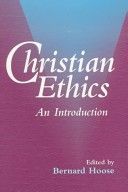
Currently, there is an upsurge of interest in the study of Christian ethics but much of what is written can appear confusing or beyond reach. In Christian Ethics, the first one-volume reference to include all the main themes in fundamental and applied moral theology, Bernard Hoose puts in understandable terms the state of moral theology today. At a time when many people fear that society has lost its way morally, he helps Christians make sense of the major issues that confront us all. Written by well-known ethicists in the English-speaking world, Christian Ethics is a comprehensive work of reference for students of moral theology. Scholars will value the excellent collection of essays and the range of scholarship they represent. The educated lay reader will also benefit from its highly readable text. Part one of the book deals with the fundamental themes in moral theology, including the role of the Bible, natural law, conscience, virtue, and the feminist contribution to Christian ethics. Part two is devoted to specific areas of applied or special ethics, under the headings of social ethics, interpersonal and sexual ethics, and medical ethics. Chapters in “Part 1: Basic Christian Ethics” are “The Bible and Christian Ethics,” by Tom Deidun; “Natural Law,” by Gerard J. Hughes; “Authority and Moral Teaching in a Catholic Christian Context,” by Joseph Selling; “Absolute Moral Norms,” by Charles E. Curran; “Virtue Ethics,” by James F. Keenan; “The Human Person,” by Joseph Selling; “Conscience,” by Richard M. Gula; “The Theory of the Fundamental Option and Moral Action,” by Thomas R. Kopfensteiner; “Feminist Ethics,” by Susan F. Parsons,” and “The Distinctiveness of Christian Morality,” by Vincent MacNamara. Chapters in “Part 2: Applied Ethics” are “Justice,” by Karen Lebacqz; “Property,” by Timothy J. Gorringe; “Morality and Law,” by Patrick Hannon; “The Punishment of Criminals,” by Bernard Hoose; “Peace, Violence and War,” by Richard G. Jones; “Sex, Sexuality, and Relationships,” by Gareth Moore; “Divorce and Remarriage,” by Kevin T. Kelly; “Truth and Lies,” by Bernard Hoose; “Euthanasia,” by Richard M. Gula; “Ethical Problems Arising from New Reproductive Techniques,” by Joyce Poole; “Organ Transplantation,” by David F. Kelly; and “Hypnosis and General Anaesthesia,” by Aureliano Pacciolla.
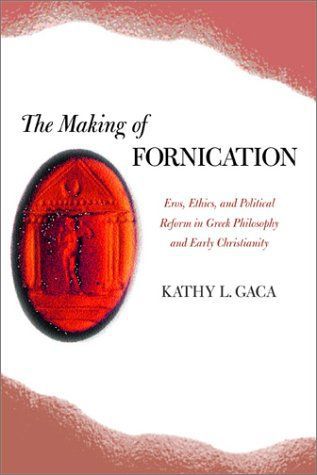
This provocative work provides a radical reassessment of the emergence and nature of Christian sexual morality, the dominant moral paradigm in Western society since late antiquity. While many scholars, including Michel Foucault, have found the basis of early Christian sexual restrictions in Greek ethics and political philosophy, Kathy L. Gaca demonstrates on compelling new grounds that it is misguided to regard Greek ethics and political theory—with their proposed reforms of eroticism, the family, and civic order—as the foundation of Christian sexual austerity. Rather, in this thoroughly informed and wide-ranging study, Gaca shows that early Christian goals to eradicate fornication were derived from the sexual rules and poetic norms of the Septuagint, or Greek Bible, and that early Christian writers adapted these rules and norms in ways that reveal fascinating insights into the distinctive and largely non-philosophical character of Christian sexual morality.Writing with an authoritative command of both Greek philosophy and early Christian writings, Gaca investigates Plato, the Stoics, the Pythagoreans, Philo of Alexandria, the apostle Paul, and the patristic Christians Clement of Alexandria, Tatian, and Epiphanes, freshly elucidating their ideas on sexual reform with precision, depth, and originality. Early Christian writers, she demonstrates, transformed all that they borrowed from Greek ethics and political philosophy to launch innovative programs against fornication that were inimical to Greek cultural mores, popular and philosophical alike. The Septuagint’s mandate to worship the Lord alone among all gods led to a Christian program to revolutionize Gentile sexual practices, only for early Christians to find this virtually impossible to carry out without going to extremes of sexual renunciation.Knowledgeable and wide-ranging, this work of intellectual history and ethics cogently demonstrates why early Christian sexual restrictions took such repressive ascetic forms, and casts sobering light on what Christian sexual morality has meant for religious pluralism in Western culture, especially among women as its bearers.
This accessible introduction to religious ethics focuses on the major forms of moral reasoning encompassing the three ‘Abrahamic’ religions: Judaism, Christianity, and Islam. Draws on a range of moral issues, such as examples arising from friendship, marriage, homosexuality, lying, forgiveness and its limits, the death penalty, the environment, warfare, and the meaning of work, career, and vocation Looks at both ethical reasoning and importantly, “how” that reasoning reveals insights into a religious tradition Investigates the resources available to address common problems confronting Abrahamic faiths, and how each faith explains and defends its moral viewpoints Offering concrete topics for interfaith discussions, this is a timely and insightful introduction to a fast-growing field of interest
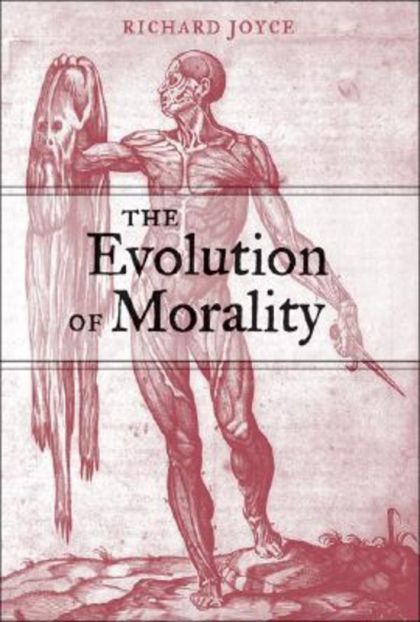
Moral thinking pervades our practical lives, but where did this way of thinking come from, and what purpose does it serve? Is it to be explained by environmental pressures on our ancestors a million years ago, or is it a cultural invention of more recent origin? In The Evolution of Morality, Richard Joyce takes up these controversial questions, finding that the evidence supports an innate basis to human morality. As a moral philosopher, Joyce is interested in whether any implications follow from this hypothesis. Might the fact that the human brain has been biologically prepared by natural selection to engage in moral judgment serve in some sense to vindicate this way of thinking—staving off the threat of moral skepticism, or even undergirding some version of moral realism? Or if morality has an adaptive explanation in genetic terms—if it is, as Joyce writes, “just something that helped our ancestors make more babies”—might such an explanation actually undermine morality’s central role in our lives? He carefully examines both the evolutionary “vindication of morality” and the evolutionary “debunking of morality,” considering the skeptical view more seriously than have others who have treated the subject.Interdisciplinary and combining the latest results from the empirical sciences with philosophical discussion, The Evolution of Morality is one of the few books in this area written from the perspective of moral philosophy. Concise and without technical jargon, the arguments are rigorous but accessible to readers from different academic backgrounds. Joyce discusses complex issues in plain language while advocating subtle and sometimes radical views. The Evolution of Morality lays the philosophical foundations for further research into the biological understanding of human morality.
ما از اخلاق چه انتظاری داریم؟ این سوال شاید تاحدودی برای عموم مردم و یا متخصصان این رشته قابل پاسخ باشد؛ اینکه خوب بودن را به ما بیاموزد و در تنظیم روابط فردی م...

جشن کتاب تهران به ایستگاه سی و یکم رسیده است. حال و احوال نشر کتاب خوب نیست و باید فرهنگدوستان را به خرید و هدیه دادن کتاب ترغیب نمود. خانه اخلاقپژوهان جوان ب...

بنیاد کتابهای اخلاق اسلامی عمدتا پالایش جان از آلودگیها و آراستن آن به زیباییها است. اندیشه محوری این قبیل کتابها آن است که انسان فعلی آنی نیست که باید باشد...

-
0 Comments