Notice: تابع WP_Block_Type_Registry::register به طورنادرست فراخوانی شد. نامهای نوع بلوک نباید حروف بزرگ داشته باشند. لطفاً برای اطلاعات بیشتر، اشکال زدایی در وردپرس را مشاهده کنید. (این پیام در نگارش 5.0.0 افزوده شده است.) in /home/ethicsho/public_html/wp-includes/functions.php on line 5313
Warning: Use of undefined constant TDC_PATH_LEGACY - assumed 'TDC_PATH_LEGACY' (this will throw an Error in a future version of PHP) in /home/ethicsho/public_html/wp-content/plugins/td-composer/td-composer.php on line 109
Warning: Use of undefined constant TDSP_THEME_PATH - assumed 'TDSP_THEME_PATH' (this will throw an Error in a future version of PHP) in /home/ethicsho/public_html/wp-content/plugins/td-composer/td-composer.php on line 113 بایگانیهای 9780521863841 - خانه اخلاق پژوهان جوان Notice: Trying to access array offset on value of type bool in /home/ethicsho/public_html/wp-content/plugins/wp-ulike/inc/general-functions.php on line 807
This book takes a major step in the philosophy of education by moving back past the Enlightenment and reinstating Aristotelian Virtue at the heart of moral education.
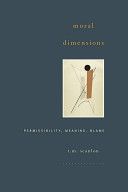
In a clear and elegant style, T. M. Scanlon reframes current philosophical debates as he explores the moral permissibility of an action. Permissibility may seem to depend on the agent’s reasons for performing an action. For example, there seems to be an important moral difference between tactical bombing and a campaign by terrorists—even if the same number of non-combatants are killed—and this difference may seem to lie in the agents’ respective aims. However, Scanlon argues that the apparent dependence of permissibility on the agent’s reasons in such cases is merely a failure to distinguish between two kinds of moral assessment: assessment of the permissibility of an action and assessment of the way an agent decided what to do. Distinguishing between these two forms of assessment leads Scanlon to an important distinction between the permissibility of an action and its meaning: the significance for others of the agent’s willingness to act in this way. An action’s meaning depends on the agent’s reasons for performing it in a way that its permissibility does not. Blame, he argues, is a response to the meaning of an action rather than its permissibility. This analysis leads to a novel account of the conditions of moral responsibility and to important conclusions about the ethics of blame.
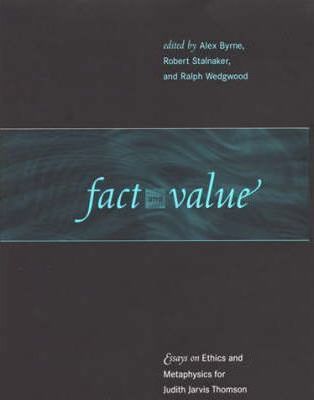
The diversity of topics discussed in this book reflects the breadth of Judith Jarvis Thomson’s philosophical work. Throughout her long career at MIT, Thomson’s straightforward approach and emphasis on problem-solving have shaped philosophy in significant ways. Some of the book’s contributions discuss specific moral and political issues such as abortion, self-defense, the rights and obligations of prospective fathers, and political campaign finance. Other contributions concern the foundations of moral theory, focusing on hedonism, virtue ethics, the nature of nonconsequentialism, and the objectivity of moral claims. Finally, contributions in metaphysics and epistemology discuss the existence of sets, the structures reflected in conditional statements, and the commitments of testimony.Contributors:Jonathan Bennett, Richard L. Cartwright, Joshua Cohen, N. Ann Davis, Catherine Z. Elgin, Gilbert Harman, Barbara Herman, Frances Myrna Kamm, Claudia Mills, T. M. Scanlon, Ernest Sosa.
This volume brings together much of the strongest and most influential work undertaken in the field of virtue ethics over the last four decades. Divided into four sections, it includes articles critical of other traditions; early attempts to offer a positive vision of virtue ethics; some later criticisms of the revival of virtue ethics; and, finally, some recent, more theoretically ambitious essays in virtue ethics.
ما از اخلاق چه انتظاری داریم؟ این سوال شاید تاحدودی برای عموم مردم و یا متخصصان این رشته قابل پاسخ باشد؛ اینکه خوب بودن را به ما بیاموزد و در تنظیم روابط فردی م...

جشن کتاب تهران به ایستگاه سی و یکم رسیده است. حال و احوال نشر کتاب خوب نیست و باید فرهنگدوستان را به خرید و هدیه دادن کتاب ترغیب نمود. خانه اخلاقپژوهان جوان ب...

بنیاد کتابهای اخلاق اسلامی عمدتا پالایش جان از آلودگیها و آراستن آن به زیباییها است. اندیشه محوری این قبیل کتابها آن است که انسان فعلی آنی نیست که باید باشد...

-
0 Comments