Notice: تابع WP_Block_Type_Registry::register به طورنادرست فراخوانی شد. نامهای نوع بلوک نباید حروف بزرگ داشته باشند. لطفاً برای اطلاعات بیشتر، اشکال زدایی در وردپرس را مشاهده کنید. (این پیام در نگارش 5.0.0 افزوده شده است.) in /home/ethicsho/public_html/wp-includes/functions.php on line 5313
Warning: Use of undefined constant TDC_PATH_LEGACY - assumed 'TDC_PATH_LEGACY' (this will throw an Error in a future version of PHP) in /home/ethicsho/public_html/wp-content/plugins/td-composer/td-composer.php on line 109
Warning: Use of undefined constant TDSP_THEME_PATH - assumed 'TDSP_THEME_PATH' (this will throw an Error in a future version of PHP) in /home/ethicsho/public_html/wp-content/plugins/td-composer/td-composer.php on line 113 بایگانیهای 9780199269051 - خانه اخلاق پژوهان جوان Notice: Trying to access array offset on value of type bool in /home/ethicsho/public_html/wp-content/plugins/wp-ulike/inc/general-functions.php on line 807
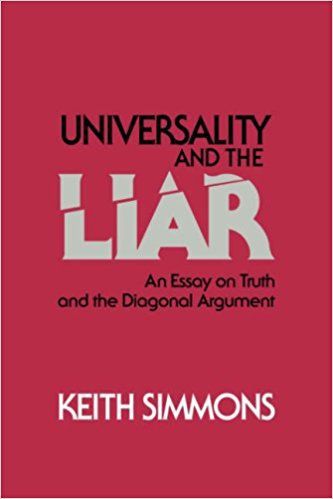
This book is about one of the most baffling of all paradoxes–the famous Liar paradox. Suppose we say: “We are lying now.” Then if we are lying, we are telling the truth; and if we are telling the truth we are lying. This paradox is more than an intriguing puzzle, since it involves the concept of truth. Thus any coherent theory of truth must deal with the Liar. Keith Simmons discusses the solutions proposed by medieval philosophers and offers his own solutions and in the process assesses other contemporary attempts to solve the paradox. Unlike such attempts, Simmons’ “singularity” solution does not abandon classical semantics and does not appeal to the kind of hierarchical view found in Barwise’s and Etchemendy’s The Liar. Moreover, Simmons’ solution resolves the vexing problem of semantic universality–the problem of whether there are semantic concepts beyond the expressive reach of a natural language such as English.
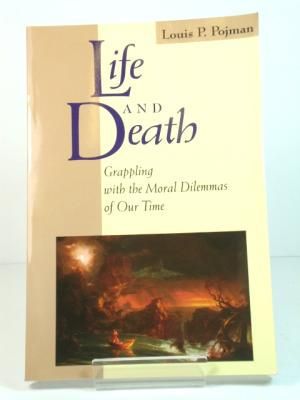
What are the acceptable limits of scientific investigation and genetic engineering, the rights and wrongs of animal rights, euthanasia and civil disobedience? This book confronts these dilemmas, tracing arguments of moral thinkers, including Socrates, Plato, Aristotle, and brings us up to date with postmodern critics.
Gives students philosophical tools to think clearly about divisive moral issues faced today. Early chapters introduce moral theory, ethical relativism and objectivism, and classical ethical theories to provide a framework for understanding moral issues. Later chapters explore specific moral issues, such as cloning, suicide, abortion, the death penalty, and animal rights. This second edition contains four new chapters. Can be used as a stand-alone text, or with an anthology by the author. The author teaches philosophy at the US Military Academy in West Point, NY.
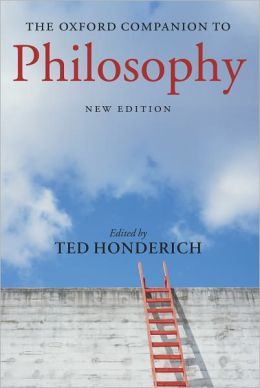
Offering clear and reliable guidance to the ideas of philosophers from antiquity to the present day and to the major philosophical systems around the globe, he Oxford Companion to Philosophy is the definitive philosophical reference work for readers at all levels. For ten years the original volume has served as a stimulating introduction for general readers and as an indispensable guide for students and scholars. A distinguished international assembly of 249 philosophers contributed almost 2,000 entries, and many of these have now been considerably revised and updated in this major new edition; to these are added over 300 brand-new pieces on a fascinating range of current topics such as animal consciousness, cloning, corporate responsibility, the family, globalization, terrorism . Here is, indeed, a world of thought, with entries on idealism and empiricism, epicureanism and stoicism, passion and emotion, deism and pantheism. The contributors represent a veritable who’s who of modern philosophy, including such eminent figures as Isaiah Berlin, Sissela Bok, Ronald Dworkin, John Searle, Michael Walzer, and W. V. Quine. We meet the great thinkers–from Aristotle and Plato, to Augustine and Aquinas, to Descartes and Kant, to Nietzsche and Schopenhauer, right up to contemporary thinkers such as Richard Rorty, Jacques Derrida, Luce Iragaray, and Noam Chomsky. There are short entries on key concepts such as personal identity and the mind-body problem, major doctrines from utilitarianism to Marxism, schools of thought such as the Heidelberg School or the Vienna Circle, and contentious public issues such as abortion, capital punishment, and welfare. In addition, the book offers short explanations of philosophical terms (qualia, supervenience, iff), puzzles (the Achilles paradox, the prisoner’s dilemma), and curiosities (the philosopher’s stone, slime). Almost every entry is accompanied by suggestions for further reading, and the book includes both a chronological chart of the history of philosophy and a gallery of portraits of eighty eminent philosophers. An indispensable guide and a constant source of stimulation and enlightenment, The Oxford Companion to Philosophy will appeal to everyone interested in abstract thought, the eternal questions, and the foundations of human understanding.
ما از اخلاق چه انتظاری داریم؟ این سوال شاید تاحدودی برای عموم مردم و یا متخصصان این رشته قابل پاسخ باشد؛ اینکه خوب بودن را به ما بیاموزد و در تنظیم روابط فردی م...

جشن کتاب تهران به ایستگاه سی و یکم رسیده است. حال و احوال نشر کتاب خوب نیست و باید فرهنگدوستان را به خرید و هدیه دادن کتاب ترغیب نمود. خانه اخلاقپژوهان جوان ب...

بنیاد کتابهای اخلاق اسلامی عمدتا پالایش جان از آلودگیها و آراستن آن به زیباییها است. اندیشه محوری این قبیل کتابها آن است که انسان فعلی آنی نیست که باید باشد...

-
0 Comments