Notice: تابع WP_Block_Type_Registry::register به طورنادرست فراخوانی شد. نامهای نوع بلوک نباید حروف بزرگ داشته باشند. لطفاً برای اطلاعات بیشتر، اشکال زدایی در وردپرس را مشاهده کنید. (این پیام در نگارش 5.0.0 افزوده شده است.) in /home/ethicsho/public_html/wp-includes/functions.php on line 5313
Warning: Use of undefined constant TDC_PATH_LEGACY - assumed 'TDC_PATH_LEGACY' (this will throw an Error in a future version of PHP) in /home/ethicsho/public_html/wp-content/plugins/td-composer/td-composer.php on line 109
Warning: Use of undefined constant TDSP_THEME_PATH - assumed 'TDSP_THEME_PATH' (this will throw an Error in a future version of PHP) in /home/ethicsho/public_html/wp-content/plugins/td-composer/td-composer.php on line 113 بایگانیهای 0-415-11976-6 - خانه اخلاق پژوهان جوان Notice: Trying to access array offset on value of type bool in /home/ethicsho/public_html/wp-content/plugins/wp-ulike/inc/general-functions.php on line 807
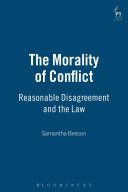
This book explores the relationship between the law and pervasive and persistent reasonable disagreement about justice. It reveals the central moral function and creative force of reasonable disagreement in and about the law and shows why and how lawyers and legal philosophers should take reasonable conflict more seriously. Even though the law should be regarded as the primary mode of settlement of our moral conflicts, it can, and should, also be the object and the forum of further moral conflicts. There is more to the rule of law than convergence and determinacy and it is important therefore to question the importance of agreement in law and politics. By addressing in detail issues pertaining to the nature and sources of disagreement, its extent and significance, as well as the procedural, institutional and substantive responses to disagreement in the law and their legitimacy, this book suggests the value of a comprehensive approach to thinking about conflict, which until recently has been analysed in a compartmentalized way. It aims to provide a fully-fledged political morality of conflict by drawing on the analysis of topical jurisprudential questions in the new light of disagreement. Developing such a global theory of disagreement in the law should be read in the context of the broader effort of reconstructing a complete account of democratic law-making in pluralistic societies. The book will be of value not only to legal philosophers and constitutional theorists, but also to political and democratic theorists, as well as to all those interested in public decision-making in conditions of conflict.
Containing material from hundreds of highly distinguished contributors representing the world’s top universities and institutions, the second edition has a truly global perspective. It contains more than 2,100 entries — including more than 450 new articles. Among the many topics covered are African, Islamic, Jewish, Russian, Chinese, and Buddhist philosophies; bioethics and biomedical ethics; art and aesthetics; epistemology; metaphysics; peace and war; social and political philosophy; the Holocaust; feminist thought; and much more. Additionally, the second edition also features 1,000 biographical entries on major figures in philosophical thought throughout history.
The Blackwell Dictionary of Western Philosophy is a concise reference to the whole history of western philosophy, from ancient Greece to the present day. Spans all the major branches of western philosophical inquiry, all of the key figures Explains the meaning and usage of each philosophical concept in a fresh and engaging style Each entry on philosophical terms concludes with an illustrative quotation from a significant philosopher, to enhance the reader’s understanding Entries on terms and individual philosophers are fully cross-referenced Co-written by the editor of the popular volume The Blackwell Companion to Philosophy (Second Edition, 2002)
This exceptional book examines and explains Plato’s answer to the normative question, “How ought we to live?” It discusses Plato’s conception of the virtues; his views about the connection between the virtues and happiness; and the account of reason, desire, and motivation that underlies his arguments about the virtues. Plato’s answer to the epistemological question, “How can we know how we ought to live?” is also discussed. His views on knowledge, belief, and inquiry, and his theory of Forms, are examined, insofar as they are relevant to his ethical view. Terence Irwin traces the development of Plato’s moral philosophy, from the Socratic dialogues to its fullest exposition in the Republic. Plato’s Ethics discusses Plato’s reasons for abandoning or modifying some aspects of Socratic ethics, and for believing that he preserves Socrates’ essential insights. A brief and selective discussion of the Statesmen, Philebus, and Laws is included. Replacing Irwin’s earlier Plato’s Moral Theory (Oxford, 1977), this book gives a clearer and fuller account of the main questions and discusses some recent controversies in the interpretation of Plato’s ethics. It does not presuppose any knowledge of Greek or any extensive knowledge of Plato.
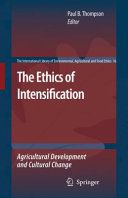
This volume was written in response to the Food and Agriculture Organization (FAO) Series of Ethics Papers that broached a series of previously neglected issues in international agricultural development. The volume contains a diverse collection of highly respected international scholars offer comments and elaboration on the FAO papers on the ethics of agricultural intensification and on intensification in animal agriculture. The full text of the FAO intensification paper is followed by chapters that mount specific reactions to its relevance for agricultural technology, environmental protection, globalization and animal welfare, and these four topics are further discussed, debated and elaborated by eight commentary chapters. Questions of agricultural development policy are addressed in terms of the relevance to farmers, consumers and other interested parties, as well as from key disciplinary and philosophical approaches. The rationale and purpose behind the FAO papers is explained and suggestions are offered on how to make ethics more central to programming and planning for agricultural development projects.
ما از اخلاق چه انتظاری داریم؟ این سوال شاید تاحدودی برای عموم مردم و یا متخصصان این رشته قابل پاسخ باشد؛ اینکه خوب بودن را به ما بیاموزد و در تنظیم روابط فردی م...

جشن کتاب تهران به ایستگاه سی و یکم رسیده است. حال و احوال نشر کتاب خوب نیست و باید فرهنگدوستان را به خرید و هدیه دادن کتاب ترغیب نمود. خانه اخلاقپژوهان جوان ب...

بنیاد کتابهای اخلاق اسلامی عمدتا پالایش جان از آلودگیها و آراستن آن به زیباییها است. اندیشه محوری این قبیل کتابها آن است که انسان فعلی آنی نیست که باید باشد...

-
0 Comments