Notice: تابع WP_Block_Type_Registry::register به طورنادرست فراخوانی شد. نامهای نوع بلوک نباید حروف بزرگ داشته باشند. لطفاً برای اطلاعات بیشتر، اشکال زدایی در وردپرس را مشاهده کنید. (این پیام در نگارش 5.0.0 افزوده شده است.) in /home/ethicsho/public_html/wp-includes/functions.php on line 5313
Warning: Use of undefined constant TDC_PATH_LEGACY - assumed 'TDC_PATH_LEGACY' (this will throw an Error in a future version of PHP) in /home/ethicsho/public_html/wp-content/plugins/td-composer/td-composer.php on line 109
Warning: Use of undefined constant TDSP_THEME_PATH - assumed 'TDSP_THEME_PATH' (this will throw an Error in a future version of PHP) in /home/ethicsho/public_html/wp-content/plugins/td-composer/td-composer.php on line 113 بایگانیهای 776 - خانه اخلاق پژوهان جوان Notice: Trying to access array offset on value of type bool in /home/ethicsho/public_html/wp-content/plugins/wp-ulike/inc/general-functions.php on line 807
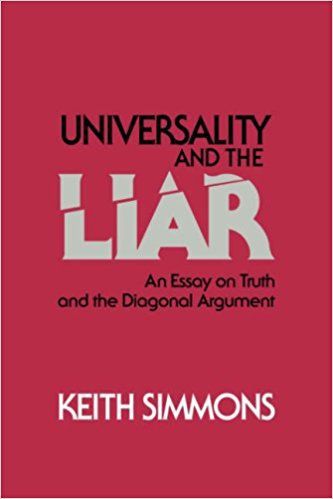
This book is about one of the most baffling of all paradoxes–the famous Liar paradox. Suppose we say: “We are lying now.” Then if we are lying, we are telling the truth; and if we are telling the truth we are lying. This paradox is more than an intriguing puzzle, since it involves the concept of truth. Thus any coherent theory of truth must deal with the Liar. Keith Simmons discusses the solutions proposed by medieval philosophers and offers his own solutions and in the process assesses other contemporary attempts to solve the paradox. Unlike such attempts, Simmons’ “singularity” solution does not abandon classical semantics and does not appeal to the kind of hierarchical view found in Barwise’s and Etchemendy’s The Liar. Moreover, Simmons’ solution resolves the vexing problem of semantic universality–the problem of whether there are semantic concepts beyond the expressive reach of a natural language such as English.
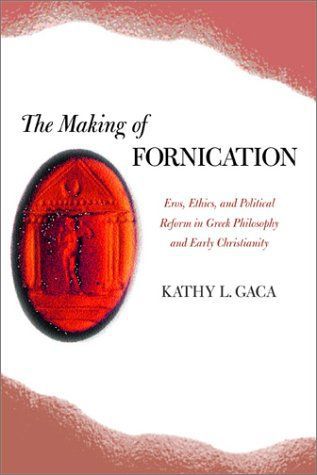
This provocative work provides a radical reassessment of the emergence and nature of Christian sexual morality, the dominant moral paradigm in Western society since late antiquity. While many scholars, including Michel Foucault, have found the basis of early Christian sexual restrictions in Greek ethics and political philosophy, Kathy L. Gaca demonstrates on compelling new grounds that it is misguided to regard Greek ethics and political theory—with their proposed reforms of eroticism, the family, and civic order—as the foundation of Christian sexual austerity. Rather, in this thoroughly informed and wide-ranging study, Gaca shows that early Christian goals to eradicate fornication were derived from the sexual rules and poetic norms of the Septuagint, or Greek Bible, and that early Christian writers adapted these rules and norms in ways that reveal fascinating insights into the distinctive and largely non-philosophical character of Christian sexual morality.Writing with an authoritative command of both Greek philosophy and early Christian writings, Gaca investigates Plato, the Stoics, the Pythagoreans, Philo of Alexandria, the apostle Paul, and the patristic Christians Clement of Alexandria, Tatian, and Epiphanes, freshly elucidating their ideas on sexual reform with precision, depth, and originality. Early Christian writers, she demonstrates, transformed all that they borrowed from Greek ethics and political philosophy to launch innovative programs against fornication that were inimical to Greek cultural mores, popular and philosophical alike. The Septuagint’s mandate to worship the Lord alone among all gods led to a Christian program to revolutionize Gentile sexual practices, only for early Christians to find this virtually impossible to carry out without going to extremes of sexual renunciation.Knowledgeable and wide-ranging, this work of intellectual history and ethics cogently demonstrates why early Christian sexual restrictions took such repressive ascetic forms, and casts sobering light on what Christian sexual morality has meant for religious pluralism in Western culture, especially among women as its bearers.
What makes people cosmopolitan? How is cosmopolitanism shaping everyday life experiences and the practices of ordinary people?Making use of empirical research, “Cosmopolitanism in Practice” examines the concrete settings in which individuals display cosmopolitan sensibilities and dispositions, illustrating the ways in which cosmopolitan self-transformations can be used as an analytical tool to explain a variety of identity outlooks and practices. The manner in which both past and present cosmopolitanisms compete with meta-narratives such as nationalism, multiculturalism and religion is also investigated, alongside the employment of cosmopolitan ideas in situations of tension and conflict.With an international team of contributors, including Ulrich Beck, Steven Vertovec, Rob Kroes and Natan Sznaider, this book draws on a variety of intellectual disciplines and international contexts to show how people embrace and make use of cosmopolitan ideas and attitudes.
This book takes a new approach to ethics by focusing on the kinds of dilemmas that confront people almost daily on the job. The author’s unique contribution is to meld philosophy with everyday decisionmaking, offering the reader a common sense approach to making ethical decisions. Mary Guy introduces ten core values which surround ethical dilemmas, demonstrating the way in which personnel can sensitize themselves to the values involved in a problem and reach a solution which maximizes the important values. Real-life case examples illustrate ethical dilemmas that involve personnel practices, organizing strategies, reporting functions, supervisory practices, whistleblowing, and more. Throughout, the author emphasizes the kinds of concerns which confront the vast majority of employees–from ambitious entry-level personnel to top executives. Realistic in tone, the discussion acknowledges the inevitable need to make compromises, showing how to optimize ethical values situations that arise on the job and for which no formal rules exist. In her introductory chapter, Guy defines ethics, clarifies the relationship between ethical behavior and morality, and presents the ten guiding values that serve as the foundation for ethical decisions. Turning to a focus on decisionmaking, she explores such issues as the theoretical framework for rational decisionmaking, rational decisionmaking in real life, the application of ethical analysis to decisionmaking, and the definition of ethical decisionmaking. The four subsequent chapters present case studies of problems that personnel commonly encounter. In each case, Guy examines the ethical issues involved, applies various scenarios for reaching an ethical decision, and demonstrates the tension that exists among ethical decisionmaking, coping with daily exigencies, and accommodating the preferences of stakeholders. The concluding chapter summarizes the relationship between ethics and decisionmaking and offers a prescription for ensuring ethical decisionmaking throughout the organization. Must reading for managers in business, government, and not-for-profit organizations, this book is also an excellent supplemental text for advanced undergraduate and graduate level courses in business and public administration.
ما از اخلاق چه انتظاری داریم؟ این سوال شاید تاحدودی برای عموم مردم و یا متخصصان این رشته قابل پاسخ باشد؛ اینکه خوب بودن را به ما بیاموزد و در تنظیم روابط فردی م...

جشن کتاب تهران به ایستگاه سی و یکم رسیده است. حال و احوال نشر کتاب خوب نیست و باید فرهنگدوستان را به خرید و هدیه دادن کتاب ترغیب نمود. خانه اخلاقپژوهان جوان ب...

بنیاد کتابهای اخلاق اسلامی عمدتا پالایش جان از آلودگیها و آراستن آن به زیباییها است. اندیشه محوری این قبیل کتابها آن است که انسان فعلی آنی نیست که باید باشد...

-
0 Comments