Notice: تابع WP_Block_Type_Registry::register به طورنادرست فراخوانی شد. نامهای نوع بلوک نباید حروف بزرگ داشته باشند. لطفاً برای اطلاعات بیشتر، اشکال زدایی در وردپرس را مشاهده کنید. (این پیام در نگارش 5.0.0 افزوده شده است.) in /home/ethicsho/public_html/wp-includes/functions.php on line 5313
Warning: Use of undefined constant TDC_PATH_LEGACY - assumed 'TDC_PATH_LEGACY' (this will throw an Error in a future version of PHP) in /home/ethicsho/public_html/wp-content/plugins/td-composer/td-composer.php on line 109
Warning: Use of undefined constant TDSP_THEME_PATH - assumed 'TDSP_THEME_PATH' (this will throw an Error in a future version of PHP) in /home/ethicsho/public_html/wp-content/plugins/td-composer/td-composer.php on line 113 بایگانیهای 518 - خانه اخلاق پژوهان جوان Notice: Trying to access array offset on value of type bool in /home/ethicsho/public_html/wp-content/plugins/wp-ulike/inc/general-functions.php on line 807
— More than two-thirds of the student population admits to cheating on examsEveryone hates taking exams; and there are always a few bad seeds in every class who will try to avoid them at all costs. Exam Scams contains a myriad of cheating tips and excuses for skipping class on exam day. From underwear inspections to student riots, this uncovers the most ingenious and outrageous ways that students attempt to dodge exams, assist their memories during them, and explain poor marks after they’re all over. The old excuse that “the dog ate my notes” won’t cut it in today’s classrooms. Therefore, students must devise much more creative excuses and cheating methods. This book is filled with original deceits from students around the globe. Though none of these scams are guaranteed to work, Exam Scams is hilarious reading for any student who has taken an exam and for every teacher who has graded a paper.
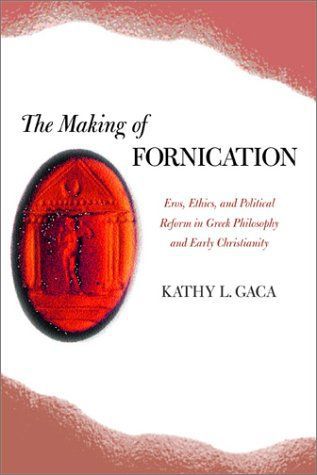
This provocative work provides a radical reassessment of the emergence and nature of Christian sexual morality, the dominant moral paradigm in Western society since late antiquity. While many scholars, including Michel Foucault, have found the basis of early Christian sexual restrictions in Greek ethics and political philosophy, Kathy L. Gaca demonstrates on compelling new grounds that it is misguided to regard Greek ethics and political theory—with their proposed reforms of eroticism, the family, and civic order—as the foundation of Christian sexual austerity. Rather, in this thoroughly informed and wide-ranging study, Gaca shows that early Christian goals to eradicate fornication were derived from the sexual rules and poetic norms of the Septuagint, or Greek Bible, and that early Christian writers adapted these rules and norms in ways that reveal fascinating insights into the distinctive and largely non-philosophical character of Christian sexual morality.Writing with an authoritative command of both Greek philosophy and early Christian writings, Gaca investigates Plato, the Stoics, the Pythagoreans, Philo of Alexandria, the apostle Paul, and the patristic Christians Clement of Alexandria, Tatian, and Epiphanes, freshly elucidating their ideas on sexual reform with precision, depth, and originality. Early Christian writers, she demonstrates, transformed all that they borrowed from Greek ethics and political philosophy to launch innovative programs against fornication that were inimical to Greek cultural mores, popular and philosophical alike. The Septuagint’s mandate to worship the Lord alone among all gods led to a Christian program to revolutionize Gentile sexual practices, only for early Christians to find this virtually impossible to carry out without going to extremes of sexual renunciation.Knowledgeable and wide-ranging, this work of intellectual history and ethics cogently demonstrates why early Christian sexual restrictions took such repressive ascetic forms, and casts sobering light on what Christian sexual morality has meant for religious pluralism in Western culture, especially among women as its bearers.
Being Apart from Reasons deals with the question of how we should go about using reasons to decide what to do. More particularly, the book presents objections to the most common response given by contemporary legal and political theorists to the moral complexity of decision-making in modern societies, namely: the attempt to release public agents from their argumentative burden by insulating a particular set of reasons from the general pool of reasons and assigning the former systematic priority over all other reasons. If those attempts succeed, public agents should not reason comprehensively, taking into account all reasons and weighing them against one another. Some reasons would be excluded from decision-making by kind. That strategy is apparent both in Rawls’ claim that reasons concerning the right are systematically prior to reasons concerning the good and in Raz’s claim that pre-emptive reasons are systematically prior to first-order reasons. The same strategy is also instantiated by certain arguments for the procedural value of law, such as Jeremy Waldron’s. In the book, each of those arguments for the insulation of reasons is objected to in order to defend the thesis the reasoning by public agents must always be as comprehensive as possible.In order to reach that conclusion a particular picture of public decision-making in needed. That picture in provided by the comparison between the use of reasons in public and private decision-making which is carried out in the first two chapters of the book. That comparison brings to light peculiar features of public decision-making that imply the need for public agents to reason comprehensively before deciding. The remaining chapters object to those arguments mentioned above which aim at justifying the exclusion of certain reasons from public agent’s decision-making.
In recent years, libertarian impulses have increasingly influenced national and economic debates, from welfare reform to efforts to curtail affirmative action. Murray N. Rothbard’s classic The Ethics of Liberty stands as one of the most rigorous and philosophically sophisticated expositions of the libertarian political position. What distinguishes Rothbard’s book is the manner in which it roots the case for freedom in the concept of natural rights and applies it to a host of practical problems. An economist by profession, Rothbard here proves himself equally at home with philosophy. And while his conclusions are radical–that a social order that strictly adheres to the rights of private property must exclude the institutionalized violence inherent in the state–his applications of libertarian principles prove surprisingly practical for a host of social dilemmas, solutions to which have eluded alternative traditions. The Ethics of Liberty authoritatively established the anarcho-capitalist economic system as the most viable and the only principled option for a social order based on freedom. This edition is newly indexed and includes a new introduction that takes special note of the Robert Nozick-Rothbard controversies.
‘These essays, including a masterful introduction by the editors & a useful glossary of Pali terms, constitute a rich addition to the emerging field of comparative religion ethics & demonstrate the fruitfulness of collaborative studies.’–Journal of Religion.
ما از اخلاق چه انتظاری داریم؟ این سوال شاید تاحدودی برای عموم مردم و یا متخصصان این رشته قابل پاسخ باشد؛ اینکه خوب بودن را به ما بیاموزد و در تنظیم روابط فردی م...

جشن کتاب تهران به ایستگاه سی و یکم رسیده است. حال و احوال نشر کتاب خوب نیست و باید فرهنگدوستان را به خرید و هدیه دادن کتاب ترغیب نمود. خانه اخلاقپژوهان جوان ب...

بنیاد کتابهای اخلاق اسلامی عمدتا پالایش جان از آلودگیها و آراستن آن به زیباییها است. اندیشه محوری این قبیل کتابها آن است که انسان فعلی آنی نیست که باید باشد...

-
0 Comments