Notice: تابع WP_Block_Type_Registry::register به طورنادرست فراخوانی شد. نامهای نوع بلوک نباید حروف بزرگ داشته باشند. لطفاً برای اطلاعات بیشتر، اشکال زدایی در وردپرس را مشاهده کنید. (این پیام در نگارش 5.0.0 افزوده شده است.) in /home/ethicsho/public_html/wp-includes/functions.php on line 5313
Warning: Use of undefined constant TDC_PATH_LEGACY - assumed 'TDC_PATH_LEGACY' (this will throw an Error in a future version of PHP) in /home/ethicsho/public_html/wp-content/plugins/td-composer/td-composer.php on line 109
Warning: Use of undefined constant TDSP_THEME_PATH - assumed 'TDSP_THEME_PATH' (this will throw an Error in a future version of PHP) in /home/ethicsho/public_html/wp-content/plugins/td-composer/td-composer.php on line 113 بایگانیهای 2324 - خانه اخلاق پژوهان جوان Notice: Trying to access array offset on value of type bool in /home/ethicsho/public_html/wp-content/plugins/wp-ulike/inc/general-functions.php on line 807
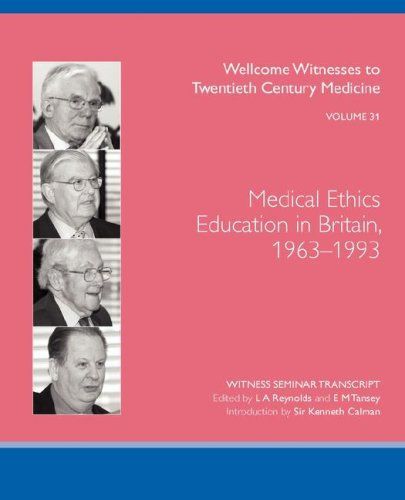
Changing attitudes toward human experimentation along with other controversial moral issues emerged after the Second World War and, in 1963, led to the establishment of the London Medical Group, organized by Ted Shotter, with similar Medical Groups elsewhere from 1967. These became forums for discussion and debate arising from dilemmas encountered in medical settings. Medical ethics did not become a recognized subject in the syllabus of Britain’s medical schools until 1993. This Witness Seminar transcript records the development of international ethical codes, the response to them over the period 1963-93 by students and doctors and the extent of resistance encountered from deans, hospital administrators and others; the Groups’ influence on medical practice; the impact on both Medical Group organizers and participants in their subsequent careers; the local and regional variations and their significant lasting contributions. The meeting was chaired by Dr Stephen Lock and included former Medical Group members, scientists, physicians and policy makers, such as Professors Kenneth Boyd, Bill Fulford, Roger Higgs, Sir Ian Kennedy, David Morton and Sir Malcolm Macnaughton. An introduction by Professor Sir Kenneth Calman and appendices of the Very Revd Edward Shotter’s reflections on the influence of the Medical Groups as a report for the Institute of Medical Ethics complete the transcript.
The dual-use dilemma arises in the context of research in the biological and other sciences as a consequence of the fact that one and the same piece of scientific research sometimes has the potential to be used for harmful as well as good purposes. Discoveries that may lead to important advances in science and medicine might therefore also facilitate development of biological weapons of mass destruction. Scientists should be aware of the ways in which their well-intentioned research could be misused by others – and they should sometimes avoid research projects when the potential for harmful misuse is great. Policy makers must make tough choices about the extent to which the dual-use nature of research might justify increased oversight, regulation, and perhaps even censorship of science. This book examines the kinds of life-science experiments that give rise to the dual-use dilemma and provides philosophical analysis of the ethical issues and policy options surrounding dual-use research. Though the dual-use dilemma is an ethical issue, the vast majority of literature on the topic thus far has been written by scientists and security experts: this is the first book-length treatment of the topic by professional ethicists. It also challenges, and offers an alternative perspective to, the hugely influential U.S. National Research Council position on the dual-use dilemma.
The World’s Great Philosophers provides an introduction to and overview of some of the most profound and influential thinkers in the history of philosophy.Presents an introduction to and overview of some of the most profound and influential thinkers in the history of philosophy. Contains 40 essays, written by an outstanding international assembly of scholars. Provides cogent and accessible discussion of key philosophers from around the world. Conveys the historical panorama of philosophical thought on the nature of reality, the human condition, and basic human values.
“Aristotle’s Ethics develops a complex theory of the qualities which make for a good human being and for several decades there has been intense discussion about whether Aristotle’s theory of voluntariness, outlined in the Ethics, actually delineates what modern thinkers would recognize as a theory of moral responsibility. Javier Echeñique presents a novel account of Aristotle’s discussion of voluntariness in the Ethics, arguing – against the interpretation by Arthur Adkins and that inspired by Peter Strawson – that he developed an original and compelling theory of moral responsibility and that this theory has contributed in important ways to our understanding of coercion, ignorance and violence. His study will be valuable for a wide range of readers interested in Aristotle and in ancient ethics more broadly”–
ما از اخلاق چه انتظاری داریم؟ این سوال شاید تاحدودی برای عموم مردم و یا متخصصان این رشته قابل پاسخ باشد؛ اینکه خوب بودن را به ما بیاموزد و در تنظیم روابط فردی م...

جشن کتاب تهران به ایستگاه سی و یکم رسیده است. حال و احوال نشر کتاب خوب نیست و باید فرهنگدوستان را به خرید و هدیه دادن کتاب ترغیب نمود. خانه اخلاقپژوهان جوان ب...

بنیاد کتابهای اخلاق اسلامی عمدتا پالایش جان از آلودگیها و آراستن آن به زیباییها است. اندیشه محوری این قبیل کتابها آن است که انسان فعلی آنی نیست که باید باشد...

-
0 Comments