Notice: تابع WP_Block_Type_Registry::register به طورنادرست فراخوانی شد. نامهای نوع بلوک نباید حروف بزرگ داشته باشند. لطفاً برای اطلاعات بیشتر، اشکال زدایی در وردپرس را مشاهده کنید. (این پیام در نگارش 5.0.0 افزوده شده است.) in /home/ethicsho/public_html/wp-includes/functions.php on line 5313
Warning: Use of undefined constant TDC_PATH_LEGACY - assumed 'TDC_PATH_LEGACY' (this will throw an Error in a future version of PHP) in /home/ethicsho/public_html/wp-content/plugins/td-composer/td-composer.php on line 109
Warning: Use of undefined constant TDSP_THEME_PATH - assumed 'TDSP_THEME_PATH' (this will throw an Error in a future version of PHP) in /home/ethicsho/public_html/wp-content/plugins/td-composer/td-composer.php on line 113 بایگانیهای Hamid R. Nemati - خانه اخلاق پژوهان جوان Notice: Trying to access array offset on value of type bool in /home/ethicsho/public_html/wp-content/plugins/wp-ulike/inc/general-functions.php on line 807
The concept of luck has played an important role in debates concerning free will and moral responsibility, yet participants in these debates have relied upon an intuitive notion of what luck is. Neil Levy develops an account of luck, which is then applied to the free will debate. He argues that the standard luck objection succeeds against common accounts of libertarian free will, but that it is possible to amend libertarian accounts so that they are no more vulnerable to luck than is compatibilism. But compatibilist accounts of luck are themselves vulnerable to a powerful luck objection: historical compatibilisms cannot satisfactorily explain how agents can take responsibility for their constitutive luck; non-historical compatibilisms run into insurmountable difficulties with the epistemic condition on control over action. Levy argues that because epistemic conditions on control are so demanding that they are rarely satisfied, agents are not blameworthy for performing actions that they take to be best in a given situation. It follows that if there are any actions for which agents are responsible, they are akratic actions; but even these are unacceptably subject to luck. Levy goes on to discuss recent non-historical compatibilisms, and argues that they do not offer a viable alternative to control-based compatibilisms. He suggests that luck undermines our freedom and moral responsibility no matter whether determinism is true or not.
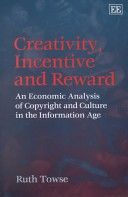
‘…well written, clear and informative. It contains many references that demonstrate the deep knowledge of the field that the author has acquired through her own research and her remarkable work at the head of the Journal of Cultural Economics. She especially provides a very clear review of the literature on the economics of copyright…. this review will become a reference that can’t be ignored by researchers interested in copyright…Towse opens avenues for further research and also stresses those questions that can help professionals better understand cultural regulations.’ – Françoise Benhamou, Journal of Cultural Economics ‘Ruth Towse’s book provides an easily accessible introduction to this field and contains much useful argument. It also stands as testament to the productive and continuing scholarly career of one of the best known figures in contemporary cultural economics.’ – David Throsby, Journal of Economic Literature ‘This is a most interesting treatise on a very topical subject of economic and legal policy …this book offers a wealth of intriguing research ideas and some interesting, if not highly rigorous, analyses of an important area of public policy.’ – Mary Kokoski, Monthly Labor Review ‘Ruth Towse’s excellent book, Creativity, Incentive and Reward is a beacon in this confused theoretical and policy mish-mash. The book, which brings together Towse’s work in copyright and cultural economics over the last decade, is thoroughly researched, analytically satisfying and beautifully written…copyright scholars owe a debt of gratitude to Towse.’ – Fiona Macmillan, Copyright World ‘This is an important work on compensation of the artist and the incentives for artistic activity. The explosive evolution of the technology of communications raises particularly pressing issues in this arena and poses new threats to remuneration of the artist. The discussion of copyright in this book provides vital information for analysis of this issue. The book is informative, intelligent and well written – precisely what is needed for understanding of its subject.’ – William J. Baumol, New York University and Princeton University, US Creativity is crucial to the Information Age economy. It is the basis of production in the cultural industries. In this excellent book, Ruth Towse provides an analysis of the interaction between creativity, the law, and markets for cultural goods and services. Copyright law establishes property rights that create economic incentives to cultural production and Ruth Towse uses her analysis to draw conclusions about policy on copyright. This unique study is of interest to a range of disciplines in economics, law, cultural studies and management.
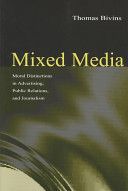
This text introduces readers to the tools necessary for making moral and ethical decisions regarding the use of mass media. The focus is on the three mass media industries most pervasive in today’s society: the news media (journalism), advertising, and public relations. In his exploration of ethical issues and media, author Thomas Bivins guides students to understand not what the “right” answers are, but to identify those answers that are most appropriate within the given context. Identifying those to whom the answers are the most appropriate is a major concern of this book. Readers come away with a greater appreciation for the complexities of making a moral decision and develop a personal “yardstick” by which to measure their decisions. The chapters in this text offer insights on: similarities and differences among the ethical dilemmas faced by the mass media; common ground on which to evaluate media behavior; media obligations; professional ethics; ethical theory and its application to the modern media; and considerations of truth and harm. This text has been developed for courses covering ethics in public relations, advertising, and journalism. Offering valuable lessons applicable to all forms of communication, Mixed Media serves as a critical starting point for understanding and developing answers to ethical questions. These lessons serve not only to better students’ ability to make ethical decisions, but also to better the media professions as they become practitioners in the mass media industry.
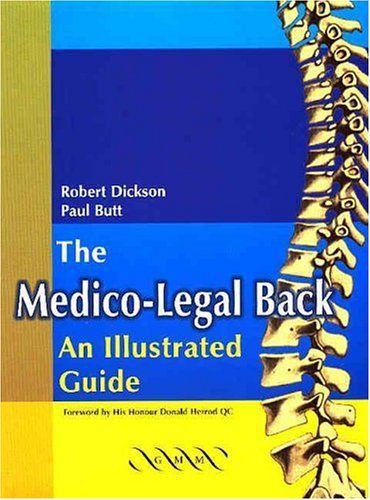
Back pain and back injury is an extremely common problem, producing chronic, debilitating symptoms for sufferers, and resulting in millions of pounds of lost revenue in absence from work and paid in compensation for spinal injuries. The Medico-Legal Back is the first book to address all aspects of the problem for a legal readership, in a clear, concise and reader-friendly style. It does away with the need to search for and then extract complex information from many different sources, and as such will be an indispensable guide to the problem for all lawyers, judges and medico-legal experts, as well as being of value to the orthopaedic surgeon with an interest in the spine. Of particular value is the use throughout the book of analogies drawn on anatomical technicalities and common movements, situations and incidents of everyday life. Fully illustrated throughout, with real scans using imaging modalities, and line diagrams generated especially for this title, The Medico-Legal Back should be on the shelves of all medico-legal personnel at all levels of expertise and experience.
ما از اخلاق چه انتظاری داریم؟ این سوال شاید تاحدودی برای عموم مردم و یا متخصصان این رشته قابل پاسخ باشد؛ اینکه خوب بودن را به ما بیاموزد و در تنظیم روابط فردی م...

جشن کتاب تهران به ایستگاه سی و یکم رسیده است. حال و احوال نشر کتاب خوب نیست و باید فرهنگدوستان را به خرید و هدیه دادن کتاب ترغیب نمود. خانه اخلاقپژوهان جوان ب...

بنیاد کتابهای اخلاق اسلامی عمدتا پالایش جان از آلودگیها و آراستن آن به زیباییها است. اندیشه محوری این قبیل کتابها آن است که انسان فعلی آنی نیست که باید باشد...

-
0 Comments