Notice: تابع WP_Block_Type_Registry::register به طورنادرست فراخوانی شد. نامهای نوع بلوک نباید حروف بزرگ داشته باشند. لطفاً برای اطلاعات بیشتر، اشکال زدایی در وردپرس را مشاهده کنید. (این پیام در نگارش 5.0.0 افزوده شده است.) in /home/ethicsho/public_html/wp-includes/functions.php on line 5313
Warning: Use of undefined constant TDC_PATH_LEGACY - assumed 'TDC_PATH_LEGACY' (this will throw an Error in a future version of PHP) in /home/ethicsho/public_html/wp-content/plugins/td-composer/td-composer.php on line 109
Warning: Use of undefined constant TDSP_THEME_PATH - assumed 'TDSP_THEME_PATH' (this will throw an Error in a future version of PHP) in /home/ethicsho/public_html/wp-content/plugins/td-composer/td-composer.php on line 113 بایگانیهای Gabriela Roxana Carone - خانه اخلاق پژوهان جوان Notice: Trying to access array offset on value of type bool in /home/ethicsho/public_html/wp-content/plugins/wp-ulike/inc/general-functions.php on line 807
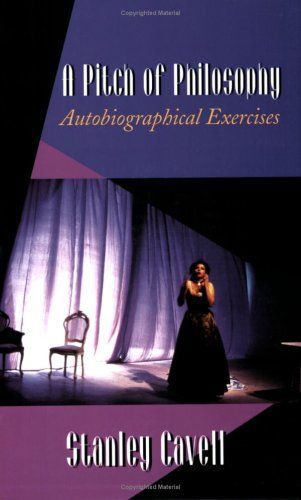
What is the pitch of philosophy? Something thrown, for us to catch? A lurch, meant to unsettle us? The relative position of a tone on a scale? A speech designed to persuade? This book is an invitation to the life of philosophy in the United States, as Emerson once lived it and as Stanley Cavell now lives it – in all its topographical ambiguity. Cavell talks about his vocation in connection with what he calls voice – the tone of philosophy – and his right to take that tone, and to describe an anecdotal journey toward the discovery of his own voice. Cavell asks how the voice of philosophy can be heard amid the commerce of everyday life. His autobiographical exercises begin at home with his parents, his father an accidental pawnbroker and accomplished raconteur, his mother a trained and talented musician. In the course of showing us his certain steps in the discovery of his trade, he conveys the sense of what it means to learn to walk on one’s own, with a Thoreauvian deliberateness. He pays suitableattention to a serious ally and antagonist to the task of philosophy as he understands it, namely, Jacques Derrida – yet Derrida has mounted a full-scale attack on “voice” and other concepts that Cavell has held open for much of a lifetime. The chapters are interwoven with intense family reminiscences in Cavell’s discovery of J. L. Austin, his understanding of Wittgenstein, his raising of Emerson to the philosophical canon, his fascination with film (images of women in a medium for women), the revelation that film and opera are the media of otherness for women. And the voice at the end: hearing in himself the voice of his mother, which is music. Complex, sentimental, witty, A Pitch ofPhilosophy is for anyone who cares to take on philosophy, under whatever name it goes.
Human beings have the unique ability to consciously reflect on the nature of the self. But reflection has its costs. We can ask what the self is, but as David Hume pointed out, the self, once reflected upon, may be nowhere to be found. The favored view is that we are material beings living in the material world. But if so, a host of destabilizing questions surface. If persons are just a sophisticated sort of animal, then what sense is there to the idea that we are free agents who control our own destinies? What makes the life of any animal, even one as sophisticated as Homo sapiens, worth anything? What place is there in a material world for God? And if there is no place for a God, then what hold can morality possibly have on us–why isn’t everything allowed? Flanagan’s collection of essays takes on these questions and more. He continues the old philosophical project of reconciling a scientific view of ourselves with a view of ourselves as agents of free will and meaning-makers. But to this project he brings the latest insights of neuroscience, cognitive science, and psychiatry, exploring topics such as whether the conscious mind can be explained scientifically, whether dreams are self-expressive or just noise, the moral socialization of children, and the nature of psychological phenomena such as multiple personality disorder and false memory syndrome. What emerges from these explorations is a liberating vision which can make sense of the self, agency, character transformation, and the value and worth of human life. Flanagan concludes that nothing about a scientific view of persons must lead to nihilism.
In academic and non-academic debates the practice of human rights enforcement is usually reduced to the intentions, interests and capabilities of agents – particularly the United States and other Western states. Whether seen as a policy adopted to promote national interest or an imperialist device used by the West, the practice of human rights enforcement is discussed in isolation from the structure of the late-modern Global Political Economy. This book develops a structural approach to post-Cold war military humanitarianism and demonstrates the nature of reciprocal causal relations between the global capitalist economy and the practice of human rights enforcement. It provides an historical analysis of the notion of individual rights and their relationship with capitalism and demonstrates that today the actors engaged in human rights enforcement – whether for selfish or humanitarian reasons – unintentionally provide global capital with a Gramscian quality of moral leadership thereby contributing to its hegemony.
ما از اخلاق چه انتظاری داریم؟ این سوال شاید تاحدودی برای عموم مردم و یا متخصصان این رشته قابل پاسخ باشد؛ اینکه خوب بودن را به ما بیاموزد و در تنظیم روابط فردی م...

جشن کتاب تهران به ایستگاه سی و یکم رسیده است. حال و احوال نشر کتاب خوب نیست و باید فرهنگدوستان را به خرید و هدیه دادن کتاب ترغیب نمود. خانه اخلاقپژوهان جوان ب...

بنیاد کتابهای اخلاق اسلامی عمدتا پالایش جان از آلودگیها و آراستن آن به زیباییها است. اندیشه محوری این قبیل کتابها آن است که انسان فعلی آنی نیست که باید باشد...

-
0 Comments