Notice: تابع WP_Block_Type_Registry::register به طورنادرست فراخوانی شد. نامهای نوع بلوک نباید حروف بزرگ داشته باشند. لطفاً برای اطلاعات بیشتر، اشکال زدایی در وردپرس را مشاهده کنید. (این پیام در نگارش 5.0.0 افزوده شده است.) in /home/ethicsho/public_html/wp-includes/functions.php on line 5313
Warning: Use of undefined constant TDC_PATH_LEGACY - assumed 'TDC_PATH_LEGACY' (this will throw an Error in a future version of PHP) in /home/ethicsho/public_html/wp-content/plugins/td-composer/td-composer.php on line 109
Warning: Use of undefined constant TDSP_THEME_PATH - assumed 'TDSP_THEME_PATH' (this will throw an Error in a future version of PHP) in /home/ethicsho/public_html/wp-content/plugins/td-composer/td-composer.php on line 113 بایگانیهای Darryl R.J. Macer - خانه اخلاق پژوهان جوان Notice: Trying to access array offset on value of type bool in /home/ethicsho/public_html/wp-content/plugins/wp-ulike/inc/general-functions.php on line 807
Richard Brandt is one of the most influential moral philosophers of the second half of the twentieth century. He is especially important in the field of ethics for his lucid and systematic exposition of utilitarianism. This new book represents in some ways a summation of his views and includes many useful applications of his theory. The focus of the book is how value judgments and moral belief can be justified. More generally, the book assesses different moral systems and theories of justice, and considers specific problems such as the optional level of charity and the moral tenability of the criminal law.
The Ten Commandments are the crystallization of God’s law. All across our nation they appear in churches, homes, and even some public buildings. But how do we apply them today, and how do they relate to the Gospel?Philip Graham Ryken believes that the Ten Commandments are an expression of God’s eternal character and thus have binding force today. In this book he explains the value of the law for usto convict us of our sin, to restrain sin in society, and to show us how to live for Christ. Dr. Ryken offers basic principles for interpreting and applying God’s law and explains these holy words commandment by commandment, illustrating each with a biblical account and relating each to the person and redemptive work of Jesus Christ.This is a book to be read and savored with reflection. God’s holiness and his standards for life are clearly related, and the joy of living by God’s law is vividly portrayed. Readers will find themselves examining their own lives, changing their ways, and delighting in the grace of God.
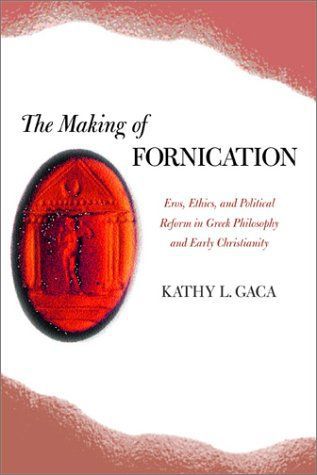
This provocative work provides a radical reassessment of the emergence and nature of Christian sexual morality, the dominant moral paradigm in Western society since late antiquity. While many scholars, including Michel Foucault, have found the basis of early Christian sexual restrictions in Greek ethics and political philosophy, Kathy L. Gaca demonstrates on compelling new grounds that it is misguided to regard Greek ethics and political theory—with their proposed reforms of eroticism, the family, and civic order—as the foundation of Christian sexual austerity. Rather, in this thoroughly informed and wide-ranging study, Gaca shows that early Christian goals to eradicate fornication were derived from the sexual rules and poetic norms of the Septuagint, or Greek Bible, and that early Christian writers adapted these rules and norms in ways that reveal fascinating insights into the distinctive and largely non-philosophical character of Christian sexual morality.Writing with an authoritative command of both Greek philosophy and early Christian writings, Gaca investigates Plato, the Stoics, the Pythagoreans, Philo of Alexandria, the apostle Paul, and the patristic Christians Clement of Alexandria, Tatian, and Epiphanes, freshly elucidating their ideas on sexual reform with precision, depth, and originality. Early Christian writers, she demonstrates, transformed all that they borrowed from Greek ethics and political philosophy to launch innovative programs against fornication that were inimical to Greek cultural mores, popular and philosophical alike. The Septuagint’s mandate to worship the Lord alone among all gods led to a Christian program to revolutionize Gentile sexual practices, only for early Christians to find this virtually impossible to carry out without going to extremes of sexual renunciation.Knowledgeable and wide-ranging, this work of intellectual history and ethics cogently demonstrates why early Christian sexual restrictions took such repressive ascetic forms, and casts sobering light on what Christian sexual morality has meant for religious pluralism in Western culture, especially among women as its bearers.
This book is recommended for anyone interested in understanding, questioning, articulating, and acting on the basis of their own and others’ perspectives on sexism, racism, and affirmative action in American higher education. –ChoiceWhile equal opportunity for all candidates is widely recognized as a goal within academia, the implementation of specific procedures to achieve equality has resulted in vehement disputes regarding both the means and ends. To encourage a reexamination of this issue, Cahn asked three prominent American social philosophers–Leslie Pickering Francis, Robert L. Simon, and Lawrence C. Becker–who hold divergent views about affirmative action, to write extended essays presenting their views. Twenty-two other philosophers then respond to these three principal essays. While no consensus is reached, the resulting clash of reasoned judgments will serve to revitalize the issues raised by affirmative action.ContentsIntroduction – Steven M. CahnPart I1. In Defense of Affirmative Action – Leslie Pickering Francis2. Affirmative Action and the University: Faculty Appointment and Preferential Treatment – Robert L. Simon3. Affirmative Action and Faculty Appointments – Lawrence C. BeckerPart II4. What Good Am I? – Laurence Thomas5. Who Counts on Campus? – Ann Hartle6. Reflections on Affirmative Action in Academia – Robert G. Turnbull7. The Injustice of Strong Affirmative Action – John Kekes8. Preferential Treatment Versus Purported Meritocratic Rights – Richard J. Arneson9. Faculties as Civil Societies: A Misleading Model for Affirmative Action – Jeffrie G. Murphy10. Facing Facts and Responsibilities – The White Man’s Burden and the Burden of Proof – Karen Hanson11. Affirmative Action: Relevant Knowledge and Relevant Ignorance – Joel J. Kupperman12. Remarks on Affirmative Action – Andrew Oldenquist13. Affirmative Action and the Multicultural Ideal – Philip L. Quinn14. Affirmative Action in the Cultural Wars – Frederick A. Olafson15. Quotas by Any Name: Some Problems of Affirmative Action in Faculty Appointments – Tom L. Beauchamp16. Are Quotas Sometimes Justified? – James Rachels17. Proportional Representation of Women and Minorities – Celia Wolf-Devine18. An Ecological Concept of Diversity – La Verne Shelton19. Careers Open to Talent – Ellen Frankel Paul20. Some Sceptical Doubts – Alasdair MacIntyre21. Affirmative Action and Tenure Decisions – Richard T. De George22. Affirmative Action and the Awarding of Tenure – Peter J. Markie23. The Case for Preferential Treatment – James P. Sterba24. Saying What We Think – Fred Sommers25. Comments on Compromise and Affirmative Action – Alan H. GoldmanAbout the AuthorsIndex About the Author(s)Steven M. Cahn is Professor of Philosophy and former Provost and Vice President for Academic Affairs at the Graduate Center of the City University of New York. He has published numerous other books, including Morality, Responsibility, and the University (Temple).Contributors: Laurence Thomas, Ann Hartle, Robert G. Turnbull, John Kekes, Richard J. Arneson, Jeffrie G. Murphy, Karen Hanson, Joel J. Kupperman, Andrew Oldenquist, Philip L. Quinn, Frederick A. Olafson, Tom L. Beauchamp, James Rachels, Celia Wolf-Devine, La Verne Shelton, Ellen Frankel Paul, Alasdair MacIntyre, Richard T. De George, Peter J. Markie, James P. Sterba, Fred Sommers, Alan H. Goldman, and the editor.
Believing the wrong thing may sometimes have drastic consequences. The question as to when a person is not only ill-guided, but genuinely at fault for holding a particular belief is an important one: It touches upon the roots of our understanding of such notions as criminal negligence and moral responsibility. The answer to this question may influence the extent to which we are willing to submit each other to punishments ranging from mild resentment to harsh prison terms.This book presents an extensive effort to shed light on the conditions under which we may appropriately deem someone blameworthy for holding a particular belief. It regiments and unifies several debates within contemporary epistemology, ethics and legal scholarship. Finally, the book brings a new philosophical look on issues like our power to control beliefs and the extent and nature of foresight. “Blameworthy Belief is unique in being an up-to-date monograph devoted entirely to the problem of a moral appraisal of beliefs and the closely related problem of deciding to believe (doxastic voluntarism and anti-voluntarism). It is bound to become a highly influential work and is of great interest not only to epistemologists, but also to philosophers of law and moral philosophers.” Heinrich Wansing, Professor of Philosophy of Science and Logic, Dresden University of Technology, Germany “Nottelmann has nicely managed to weave accounts of competing views into his discussion, and so this book provides an excellent survey of the literature en route to the development of a sensible account of how we could be said to be responsible for believing various things, even though belief formation is not under our voluntary control.” John Heil, Professor of Philosophy, Washington University in St. Louis, U.S.A., and Monash University, Australia
ما از اخلاق چه انتظاری داریم؟ این سوال شاید تاحدودی برای عموم مردم و یا متخصصان این رشته قابل پاسخ باشد؛ اینکه خوب بودن را به ما بیاموزد و در تنظیم روابط فردی م...

جشن کتاب تهران به ایستگاه سی و یکم رسیده است. حال و احوال نشر کتاب خوب نیست و باید فرهنگدوستان را به خرید و هدیه دادن کتاب ترغیب نمود. خانه اخلاقپژوهان جوان ب...

بنیاد کتابهای اخلاق اسلامی عمدتا پالایش جان از آلودگیها و آراستن آن به زیباییها است. اندیشه محوری این قبیل کتابها آن است که انسان فعلی آنی نیست که باید باشد...

-
0 Comments