Notice: تابع WP_Block_Type_Registry::register به طورنادرست فراخوانی شد. نامهای نوع بلوک نباید حروف بزرگ داشته باشند. لطفاً برای اطلاعات بیشتر، اشکال زدایی در وردپرس را مشاهده کنید. (این پیام در نگارش 5.0.0 افزوده شده است.) in /home/ethicsho/public_html/wp-includes/functions.php on line 5313
Warning: Use of undefined constant TDC_PATH_LEGACY - assumed 'TDC_PATH_LEGACY' (this will throw an Error in a future version of PHP) in /home/ethicsho/public_html/wp-content/plugins/td-composer/td-composer.php on line 109
Warning: Use of undefined constant TDSP_THEME_PATH - assumed 'TDSP_THEME_PATH' (this will throw an Error in a future version of PHP) in /home/ethicsho/public_html/wp-content/plugins/td-composer/td-composer.php on line 113 بایگانیهای War On Terrorism, 2001-/ Moral And Ethical Aspects - خانه اخلاق پژوهان جوان Notice: Trying to access array offset on value of type bool in /home/ethicsho/public_html/wp-content/plugins/wp-ulike/inc/general-functions.php on line 807
This work explains how human beings can live more peacefully with one another by understanding the conditions of possibility for dialogue. Philosophically, this challenge is articulated as the problem of: how dialogue as dia-logos is possible when the shared logos is precisely that which is in question. Emmanuel Levinas, in demonstrating that the shared logos is a function of interhuman relationship, helps us to make some progress in understanding the possibilities for dialogue in this situation. If the terms of the argument to his point are taken largely from Levina’s 1961 Totality & Infinity, Dudiak further proposes that Levina’s 1974 Otherwise than Being can be read as a deepening of these earlier analyses, delineating, both the conditions of possibility & impossibility for discourse itself. Throughout these analyses Dudiak discovers that in Levina’s view dialogue is ultimately possible, only for a gracious subjectivity already graced by God by way of the other, but where the word God is inseparable from my subjectivity as a graciousness to the other. Finally, for Levinas, the facilitation of dialogue, the facilitation of peace, comes down to the subject’s capacity & willingness to be who he or she is, to take the beautiful risk of a peaceful gesture offered to the other & that peace, in this gesture itself. As Levinas himself puts it: “Peace then is under my responsibility. I am a hostage, for I am alone to wage it, running a fine risk, dangerously.” Levinas’s philosophical discourse is precisely itself to be read as such a gesture.
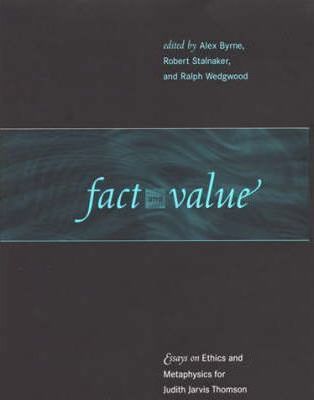
The diversity of topics discussed in this book reflects the breadth of Judith Jarvis Thomson’s philosophical work. Throughout her long career at MIT, Thomson’s straightforward approach and emphasis on problem-solving have shaped philosophy in significant ways. Some of the book’s contributions discuss specific moral and political issues such as abortion, self-defense, the rights and obligations of prospective fathers, and political campaign finance. Other contributions concern the foundations of moral theory, focusing on hedonism, virtue ethics, the nature of nonconsequentialism, and the objectivity of moral claims. Finally, contributions in metaphysics and epistemology discuss the existence of sets, the structures reflected in conditional statements, and the commitments of testimony.Contributors:Jonathan Bennett, Richard L. Cartwright, Joshua Cohen, N. Ann Davis, Catherine Z. Elgin, Gilbert Harman, Barbara Herman, Frances Myrna Kamm, Claudia Mills, T. M. Scanlon, Ernest Sosa.
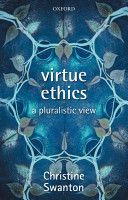
Christine Swanton offers a new, comprehensive theory of virtue ethics which addresses the major concerns of modern ethical theory from a character-based perspective. Discussion of many problems in moral theory, such as moral constraints, rightness of action, the good life, the demandingness ofethics, the role of the subjective, and the practicality of ethics, has been dominated by Kantian and Consequentialist theories, with their own distinctive conceptual apparatus. Virtue Ethics shows how a different framework can shed new light on these intractable issues. Swanton’s approach is distinctive in departing in siginificant ways from classical versions of virtue ethics derived primarily from Aristotle. Employing insights from Nietzsche and other sources, she argues against both eudaimonistic virtue ethics and traditional virtue ethical conceptions ofrightness. In developing a pluralistic view, she shows how different ‘modes of moral acknowledgement’ such as love, respect, appreciation, and creativity, are embedded in the very fabric of virtue, the moral life, and the good life.
The fox knows many things, the Greeks said, but the hedgehog knows one big thing. In his most comprehensive work the author argues that value in all its forms is one big thing: that what truth is, life means, morality requires, and justice demands are different aspects of the same large question. He develops original theories on a great variety of issues very rarely considered in the same book: moral skepticism, literary, artistic, and historical interpretation, free will, ancient moral theory, being good and living well, liberty, equality, and law among many other topics. What we think about any one of these must stand up, eventually, to any argument we find compelling about the rest. Skepticism in all its forms, philosophical, cynical, or post-modern, threatens that unity. The Galilean revolution once made the theological world of value safe for science. But the new republic gradually became a new empire: the modern philosophers inflated the methods of physics into a totalitarian theory of everything. They invaded and occupied all the honorifics, reality, truth, fact, ground, meaning, knowledge, and being, and dictated the terms on which other bodies of thought might aspire to them, and skepticism has been the inevitable result. The author feels we need a new revolution, and that we must make the world of science safe for value.
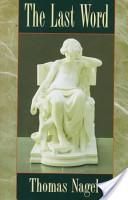
If there is such a thing as reason, it has to be universal. Reason must reflect objective principles whose validity is independent of our point of view–principles that anyone with enough intelligence ought to be able to recognize as correct. But this generality of reason is what relativists and subjectivists deny in ever-increasing numbers. And such subjectivism is not just an inconsequential intellectual flourish or badge of theoretical chic. It is exploited to deflect argument and to belittle the pretensions of the arguments of others. The continuing spread of this relativistic way of thinking threatens to make public discourse increasingly difficult and to exacerbate the deep divisions of our society. In The Last Word, Thomas Nagel, one of the most influential philosophers writing in English, presents a sustained defense of reason against the attacks of subjectivism, delivering systematic rebuttals of relativistic claims with respect to language, logic, science, and ethics. He shows that the last word in disputes about the objective validity of any form of thought must lie in some unqualified thoughts about how things are–thoughts that we cannot regard from outside as mere psychological dispositions.
ما از اخلاق چه انتظاری داریم؟ این سوال شاید تاحدودی برای عموم مردم و یا متخصصان این رشته قابل پاسخ باشد؛ اینکه خوب بودن را به ما بیاموزد و در تنظیم روابط فردی م...

جشن کتاب تهران به ایستگاه سی و یکم رسیده است. حال و احوال نشر کتاب خوب نیست و باید فرهنگدوستان را به خرید و هدیه دادن کتاب ترغیب نمود. خانه اخلاقپژوهان جوان ب...

بنیاد کتابهای اخلاق اسلامی عمدتا پالایش جان از آلودگیها و آراستن آن به زیباییها است. اندیشه محوری این قبیل کتابها آن است که انسان فعلی آنی نیست که باید باشد...

-
0 Comments