

Notice: تابع WP_Block_Type_Registry::register به طورنادرست فراخوانی شد. نامهای نوع بلوک نباید حروف بزرگ داشته باشند. لطفاً برای اطلاعات بیشتر، اشکال زدایی در وردپرس را مشاهده کنید. (این پیام در نگارش 5.0.0 افزوده شده است.) in /home/ethicsho/public_html/wp-includes/functions.php on line 5313
Warning: Use of undefined constant TDC_PATH_LEGACY - assumed 'TDC_PATH_LEGACY' (this will throw an Error in a future version of PHP) in /home/ethicsho/public_html/wp-content/plugins/td-composer/td-composer.php on line 109
Warning: Use of undefined constant TDSP_THEME_PATH - assumed 'TDSP_THEME_PATH' (this will throw an Error in a future version of PHP) in /home/ethicsho/public_html/wp-content/plugins/td-composer/td-composer.php on line 113 بایگانیهای Utilitarianism - خانه اخلاق پژوهان جوان Notice: Trying to access array offset on value of type bool in /home/ethicsho/public_html/wp-content/plugins/wp-ulike/inc/general-functions.php on line 807
Providing a thorough introduction to current philosophical views on morality,Normative Ethicsexamines an act’s rightness or wrongness in light of such factors as consequences, harm, and consent. Shelly Kagan offers a division between moral factors and theoretical foundations that reflects the actual working practices of contemporary moral philosophers.The first half of the book presents a systematic survey of the basic normative factors, focusing on controversial questions concerning the precise content of each factor, its scope and significance, and its relationship to other factors. The second half of the book then examines the competing theories about the foundations of normative ethics, theories that attempt to explain why the basic normative factors have the moral significance that they do.Intended for upper-level or graduate students of philosophy, this book should also appeal to the general reader looking for a clearly written overview of the basic principles of moral philosophy.
Being a teenager can be hell-especially when you’re friends with someone who was born there. Kenzie Sutcliffe woke up to another normal morning-until a demon popped up in her shower. While trying to get rid of a monster zit, she dropped her acne lotion in the tub. And when fifty bucks’ worth of it swirled down the drain, it freed a demon from his prison portal. A mysteriously geeky-looking demon. So now Kenzie is saddled with a creature who looks and acts like every other guy she knows-that is, annoying. At least Levi has a job-if you can call it that. He has to stir up envy and jealousy in humans, or he starves. All he’s tempting Kenzie to do is to crawl back into her bedroom and hide there forever. Because no one is going to be coveting her life after this.
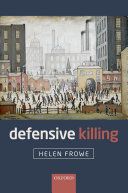
Most people believe that it is sometimes morally permissible for a person to use force to defend herself or others against harm. In Defensive Killing, Helen Frowe offers a detailed exploration of when and why the use of such force is permissible. She begins by considering the use of force between individuals, investigating both the circumstances under which an attacker forfeits her right not to be harmed, and the distinct question of when it is all-things-considered permissible to use force against an attacker. Frowe then extends this enquiry to war, defending the view that we should judge the ethics of killing in war by the moral rules that govern killing between individuals. She argues that this requires us to significantly revise our understanding of the moral status of non-combatants in war. Non-combatants who intentionally contribute to an unjust war forfeit their rights not to be harmed, such that they are morally liable to attack by combatants fighting a just war.
Choice Outstanding Academic Title, 2000.A Choice Outstanding Academic Title for 1999Academic debates about pluralism and truth have become increasingly polarized in recent years. One side embraces extreme relativism, deeming any talk of objective truth as philosophically naive. The opposition, frequently arguing that any sort of relativism leads to nihilism, insists on an objective notion of truth according to which there is only one true story of the world. Both sides agree that there is no middle path.In Truth in Context, Michael Lynch argues that there is a middle path, one where metaphysical pluralism is consistent with a robust realism about truth. Drawing on the work of Hilary Putnam, W. V. O. Quine, and Ludwig Wittgenstein, among others, Lynch develops an original version of metaphysical pluralism, which he calls relativistic Kantianism. He argues that one can take facts and propositions as relative without implying that our ordinary concept of truth is a relative, epistemic, or “soft” concept. The truths may be relative, but our concept of truth need not be.
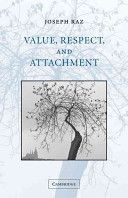
Joseph Raz is one of the world’s leading philosophers of law, and in his Seeley Lectures he reflects critically on one of the central tenets of ethical thought, the view that values are universal. He concludes that we should try to understand what is and what is not entailed by the universality of values, with such an understanding central to the future hopes of mankind, rather than abandoning the belief altogether. This is a concise humane account of some fundamental questions of social existence.
ما از اخلاق چه انتظاری داریم؟ این سوال شاید تاحدودی برای عموم مردم و یا متخصصان این رشته قابل پاسخ باشد؛ اینکه خوب بودن را به ما بیاموزد و در تنظیم روابط فردی م...

جشن کتاب تهران به ایستگاه سی و یکم رسیده است. حال و احوال نشر کتاب خوب نیست و باید فرهنگدوستان را به خرید و هدیه دادن کتاب ترغیب نمود. خانه اخلاقپژوهان جوان ب...

بنیاد کتابهای اخلاق اسلامی عمدتا پالایش جان از آلودگیها و آراستن آن به زیباییها است. اندیشه محوری این قبیل کتابها آن است که انسان فعلی آنی نیست که باید باشد...

-
0 Comments