Notice: تابع WP_Block_Type_Registry::register به طورنادرست فراخوانی شد. نامهای نوع بلوک نباید حروف بزرگ داشته باشند. لطفاً برای اطلاعات بیشتر، اشکال زدایی در وردپرس را مشاهده کنید. (این پیام در نگارش 5.0.0 افزوده شده است.) in /home/ethicsho/public_html/wp-includes/functions.php on line 5313
Warning: Use of undefined constant TDC_PATH_LEGACY - assumed 'TDC_PATH_LEGACY' (this will throw an Error in a future version of PHP) in /home/ethicsho/public_html/wp-content/plugins/td-composer/td-composer.php on line 109
Warning: Use of undefined constant TDSP_THEME_PATH - assumed 'TDSP_THEME_PATH' (this will throw an Error in a future version of PHP) in /home/ethicsho/public_html/wp-content/plugins/td-composer/td-composer.php on line 113 بایگانیهای Social Science / Anthropology / General - خانه اخلاق پژوهان جوان Notice: Trying to access array offset on value of type bool in /home/ethicsho/public_html/wp-content/plugins/wp-ulike/inc/general-functions.php on line 807
A companion volume to Free Will: A Philosophical Study, this new anthology collects influential essays on free will, including both well-known contemporary classics and exciting recent work. Agency and Responsibility: Essays on the Metaphysics of Freedom is divided into three parts. The essays in the first section address metaphysical issues concerning free will and causal determinism. The second section groups papers presenting a positive account of the nature of free action, including competing compatibilist and incompatibilist analyses. The third section concerns free will and moral responsibility, including theories of moral responsibility and the challenge to an alternative possibilities condition posed by Frankurt-type scenarios. Distinguished by its balance and consistently high quality, the volume presents papers selected for their significance, innovation, and clarity of expression. Contributors include Harry Frankfurt, Peter van Inwagen, David Lewis, Elizabeth Anscombe, John Martin Fischer, Michael Bratman, Roderick Chisholm, Robert Kane, Peter Strawson, and Susan Wolf. The anthology serves as an up-to-date resource for scholars as well as a useful text for courses in ethics, philosophy of religion, or metaphysics. In addition, paired with Free Will: A Philosophical Study, it would form an excellent upper-level undergraduate or graduate-level course in free will, responsibility, motivation, or action theory.
“This compilation serves as the ultimate source on all theories and models associated with information privacy and safeguard practices to help anchor and guide the development of technologies, standards, and best practices to meet these challenges”–Provided by publisher.
Alasdair MacIntyre argues that Freud’s conception of the unconscious is complicated by his tendency to use the term in two different ways. MacIntyre shows how Freud uses the term “unconscious” both as a straightforward description of psychological phenomena, and as an evaluative notion to explain the links between childhood events and adult behavior. This clarification helps to shed light on the many misunderstandings of psychoanalysis, and to separate out what is and what is not of lasting value in Freud’s account of the unconscious. This new edition includes a substantial new preface by the author, in which he discusses repression, determinism, transference, and “practical rationality,” and offers a rare comparison of Aristotle and Lacan on the concept of desire. MacIntyre takes the opportunity to reflect both on the reviews and criticisms of the first edition and also on his own philosophical stance.
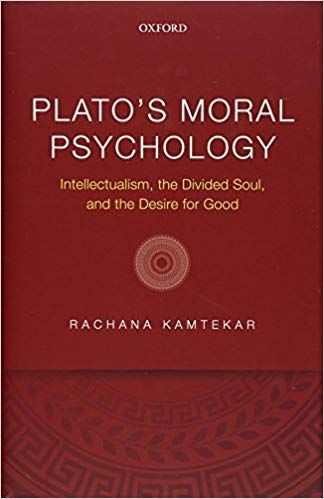
Plato’s Moral Psychology is concerned with Plato’s account of the soul and its impact on our living well or badly, virtuously or viciously. The core of Plato’s moral psychology is his account of human motivation, and Rachana Kamtekar argues that throughout the dialogues Plato maintains that human beings have a natural desire for our own good, and that actions and conditions contrary to this desire are involuntary (from which follows the ‘Socratic paradox’ that wrongdoing is involuntary). Our natural desire for our own good may be manifested in different ways: by our pursuit of what we calculate is best, but also by our pursuit of pleasant or fine things – pursuits which Plato assigns to distinct parts of the soul. Kamtekar develops a very different interpretation of Plato’s moral psychology from the mainstream interpretation, according to which Plato first proposes that human beings only do what we believe to be the best of the things we can do (‘Socratic intellectualism’) and then in the middle dialogues rejects this in favour of the view that the soul is divided into parts with some good-dependent and some good-independent motivations (‘the divided soul’).
“Ernest Sosa extends his distinctive approach to epistemology, intertwining issues concerning the role of the will in judgment and belief with issues of epistemic evaluation. Questions about skepticism and the nature of knowledge are at the forefront. The answers defended are new in their explicit and sustained focus on judgment and epistemic agency. While noting that human knowledge trades on distinctive psychological capacities, Sosa also emphasizes the role of the social in human knowledge. Basic animal knowledge is supplemented by a level of reflective knowledge focused on judgment, and a level of ‘knowing full well’ that is distinctive of the animal that is rational”–
ما از اخلاق چه انتظاری داریم؟ این سوال شاید تاحدودی برای عموم مردم و یا متخصصان این رشته قابل پاسخ باشد؛ اینکه خوب بودن را به ما بیاموزد و در تنظیم روابط فردی م...

جشن کتاب تهران به ایستگاه سی و یکم رسیده است. حال و احوال نشر کتاب خوب نیست و باید فرهنگدوستان را به خرید و هدیه دادن کتاب ترغیب نمود. خانه اخلاقپژوهان جوان ب...

بنیاد کتابهای اخلاق اسلامی عمدتا پالایش جان از آلودگیها و آراستن آن به زیباییها است. اندیشه محوری این قبیل کتابها آن است که انسان فعلی آنی نیست که باید باشد...

-
0 Comments