
Notice: تابع WP_Block_Type_Registry::register به طورنادرست فراخوانی شد. نامهای نوع بلوک نباید حروف بزرگ داشته باشند. لطفاً برای اطلاعات بیشتر، اشکال زدایی در وردپرس را مشاهده کنید. (این پیام در نگارش 5.0.0 افزوده شده است.) in /home/ethicsho/public_html/wp-includes/functions.php on line 5313
Warning: Use of undefined constant TDC_PATH_LEGACY - assumed 'TDC_PATH_LEGACY' (this will throw an Error in a future version of PHP) in /home/ethicsho/public_html/wp-content/plugins/td-composer/td-composer.php on line 109
Warning: Use of undefined constant TDSP_THEME_PATH - assumed 'TDSP_THEME_PATH' (this will throw an Error in a future version of PHP) in /home/ethicsho/public_html/wp-content/plugins/td-composer/td-composer.php on line 113 بایگانیهای Philosophy / Epistemology - خانه اخلاق پژوهان جوان Notice: Trying to access array offset on value of type bool in /home/ethicsho/public_html/wp-content/plugins/wp-ulike/inc/general-functions.php on line 807
This book provides a comprehensive collection of influential essays that present a balanced survey of the major ideas that have come out of this area of study in the last two decades. Each article has been carefully chosen to enable any student of political philosophy to grasp the main debates within the topic. Clearly divided into two parts, Part One deals with fundamental philosophical issues: the nature of social explanation; distributive justice and liberalism and communitarianism. Part Two contains seminal papers in more specific areas: citizenship and multiculturalism; nationalism; democracy and criminal justice. Readings from the following thinkers are included: Lukes, Nozick, Rawls, Parekh, Walzer, Elster, Frankfurt, Gutmann, Barry, Duff, Cohen, Parfit, Taylor, Scruton, von Hirsch, Wright, Sandel, Young, MacIntyre. The readings represent a range of views and demonstrate the richness of the philosophical contribution to political thought. Each section has an introduction by theeditors that situates the papers in the ongoing debate and Further Reading sections feature at the end of each chapter.
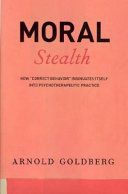
“In Moral Stealth, Goldberg explores and explains that problem of “correct behavior.” He demonstrates that the inflated and official expectations that are part of an analyst’s training – that therapists be universally curious, hopeful, kind, and purposeful, for example – are often of less help than simple empathy amid the ambiguous morality of actual patient interactions. Being a good therapist and being a good person, he argues, are not necessarily the same.” “Drawing on case studies from his own practice and from the experiences of others, as well as on philosophers such as John Dewey, Slavoj Zizek, and Jurgen Habermas, Goldberg breaks new ground and leads the way for therapists to understand the relationship between private morality and clinical practice.”–BOOK JACKET.
When the noted political philosopher Iris Marion Young died in 2006, her death was mourned as the passing of “one of the most important political philosophers of the past quarter-century” (Cass Sunstein) and as an important and innovative thinker working at the conjunction of a number of important topics: global justice; democracy and difference; continental political theory; ethics and international affairs; and gender, race and public policy. In her long-awaited RESPONSIBILITY FOR JUSTICE, Young discusses our responsibilities to address “structural” injustices in which we among many are implicated (but for which we not to blame), often by virtue of participating in a market, such as buying goods produced in sweatshops, or participating in booming housing markets that leave many homeless. Young argues that addressing these structural injustices requires a new model of responsibility, which she calls the “social connection” model. She develops this idea by clarifying the nature of structural injustice; developing the notion of political responsibility for injustice and how it differs from older ideas of blame and guiWith a foreword by Martha C. Nussbaum, this last statement by a revered and highly influential thinker will be of great interest to political theorists and philosophers, ethicists, and feminist and political philosophers. ‘Iris Marion Young’s death in 2006 was a tragic loss for the field of political theory, and this manuscript is evidence of how much she had yet to contribute. Like all her work, it addresses issues of enormous philosophical and political importance, and does so in a way that is original and insightful. It integrates a rich array of examples, concepts, theories and resources, from empirical social science to continental philosophy, and does so in a way that is seamless and effortless… it’s an important manuscript and a fitting testament to Young’s career.”- Will Kymlicka, Philosophy, Queens University ‘[The book] is both very distinctively the work of Iris Marion Young in its topic, style of argument and presentation, but it also makes a number of important contributions to contemporary political philosophy, through trying to work out a ‘social connection’ theory of responsibility. It is particularly impressive in the open way it draws on sources – equally at home discussing Derrida, Sartre and Levinas, as contemporary analytic philosophers such as G.A. Cohen, Alan Buchanan and Robert Goodin.’ Jonathan Wolff, Philosophy, University College London
Russell Hardin presents a new explication of David Hume’s moral and political theory. With Hume, he holds that our normative views can be scientifically explained but they cannot be justified as true. Hume argued for the psychological basis of such views. In particular, he argued for sympathy as the mirroring of the psychological sensations and emotions of others. By placing Hume in the developing tradition of social science, as a strong forerunner of his younger friend Adam Smith, Hardin demonstrates Hume’s strong strategic sense, his nascent utilitarianism, his powerful theory of convention as a main source of social and political order, and his recognition of moral and political theory as a single enterprise.”Worthy of hearty recommendation.”–Lee Hardy, The Review of MetaphysicsRussell Hardin is Professor of Politics at New York University.Preface1. Hume’s Place in History2. Moral Psychology3. Strategic Analysis4. Convention5. Political Theory6. Justice As Order7. Utilitarianism8. Value Theory9. RetrospectiveReferencesEndnotes
ما از اخلاق چه انتظاری داریم؟ این سوال شاید تاحدودی برای عموم مردم و یا متخصصان این رشته قابل پاسخ باشد؛ اینکه خوب بودن را به ما بیاموزد و در تنظیم روابط فردی م...

جشن کتاب تهران به ایستگاه سی و یکم رسیده است. حال و احوال نشر کتاب خوب نیست و باید فرهنگدوستان را به خرید و هدیه دادن کتاب ترغیب نمود. خانه اخلاقپژوهان جوان ب...

بنیاد کتابهای اخلاق اسلامی عمدتا پالایش جان از آلودگیها و آراستن آن به زیباییها است. اندیشه محوری این قبیل کتابها آن است که انسان فعلی آنی نیست که باید باشد...

-
0 Comments