Notice: تابع WP_Block_Type_Registry::register به طورنادرست فراخوانی شد. نامهای نوع بلوک نباید حروف بزرگ داشته باشند. لطفاً برای اطلاعات بیشتر، اشکال زدایی در وردپرس را مشاهده کنید. (این پیام در نگارش 5.0.0 افزوده شده است.) in /home/ethicsho/public_html/wp-includes/functions.php on line 5313
Warning: Use of undefined constant TDC_PATH_LEGACY - assumed 'TDC_PATH_LEGACY' (this will throw an Error in a future version of PHP) in /home/ethicsho/public_html/wp-content/plugins/td-composer/td-composer.php on line 109
Warning: Use of undefined constant TDSP_THEME_PATH - assumed 'TDSP_THEME_PATH' (this will throw an Error in a future version of PHP) in /home/ethicsho/public_html/wp-content/plugins/td-composer/td-composer.php on line 113 بایگانیهای People With Mental Disabilities - Religious Life - خانه اخلاق پژوهان جوان Notice: Trying to access array offset on value of type bool in /home/ethicsho/public_html/wp-content/plugins/wp-ulike/inc/general-functions.php on line 807
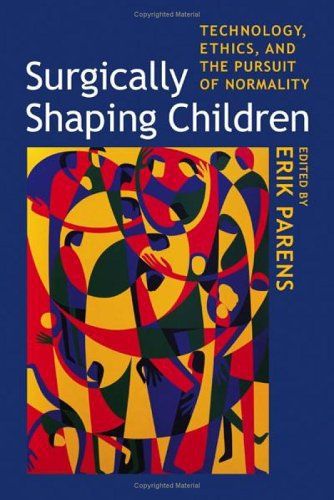
At a time when medical technologies make it ever easier to enhance our minds and bodies, a debate has arisen about whether such efforts promote a process of “normalization,” which makes it ever harder to tolerate the natural anatomical differences among us. The debate becomes especially complicated when it addresses the surgical alteration, or “shaping,” of children. This volume explores the ethical and social issues raised by the recent proliferation of surgeries designed to make children born with physical differences look more normal.Using three cases — surgeries to eliminate craniofacial abnormalities such as cleft lip and palate, surgeries to correct ambiguous genitalia, and surgeries to lengthen the limbs of children born with dwarfism — the contributors consider the tensions parents experience when making such life-altering decisions on behalf of or with their children.The essays in this volume offer in-depth examinations of the significance and limits of surgical alteration through personal narratives, theoretical reflections, and concrete suggestions about how to improve the decision-making process. Written from the perspectives of affected children and their parents, health care providers, and leading scholars in philosophy, sociology, history, law, and medicine, this collection provides an integrated and comprehensive foundation from which to consider a complex and controversial issue. It takes the reader on a journey from reflections on the particulars of current medical practices to reflections on one of the deepest and most complex of human desires: the desire for normality.ContributorsPriscilla Alderson, Adrienne Asch, Cassandra Aspinall, Alice Domurat Dreger, James C. Edwards, Todd C. Edwards, Ellen K. Feder, Arthur W. Frank, Lisa Abelow Hedley, Eva Fedder Kittay, Hilde Lindemann, Jeffery L. Marsh, Paul Steven Miller, Sherri G. Morris, Wendy E. Mouradian, Donald L. Patrick, Nichola Rumsey, Emily Sullivan Sanford, Tari D. Topolski
Race, Rights, and Justice explores questions of the nature of law and constitutional interpretation, international law and global justice, and the nature, function, and importance of rights each from a perspective that takes seriously the realities of race and racism. After a critical assessment of various contemporary theories of law is provided, a new theory of legal interpretation is set forth and defended. The respective words of Immanuel Kant and H. L. A. Hart on the possibility and desirability of international law are carefully explicated. Following this, Race, Rights, and Justice defends John Rawls’ Law of Peoples from the cosmopolitan liberal critique of it. The nature and importance of rights, both individual and collective, are clarified while correcting some political philosophies that have propagated confused rhetoric about rights. And the collective right to humanitarian intervention is investigated philosophically in terms of the recent problems in Colombia, with surprisingly original results. While the methodology of this book is thoroughly analytical, philosophically speaking, some of the conclusions drawn are substantially original, infusing the facts of race and racism into mainstream matters of philosophy of law.”In this collection of essays, J. Angelo Corlett continues his important work of bringing the perspective of indigenous peoples, and more generally of race, into mainstream philosophical debates about justice and rights. Corlett’s book also has very valuable insights into the nature of international law that will greatly enrich our contemporary debates.”Larry May, Washington University in St. Louis, USA”Angelo Corlett is a prolific writer whose work is invariably stimulating, provocative, and insightful. Race, Rights, and Justice is an important addition to the oeuvre. Corlett is not afraid to tackle big problems, and big names. See, for example, his scathing criticisms of Bork and Scalia on constitutional interpretation.”Burleigh T. Wilkins, University of California, Santa Barbara, USA
Defending Life is arguably the most comprehensive defense of the prolife position on abortion – morally, legally, and politically – that has ever been published in an academic monograph. It offers a detailed and critical analysis of Roe v. Wade and Planned Parenthood v. Casey as well as arguments by those who defend a Rawlsian case for abortion-choice, such as J. J. Thomson. The author defends the substance view of persons as the view with the most explanatory power. The substance view entails that the unborn is a subject of moral rights from conception. While defending this view, the author responds to the arguments of thinkers such as Boonin, Dworkin, Stretton, Ford, and Brody. He also critiques Thomson’s famous violinist argument and its revisions by Boonin and McDonagh. Defending Life includes chapters critiquing arguments found in popular politics and the controversy over cloning and stem cell research.
Since its first publication in 1945? Lord Russell’s A History of Western Philosophy has been universally acclaimed as the outstanding one-volume work on the subject — unparalleled in its comprehensiveness, its clarity, its erudition, its grace and wit. In seventy-six chapters he traces philosophy from the rise of Greek civilization to the emergence of logical analysis in the twentieth century. Among the philosophers considered are: Pythagoras, Heraclitus, Parmenides, Empedocles, Anaxagoras, the Atomists, Protagoras, Socrates, Plato, Aristotle, the Cynics, the Sceptics, the Epicureans, the Stoics, Plotinus, Ambrose, Jerome, Augustine, Benedict, Gregory the Great, John the Scot, Aquinas, Duns Scotus, William of Occam, Machiavelli, Erasmus, More, Bacon, Hobbes, Descartes, Spinoza, Leibniz, Locke, Berkeley, Hume, Rousseau, Kant, Hegel, Schopenhauer, Nietzsche, the Utilitarians, Marx, Bergson, James, Dewey, and lastly the philosophers with whom Lord Russell himself is most closely associated — Cantor, Frege, and Whitehead, co-author with Russell of the monumental Principia Mathematica.
ما از اخلاق چه انتظاری داریم؟ این سوال شاید تاحدودی برای عموم مردم و یا متخصصان این رشته قابل پاسخ باشد؛ اینکه خوب بودن را به ما بیاموزد و در تنظیم روابط فردی م...

جشن کتاب تهران به ایستگاه سی و یکم رسیده است. حال و احوال نشر کتاب خوب نیست و باید فرهنگدوستان را به خرید و هدیه دادن کتاب ترغیب نمود. خانه اخلاقپژوهان جوان ب...

بنیاد کتابهای اخلاق اسلامی عمدتا پالایش جان از آلودگیها و آراستن آن به زیباییها است. اندیشه محوری این قبیل کتابها آن است که انسان فعلی آنی نیست که باید باشد...

-
0 Comments