Notice: تابع WP_Block_Type_Registry::register به طورنادرست فراخوانی شد. نامهای نوع بلوک نباید حروف بزرگ داشته باشند. لطفاً برای اطلاعات بیشتر، اشکال زدایی در وردپرس را مشاهده کنید. (این پیام در نگارش 5.0.0 افزوده شده است.) in /home/ethicsho/public_html/wp-includes/functions.php on line 5313
Warning: Use of undefined constant TDC_PATH_LEGACY - assumed 'TDC_PATH_LEGACY' (this will throw an Error in a future version of PHP) in /home/ethicsho/public_html/wp-content/plugins/td-composer/td-composer.php on line 109
Warning: Use of undefined constant TDSP_THEME_PATH - assumed 'TDSP_THEME_PATH' (this will throw an Error in a future version of PHP) in /home/ethicsho/public_html/wp-content/plugins/td-composer/td-composer.php on line 113 بایگانیهای Neoliberalism - خانه اخلاق پژوهان جوان Notice: Trying to access array offset on value of type bool in /home/ethicsho/public_html/wp-content/plugins/wp-ulike/inc/general-functions.php on line 807
In The Ethics of Romanticism Laurence Lockridge vigorously revives ethical criticism and at the same time brings to light the Romantics’ profound engagement with ethical questions. He argues that a will to value is the pervasive motive of Romantic writers from Blake, Wordsworth, Coleridge and De Quincey to Shelley, Hazlitt, Keats and Byron. They articulate a compelling ethics that has had a significant influence on modern thought. Yet its character has never before been systematically explored within the larger contexts of European thought. Lockridge argues that a focus on the ethical dimension of literature is the single most powerful strategy for structuring a writer’s work as a whole, and that it can even prove congenial. He gives original, interrelated readings of the eight major British Romantic writers. In discussing the place of ethical criticism in modern letters, he qualifies or refutes opposing views – conservative, Marxist, and deconstructive. His book gives strong evidence of one direction criticism might fruitfully take in future years.
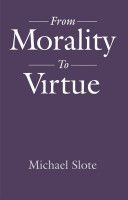
In this book, Slote offers the first full-scale foundational account of virtue ethics to have appeared since the recent revival of interest in the ethics of virtue. Slote advocates a particular form of such ethics for its intuitive and structural advantages over Kantianism, utilitarianism, and common-sense morality, and he argues that the problems of other views can be avoided and a contemporary plausible version of virtue ethics achieved only by abandoning specifically moral concepts for general aretaic notions like admirability and virtue. Although this study is not bound by particular Aristotelian doctrines, it places an Aristotelian emphasis on both self-benefiting and other-benefiting virtues. Slote criticizes Kantian and common-sense morality for internal incoherencies and for downgrading the moral individual and her well-being in some previously unnoticed ways. By contrast, this book defends a distinctive, intuitive, and symmetric ethical principle according to which we should balance self-concern with concern for others, but it also concludes that there is, contrary to utilitarianism, no single basis for status as a virtue nor any simple relation between the virtues and human well-being.
Richard Rorty is famous, maybe even infamous, for his philosophical nonchalance. His groundbreaking work not only rejects all theories of truth but also dismisses modern epistemology and its preoccupation with knowledge and representation. At the same time, the celebrated pragmatist believed there could be no universally valid answers to moral questions, which led him to a complex view of religion rarely expressed in his writings.In this posthumous publication, Rorty, a strict secularist, finds in the pragmatic thought of John Dewey, John Stuart Mill, Henry James, and George Santayana, among others, a political imagination shared by religious traditions. His intent is not to promote belief over nonbelief or to blur the distinction between religious and public domains. Rorty seeks only to locate patterns of similarity and difference so an ethics of decency and a politics of solidarity can rise. He particularly responds to Pope Benedict XVI and his campaign against the relativist vision. Whether holding theologians, metaphysicians, or political ideologues to account, Rorty remains steadfast in his opposition to absolute uniformity and its exploitation of political strength.
ما از اخلاق چه انتظاری داریم؟ این سوال شاید تاحدودی برای عموم مردم و یا متخصصان این رشته قابل پاسخ باشد؛ اینکه خوب بودن را به ما بیاموزد و در تنظیم روابط فردی م...

جشن کتاب تهران به ایستگاه سی و یکم رسیده است. حال و احوال نشر کتاب خوب نیست و باید فرهنگدوستان را به خرید و هدیه دادن کتاب ترغیب نمود. خانه اخلاقپژوهان جوان ب...

بنیاد کتابهای اخلاق اسلامی عمدتا پالایش جان از آلودگیها و آراستن آن به زیباییها است. اندیشه محوری این قبیل کتابها آن است که انسان فعلی آنی نیست که باید باشد...

-
0 Comments