Notice: تابع WP_Block_Type_Registry::register به طورنادرست فراخوانی شد. نامهای نوع بلوک نباید حروف بزرگ داشته باشند. لطفاً برای اطلاعات بیشتر، اشکال زدایی در وردپرس را مشاهده کنید. (این پیام در نگارش 5.0.0 افزوده شده است.) in /home/ethicsho/public_html/wp-includes/functions.php on line 5313
Warning: Use of undefined constant TDC_PATH_LEGACY - assumed 'TDC_PATH_LEGACY' (this will throw an Error in a future version of PHP) in /home/ethicsho/public_html/wp-content/plugins/td-composer/td-composer.php on line 109
Warning: Use of undefined constant TDSP_THEME_PATH - assumed 'TDSP_THEME_PATH' (this will throw an Error in a future version of PHP) in /home/ethicsho/public_html/wp-content/plugins/td-composer/td-composer.php on line 113 بایگانیهای Moral - خانه اخلاق پژوهان جوان Notice: Trying to access array offset on value of type bool in /home/ethicsho/public_html/wp-content/plugins/wp-ulike/inc/general-functions.php on line 807
From the preface: ” The materialist conception of history is not only important because it allows us to explain history better than has been done up to now, but also because it enables us to make history better than has been hitherto done. And the latter is more important than the former. From the progress of the practice our theoretical knowledge grows and in the progress of the practice our theoretical progress is proved. No world-conception has been in so high a degree a philosophy of deeds as the dialectical materialism. Not only upon research but upon deeds do we rely to show the superiority of our philosophy. ” Karl Kautsky (1854-1938), compiler of Karl Marx’s Theories of Surplus Value (1905-10), has been rightly considered the successor of Engels in the intellectual leadership of the Marxian School. Kautsky was the founder of Die Neue Zeit and a political leader of the German Social Democrats. He denounced both Germany’s aggression in World War I as well as the conduct of Russian Bolshevism after the 1917 Revolution. This book was originally published in 1906.
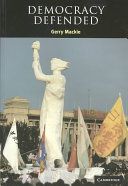
Is there a public good? A prevalent view in political science is that democracy is unavoidably chaotic, arbitrary, meaningless, and impossible. Such scepticism began with Condorcet in the eighteenth century, and continued most notably with Arrow and Riker in the twentieth century. In this powerful book, Gerry Mackie confronts and subdues these long-standing doubts about democratic governance. Problems of cycling, agenda control, strategic voting, and dimensional manipulation are not sufficiently harmful, frequent, or irremediable, he argues, to be of normative concern. Mackie also examines every serious empirical illustration of cycling and instability, including Rikers famous argument that the US Civil War was due to arbitrary dimensional manipulation. Almost every empirical claim is erroneous, and none is normatively troubling, Mackie says. This spirited defence of democratic institutions should prove both provocative and influential.
Normative reasons are reasons to do and believe things. Intellectual inquiry seems to presuppose their existence, for we cannot justifiably conclude that we exist; that there is an external world; and that there are better and worse ways of investigating it and behaving in it, unless there are reasons to do and believe such things. But just what in the world are normative reasons? In this book a case will be made for believing normative reasons are favouring relations that have a single, external source, filling this significant gap in the literature in an area within contemporary philosophy that has quickly grown in prominence. Providing a divine command metanormative analysis of normative reasons on entirely non-religious grounds, its arguments will be relevant to both secular and non-secular audiences alike and will address key issues in meta-ethics, evolutionary theory – especially evolutionary debunking threats to moral reasons and the normative more generally – and epistemology. .
ما از اخلاق چه انتظاری داریم؟ این سوال شاید تاحدودی برای عموم مردم و یا متخصصان این رشته قابل پاسخ باشد؛ اینکه خوب بودن را به ما بیاموزد و در تنظیم روابط فردی م...

جشن کتاب تهران به ایستگاه سی و یکم رسیده است. حال و احوال نشر کتاب خوب نیست و باید فرهنگدوستان را به خرید و هدیه دادن کتاب ترغیب نمود. خانه اخلاقپژوهان جوان ب...

بنیاد کتابهای اخلاق اسلامی عمدتا پالایش جان از آلودگیها و آراستن آن به زیباییها است. اندیشه محوری این قبیل کتابها آن است که انسان فعلی آنی نیست که باید باشد...

-
0 Comments