Notice: تابع WP_Block_Type_Registry::register به طورنادرست فراخوانی شد. نامهای نوع بلوک نباید حروف بزرگ داشته باشند. لطفاً برای اطلاعات بیشتر، اشکال زدایی در وردپرس را مشاهده کنید. (این پیام در نگارش 5.0.0 افزوده شده است.) in /home/ethicsho/public_html/wp-includes/functions.php on line 5313
Warning: Use of undefined constant TDC_PATH_LEGACY - assumed 'TDC_PATH_LEGACY' (this will throw an Error in a future version of PHP) in /home/ethicsho/public_html/wp-content/plugins/td-composer/td-composer.php on line 109
Warning: Use of undefined constant TDSP_THEME_PATH - assumed 'TDSP_THEME_PATH' (this will throw an Error in a future version of PHP) in /home/ethicsho/public_html/wp-content/plugins/td-composer/td-composer.php on line 113 بایگانیهای Moral Conditions - خانه اخلاق پژوهان جوان Notice: Trying to access array offset on value of type bool in /home/ethicsho/public_html/wp-content/plugins/wp-ulike/inc/general-functions.php on line 807
Delineating implications for administrative ethics from other fields such as sociology, psychology, and philosophy, this reference provides a comprehensive review of administrative ethics in the public sector. Detailing the context within which contemporary ethics training has developed, the book examines the effectiveness of ethics training, legal and organizational devices for encouraging desired conduct, and other topics of particular relevance to the political and social contexts of public administration. Written by over 25 leading scholars in public administration ethics, the book creates a taxonomy for administrative ethics using the categories of modern philosophy.
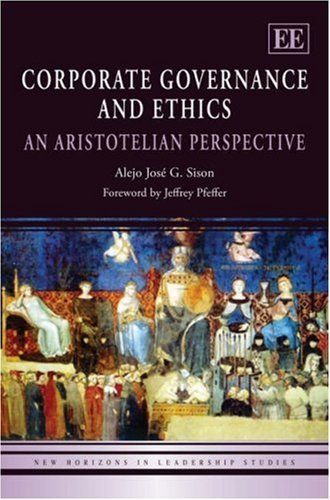
Corporate Governance and Ethics is an illuminating and practical reading of Aristotle’s Politics for today’s corporate directors. With a deft synthesis of ethics, economics and politics, Alejo Sison elevates the discussion of corporate governance out of the realm of abstract rules and structures into a more effective form of Aristotelian politics. He argues that corporate governance is a human practice where subjective, ethical conditions outweigh the mastery of techniques, since the firm is not a mere production function but, above all, a community of workers. Corporate governance issues are discussed in a holistic fashion, using international case studies to embed the discussion in environments defined by their economic, legal and cultural systems. One of the author’s key messages is that reform starts with the ethical and political education of directors.Alejo Sison uses an integrative approach to corporate governance that incorporates ethical-political considerations with the economic and legal dimensions of issues. He backs his theoretical claims with a series of case histories including Fiat from Italy, Cheung Kong Holdings and Whampoa Limited from China, Banco Popular from Spain and United Airlines from the US. He provides a special focus on the education of corporate directors in accordance with the principles of Aristotle’s Politics. This accessible book will appeal to corporate directors, executives and managers; academics and students with an interest in corporate governance, leadership and ethics, corporate citizenship and corporate social responsibility; and modern readers of Aristotle’s virtue theory and politics in relation to business ethics.
Richard Swinburne presents a substantially rewritten and updated edition of his most celebrated book. No other work has made a more powerful case for the probability of the existence of God. Swinburne argues compellingly that the existence of the universe, its law-governed nature and fine-tuning, human consciousness and moral awareness, and evidence of miracles and religious experience, all taken together (and despite the occurrence of pain and suffering), make it likely that there is a God.
For centuries philosophers have wrestled with the dichotomy between individual freedom on the one hand and collective solidarity on the other. Yet today there is a growing realization that this template is fundamentally flawed. In this book, Mark Young embraces and advocates a more holistic concept of freedom; one which is not merely defined negatively but which positively provides the preconditions for individuals to actively exercise their autonomy and to flourish as human beings in the process.Young posits the idea of ‘freedom in community’ and traces its origin back to Aristotle. Taking as his premise that humans are deeply social beings who live their lives intricately interwoven with each other, he examines what type of political community is relevant for us in this post-Classical, post-Enlightenment and, indeed, post-Existential world. Identifying the failure of traditional ‘statist’ models of politics, Young instead argues for a civil society: a globally interlinked and free set of liberal communities as the best context for nourishing human flourishing. In this way we can achieve a proper setting for Eudaimonia in a modern sense.
ما از اخلاق چه انتظاری داریم؟ این سوال شاید تاحدودی برای عموم مردم و یا متخصصان این رشته قابل پاسخ باشد؛ اینکه خوب بودن را به ما بیاموزد و در تنظیم روابط فردی م...

جشن کتاب تهران به ایستگاه سی و یکم رسیده است. حال و احوال نشر کتاب خوب نیست و باید فرهنگدوستان را به خرید و هدیه دادن کتاب ترغیب نمود. خانه اخلاقپژوهان جوان ب...

بنیاد کتابهای اخلاق اسلامی عمدتا پالایش جان از آلودگیها و آراستن آن به زیباییها است. اندیشه محوری این قبیل کتابها آن است که انسان فعلی آنی نیست که باید باشد...

-
0 Comments