



Notice: تابع WP_Block_Type_Registry::register به طورنادرست فراخوانی شد. نامهای نوع بلوک نباید حروف بزرگ داشته باشند. لطفاً برای اطلاعات بیشتر، اشکال زدایی در وردپرس را مشاهده کنید. (این پیام در نگارش 5.0.0 افزوده شده است.) in /home/ethicsho/public_html/wp-includes/functions.php on line 5313
Warning: Use of undefined constant TDC_PATH_LEGACY - assumed 'TDC_PATH_LEGACY' (this will throw an Error in a future version of PHP) in /home/ethicsho/public_html/wp-content/plugins/td-composer/td-composer.php on line 109
Warning: Use of undefined constant TDSP_THEME_PATH - assumed 'TDSP_THEME_PATH' (this will throw an Error in a future version of PHP) in /home/ethicsho/public_html/wp-content/plugins/td-composer/td-composer.php on line 113 بایگانیهای Justice - خانه اخلاق پژوهان جوان Notice: Trying to access array offset on value of type bool in /home/ethicsho/public_html/wp-content/plugins/wp-ulike/inc/general-functions.php on line 807
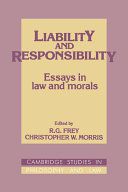
This collection of contemporary essays by a group of well-known philosophers and legal theorists covers various topics in the philosophy of law, focusing on issues concerning liability in contract, tort, and criminal law. The book is divided into four sections. The first provides a conceptual overview of the issues at stake in a philosophical discussion of liability and responsibility. The second, third, and fourth sections present, in turn, more detailed explorations of the roles of notions of liability and responsibility in contracts, torts, and punishment. The collection not only presents some of the most challenging work being done in legal philosophy today, it also demonstrates the interdisciplinary character of the field of philosophy of law, with contributors taking into account recent developments in economics, political science, and rational choice theory. This thought-provoking volume will help to shed light on the underexplored ground that lies between law and morals.
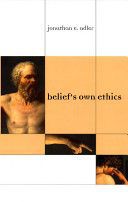
The fundamental question of the ethics of belief is “What ought one to believe?” According to the traditional view of evidentialism, the strength of one’s beliefs should be proportionate to the evidence. Conventional ways of defending and challenging evidentialism rely on the idea that what one ought to believe is a matter of what it is rational, prudent, ethical, or personally fulfilling to believe. Common to all these approaches is that they look outside of belief itself to determine what one ought to believe.In this book Jonathan Adler offers a strengthened version of evidentialism, arguing that the ethics of belief should be rooted in the concept of belief—that evidentialism is belief’s own ethics. A key observation is that it is not merely that one ought not, but that one cannot, believe, for example, that the number of stars is even. The “cannot” represents a conceptual barrier, not just an inability. Therefore belief in defiance of one’s evidence (or evidentialism) is impossible. Adler addresses such questions as irrational beliefs, reasonableness, control over beliefs, and whether justifying beliefs requires a foundation. Although he treats the ethics of belief as a central topic in epistemology, his ideas also bear on rationality, argument and pragmatics, philosophy of religion, ethics, and social cognitive psychology.
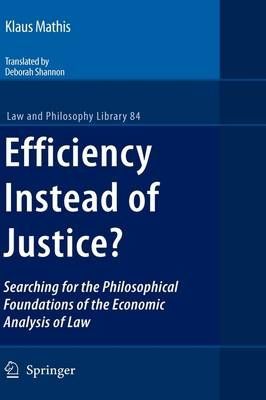
Economic analysis of law is an interesting and challenging attempt to employ the concepts and reasoning methods of modern economic theory so as to gain a deeper understanding of legal problems. According to Richard A. Posner it is the role of the law to encourage market competition and, where the market fails because transaction costs are too high, to simulate the result of competitive markets. This would maximize economic efficiency and social wealth.In this work, the lawyer and economist Klaus Mathis critically appraises Posner’s normative justification of the efficiency paradigm from the perspective of the philosophy of law. Posner acknowledges the influences of Adam Smith and Jeremy Bentham, whom he views as the founders of normative economics. He subscribes to Smith’s faith in the market as an ideal allocation model, and to Bentham’s ethical consequentialism. Finally, aligning himself with John Rawls’s contract theory, he seeks to legitimize his concept of wealth maximization with a consensus theory approach.In his interdisciplinary study, the author points out the possibilities as well as the limits of economic analysis of law. It provides a method of analysing the law which, while very helpful, is also rather specific. The efficiency arguments therefore need to be incorporated into a process for resolving value conflicts. In a democracy this must take place within the political decision-making process. In this clearly written work, Klaus Mathis succeeds in making even non-economists more aware of the economic aspects of the law.
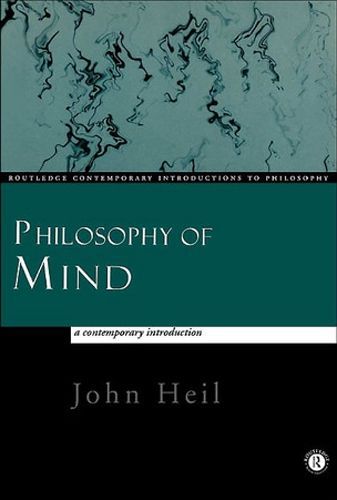
Philosophy of Mind: A Contemporary Introductioncovers the major topics typically studied in philosophy of mind and discusses the dualist, behaviorist, functionalist, interpretationist, and eliminativist accounts of the nature of mind, along with a critical assessment of the recent trends in the subject. This fully revised and updated version of the highly successful first edition builds on the previously addressed themes and expands on central topics. The new edition includes: * A brand new chapter on consciousness * An expansion of the Davidson and Dennett discussions, splitting them into two stand-alone chapters * A chapter looking at general issues associated with present day approaches to the theory of mind
Leading figures in ancient philosophy present nineteen original papers on three key themes in the work of Richard Sorabji. The papers dealing with Metaphysics range from Democritus to Numenius on basic questions about the structure and nature of reality: necessitation, properties, and time. The section on Soul includes one paper on the individuation of souls in Plato and five papers on Aristotle’s and Aristotelian theories of cognition, with a special emphasis on perception. The section devoted to Ethics concentrates upon Stoicism and the complex views the Stoics held on such topics as motivation, akrasia, oikeiosis, and the emotions. It also includes one paper on the influence of Greek ethics in Modern Philosophy. The volume also contains a fascinating “intellectual autobiography” by Sorabji himself, and a full Bibliography of his works.
ما از اخلاق چه انتظاری داریم؟ این سوال شاید تاحدودی برای عموم مردم و یا متخصصان این رشته قابل پاسخ باشد؛ اینکه خوب بودن را به ما بیاموزد و در تنظیم روابط فردی م...

جشن کتاب تهران به ایستگاه سی و یکم رسیده است. حال و احوال نشر کتاب خوب نیست و باید فرهنگدوستان را به خرید و هدیه دادن کتاب ترغیب نمود. خانه اخلاقپژوهان جوان ب...

بنیاد کتابهای اخلاق اسلامی عمدتا پالایش جان از آلودگیها و آراستن آن به زیباییها است. اندیشه محوری این قبیل کتابها آن است که انسان فعلی آنی نیست که باید باشد...

-
0 Comments