Notice: تابع WP_Block_Type_Registry::register به طورنادرست فراخوانی شد. نامهای نوع بلوک نباید حروف بزرگ داشته باشند. لطفاً برای اطلاعات بیشتر، اشکال زدایی در وردپرس را مشاهده کنید. (این پیام در نگارش 5.0.0 افزوده شده است.) in /home/ethicsho/public_html/wp-includes/functions.php on line 5313
Warning: Use of undefined constant TDC_PATH_LEGACY - assumed 'TDC_PATH_LEGACY' (this will throw an Error in a future version of PHP) in /home/ethicsho/public_html/wp-content/plugins/td-composer/td-composer.php on line 109
Warning: Use of undefined constant TDSP_THEME_PATH - assumed 'TDSP_THEME_PATH' (this will throw an Error in a future version of PHP) in /home/ethicsho/public_html/wp-content/plugins/td-composer/td-composer.php on line 113 بایگانیهای Individualism - خانه اخلاق پژوهان جوان Notice: Trying to access array offset on value of type bool in /home/ethicsho/public_html/wp-content/plugins/wp-ulike/inc/general-functions.php on line 807
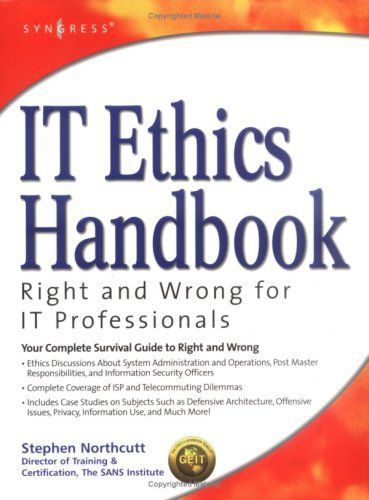
The target audience for this book is any IT professional responsible for designing, configuring, deploying or managing information systems. This audience understands that the purpose of ethics in information security is not just morally important; it equals the survival of their business. A perfect example of this is Enron. Enron’s ultimate failure due to a glitch in the ethics systems of the business created the most infamous example of an ethics corporate breakdown resulting in disaster. Ethics is no longer a matter of morals anymore when it comes to information security; it is also a matter of success or failure for big business. * This groundbreaking book takes on the difficult ethical issues that IT professional confront every day. * The book provides clear guidelines that can be readily translated into policies and procedures. * This is not a text book. Rather, it provides specific guidelines to System Administrators, Security Consultants and Programmers on how to apply ethical standards to day-to-day operations.
The book is a critical review of accountability conducted under the authority of the United Nations Security Council, by the International Criminal Tribunal for Rwanda (ICTR), and the United Nations Transitional Administration in East Timor (UNTAET). It is centred on two case studies: the 1999 events in Rwanda, which constituted genocide, “the crime of crimes”, and the 1999 mayhem in East Timor. The books subjects to testing cross-examination tools to hold accountable persons with “the greatest responsibility” for serious international humanitarian law violations.A detailed expose is made of conspiracy to commit genocide. Comparison is also made whether joint criminal enterprise, and the forms of co-perpetration embodied in the Statute of the International Criminal Court provide effective alternatives in the case of atrocity crimes. A unique aspect of the book is its high-light of lessons learn in prosecution strategies; approaches in profiling perpetrators, particularly those with the highest level of responsibility for international humanitarian law violations; victor’s justice; superior responsibility; guilty pleas, and the effectiveness of the East Timor and the Indonesian Ad Hoc Human Rights Court processes. In the final analysis, the book offers a Matrix on Accountability.
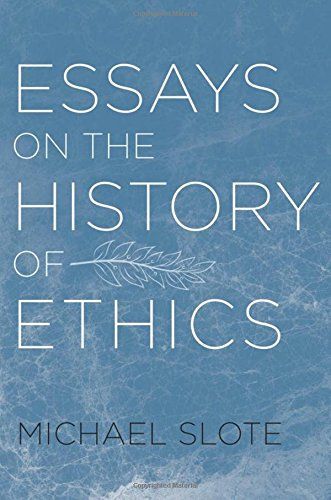
In Essays on the History of Ethics Michael Slote collects his essays that deal with aspects of both ancient and modern ethical thought and seek to point out conceptual/normative comparisons and contrasts among different views. Arranged in chronological order of the philosopher under discussion, the relationship between ancient ethical theory and modern moral philosophy is a major theme of several of the papers and, in particular, Plato, Aristotle, Hume, Kant, and/or utilitarianism feature centrally in (most of) the discussions. One essay seeks to show that there are three main ways to conceive the relationship between human well-being and virtue: one is dualistic a la Kant (they are disparate notions); one is the sort of reductionism familiar from the history of utilitarianismm; and one, not previously named by philosophers, is implicit in the approach the Stoics, Plato, and Aristotle take (in their different ways) to the topic of virtue and well-being. Slote names this third approach “elevationism” and argue that it is more promising than either reductionism or dualism. Two of the essays are narrowly focused on Hume’s ethics, and one seeks to show that even Kant’s opponents have reason to accept a number of important and original Kantian ideas. Finally, the two last essays in the volume talk about ethical thought during the last half of the twentieth century and the first few years of the twenty-first, arguing that the care ethics of Carol Gilligan and Nel Noddings has a distinctive and important contribution to make to ongoing ethical theorizing–and to our understanding of the history of ethics as well.
In this book, Weikart helps unlock the mystery of Hitler’s evil by vividly demonstrating the surprising conclusion that Hitler’s immorality flowed from a coherent ethic. Hitler was inspired by evolutionary ethics to pursue the utopian project of biologically improving the human race. This ethic underlay or influenced almost every major feature of Nazi policy: eugenics (i.e., measures to improve human heredity, including compulsory sterilization), euthanasia, racism, population expansion, offensive warfare, and racial extermination.
ما از اخلاق چه انتظاری داریم؟ این سوال شاید تاحدودی برای عموم مردم و یا متخصصان این رشته قابل پاسخ باشد؛ اینکه خوب بودن را به ما بیاموزد و در تنظیم روابط فردی م...

جشن کتاب تهران به ایستگاه سی و یکم رسیده است. حال و احوال نشر کتاب خوب نیست و باید فرهنگدوستان را به خرید و هدیه دادن کتاب ترغیب نمود. خانه اخلاقپژوهان جوان ب...

بنیاد کتابهای اخلاق اسلامی عمدتا پالایش جان از آلودگیها و آراستن آن به زیباییها است. اندیشه محوری این قبیل کتابها آن است که انسان فعلی آنی نیست که باید باشد...

-
0 Comments