Notice: تابع WP_Block_Type_Registry::register به طورنادرست فراخوانی شد. نامهای نوع بلوک نباید حروف بزرگ داشته باشند. لطفاً برای اطلاعات بیشتر، اشکال زدایی در وردپرس را مشاهده کنید. (این پیام در نگارش 5.0.0 افزوده شده است.) in /home/ethicsho/public_html/wp-includes/functions.php on line 5313
Warning: Use of undefined constant TDC_PATH_LEGACY - assumed 'TDC_PATH_LEGACY' (this will throw an Error in a future version of PHP) in /home/ethicsho/public_html/wp-content/plugins/td-composer/td-composer.php on line 109
Warning: Use of undefined constant TDSP_THEME_PATH - assumed 'TDSP_THEME_PATH' (this will throw an Error in a future version of PHP) in /home/ethicsho/public_html/wp-content/plugins/td-composer/td-composer.php on line 113 بایگانیهای Foreign Trade Regulation - Moral And Ethical Aspects - خانه اخلاق پژوهان جوان Notice: Trying to access array offset on value of type bool in /home/ethicsho/public_html/wp-content/plugins/wp-ulike/inc/general-functions.php on line 807
Paternalistic intervention, especially in the context of modern medicine and health care, is the topical issue of The Limits of Medical Paternalism. Dr Hayry aims to define and morally assess paternalistic interventions through a defined conceptual background. The method employed for this purpose is that of applied philosophical ethics in the analytic tradition. It is argued that there is a marked distinction between strong and weak paternalism. Strong paternalism is defined as the violation of autonomy of a patient ‘in her own best interest’ when the person is capable of autonomous decision-making in matters that concern primarily only herself. Weak paternalism is the violation of autonomy when a person is temporarily incapable of self-determined decision-making; it is therefore sometimes justifiable. The application of these views is that no overall a priori judgement concerning the rights and wrongs of such medical intervention is possible.
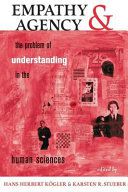
How do we, as interpreters and theorists in the human and social sciences, understand agency? What are the methods, models, and mediating theoretical frameworks that allow us to give a reliable and adequate account of beliefs, actions, and cultural practices? More specifically, how can we as interpretive analysts employ our own cognitive capacities so as to render the beliefs, intentions, and actions of other human beings intelligible? These are the leading questions that a group of well-established social philosophers explore in this volume in light of the most recent (and hotly debated) findings in cognitive science, developmental psychology, and philosophy of mind. In particular, the debate concerning simulation — whether agents interpret others by means of implicit theoretical assumptions, or whether they rather simulate their behavior by putting themselves in their shoes — has produced a wide set of important empirical and philosophical insights. This book takes up those insights and discusses their impact in the context of their most important paradigms in social methodology today.A systematic introduction pertaining to the understanding-explanation debate sets the stage, followed by eleven chapters representing the different approaches tot he field. The paradigms include Wittgensteinian, Davidsonian and Diltheyan approaches, hermeneutics and critical theory, game theory, naturalized epistemology, philosophy of history and twentieth-century social theory, as well as simulation approach proper. As stake are the relation between everyday and social-scientific interpretation, the role of empathy (or role-taking) in understanding human agency, the implications of attributing rationality in the course of interpretation, as well as the relation between rational and causal models in social explanation. The discussions cut across well-established disciplinary boundaries so that the book appeals to both analytic and hermeneutic traditions within philosophy. In addition, the book speaks to all who are engaged in interpreting or explaining human agency in the cultural and social sciences.
This collection of essays is concerned with deepening our understanding of the notion of intention, and the commitment involved in intending, exploring its implications for our understanding of temptation and self-control.
The Groundwork of the Metaphysics of Morals is Kant’s central contribution to moral philosophy, and has inspired controversy ever since it was first published in 1785. Kant champions the insights of ‘common human understanding’ against what he sees as the dangerous perversions of ethical theory. Morality is revealed to be a matter of human autonomy: Kant locates the source of the ‘categorical imperative’ within each and every human will. However, he also portrays everyday morality in a way that many readers find difficult to accept. The Groundwork is a short book, but its argument is dense, intricate and at times treacherous. This commentary explains Kant’s arguments paragraph by paragraph, and also contains an introduction, a synopsis of the argument, six short interpretative essays on key topics of the Groundwork, and a glossary of key terms. It will be an indispensable tool for anyone wishing to study the Groundwork in detail.
ما از اخلاق چه انتظاری داریم؟ این سوال شاید تاحدودی برای عموم مردم و یا متخصصان این رشته قابل پاسخ باشد؛ اینکه خوب بودن را به ما بیاموزد و در تنظیم روابط فردی م...

جشن کتاب تهران به ایستگاه سی و یکم رسیده است. حال و احوال نشر کتاب خوب نیست و باید فرهنگدوستان را به خرید و هدیه دادن کتاب ترغیب نمود. خانه اخلاقپژوهان جوان ب...

بنیاد کتابهای اخلاق اسلامی عمدتا پالایش جان از آلودگیها و آراستن آن به زیباییها است. اندیشه محوری این قبیل کتابها آن است که انسان فعلی آنی نیست که باید باشد...

-
0 Comments