Notice: تابع WP_Block_Type_Registry::register به طورنادرست فراخوانی شد. نامهای نوع بلوک نباید حروف بزرگ داشته باشند. لطفاً برای اطلاعات بیشتر، اشکال زدایی در وردپرس را مشاهده کنید. (این پیام در نگارش 5.0.0 افزوده شده است.) in /home/ethicsho/public_html/wp-includes/functions.php on line 5313
Warning: Use of undefined constant TDC_PATH_LEGACY - assumed 'TDC_PATH_LEGACY' (this will throw an Error in a future version of PHP) in /home/ethicsho/public_html/wp-content/plugins/td-composer/td-composer.php on line 109
Warning: Use of undefined constant TDSP_THEME_PATH - assumed 'TDSP_THEME_PATH' (this will throw an Error in a future version of PHP) in /home/ethicsho/public_html/wp-content/plugins/td-composer/td-composer.php on line 113 بایگانیهای Electronic Encyclopedias - خانه اخلاق پژوهان جوان Notice: Trying to access array offset on value of type bool in /home/ethicsho/public_html/wp-content/plugins/wp-ulike/inc/general-functions.php on line 807
Behind headlines on the conflict in Iraq and global terrorism, a much deeper battle is raging over children and the values they should adopt. Political and religious leaders including Blair and Bush have been joined the popular press in Enlightenment-bashing and bitter attacks on “liberal parenting,” calling for a return to authority and religious tradition. How do we raise good children? How do we make good citizens? In defiant yet acute fashion, Stephen Law urges us to re-evaluate the liberal tradition of thinking about morality. Tackling authoritarian rhetoric head-on, he argues that children should learn about right and wrong and respect for others, but that their education should be grounded in the hard-won values of the Enlightenment. Taking on neo-conservatives and religious and media commentators, The War for Children’s Minds is a candid and controversial call for a liberal, philosophically informed approach to raising children. Rejecting accusations that liberal parenting is aSixties hangover that entails an aimless “whatever” attitude to morality, Stephen Law exposes the weaknesses of arguments calling for a return to authoritarian styles of moral education. He clearly shows that thinking for oneself does not mean that all moral points of view are equally good, or that we must reject faith in order to think freely. A staunch defence of the humane, liberal life The War for Children’s Minds is a much-needed guide to an urgent moral conundrum.
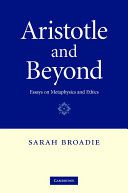
Aristotle’s Nicomachean Ethics, which equates the ultimate end of human life with happiness (eudaimonia), is thought by many readers to argue that this highest goal consists in the largest possible aggregate of intrinsic goods. Richard Kraut proposes instead that Aristotle identifies happiness with only one type of good: excellent activity of the rational soul. In defense of this reading, Kraut discusses Aristotle’s attempt to organize all human goods into a single structure, so that each subordinate end is desirable for the sake of some higher goal.This book also emphasizes the philosopher’s hierarchy of natural kinds, in which every type of creature achieves its good by imitating divine life. As Kraut argues, Aristotle’s belief that thinking is the sole activity of the gods leads him to an intellectualist conception of the ethical virtues. Aristotle values these traits because, by subordinating emotion to reason, they enhance our ability to lead a life devoted to philosophy or politics.
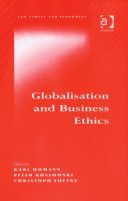
Offers an extensive and probing ethical analysis of economic globalisation. This innovative and highly informative book on globalisation and business ethics will set the tone for the debate on this important issue in the coming years, and will be an invaluable source of information for everyone committed to the global economic responsibilities of businesses and governments. Ron Jeurissen, Professor of business ethics, Nyenrode Business Universiteit/ European Institute for Business Ethics, The Netherlands This volume takes an interdisciplinary approach to provide a theoretical overview of how business ethics deals with the phenomenon of globalization. The authors first examine the origins and development of globalization and its interaction with business ethics, before discussing the impact on and role of national and multinational corporations. The book goes on to examine the relationship between industrialized and developing countries, and explores the place of ethics in globalized markets. Contents: Introduction; Part I Globalisation: Concepts and Problems: Globalisation from a business ethics point of view, Karl Homann; Concepts of globalisation: the institutional prerequisites for the integration of world markets, Michael Ehret, Michaela Haase and Martin Kaluza; Diagnoses of our time: theoretical approaches to the globalised age, Manfred Prisching; Globalisation as a gendered process: a differentiated survey on feminist and postcolonial perspectives, Silvia Bauer and Tatjana Schönwälder- Kuntze. Part II Globalisation, Business and Corporate Governance: Globalisation of corporate governance, Klaus J. Hopt; Business ethics in globalised financial markets, Peter Koslowki; Transparency and integrity: contrary concepts?, Frits Schipper; Tangible ethics: commitments in business organisations, Eberhard Schnebel and Margo A. Bienert. Part III Global Justice: A theory of global justice focussing on absolute poverty, Elke Mack; Just relations between North and South in international financial markets, Bernhard Emunds; Access to essential medicines: global justice beyond equality, Georg Marckmann and Matthis Synofzik. Part IV Globalisation, Philosophy and Culture: Social glue under conditions of globalisation: philosophers on essential normative resources, Christopher Lütge; Sovereignty of interpretation: a dubious model of cultural globalisation, Michael Neuner; Index. About the Author: Karl Homann is Professor and Chair for Philosophy and Economics at the University of Munich, Germany. Peter Koslowski is Professor of Philosophy, especially Philosophy of Management and Organizations and History of Philosophy, at the Free University Amsterdam, The Netherlands. Christoph Luetge is Assistant Professor in the Department of Philosophy, and Chair for Philosophy and Economics at the University of Munich, Germany.
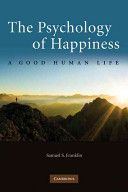
When Thomas Jefferson placed “the pursuit of happiness” along with life and liberty in The Declaration of Independence he was most likely referring to Aristotle’s concept of happiness, or eudaimonia. Eudaimonia is not about good feelings but rather the fulfillment of human potentials. Fulfillment is made possible by virtue; the moderation of desire and emotion by reason. The Psychology of Happiness is the first book to bring together psychological, philosophical, and physiological theory and research in support of Aristotle’s view. It examines the similarity between Aristotle’s concept of virtue and modern cognitive theories of emotion. It discusses the discovery of human potentials, the development of virtue and its neurological basis, the mistaken idea that fulfillment is selfish, and several other issues related to the pursuit of a good human life.
ما از اخلاق چه انتظاری داریم؟ این سوال شاید تاحدودی برای عموم مردم و یا متخصصان این رشته قابل پاسخ باشد؛ اینکه خوب بودن را به ما بیاموزد و در تنظیم روابط فردی م...

جشن کتاب تهران به ایستگاه سی و یکم رسیده است. حال و احوال نشر کتاب خوب نیست و باید فرهنگدوستان را به خرید و هدیه دادن کتاب ترغیب نمود. خانه اخلاقپژوهان جوان ب...

بنیاد کتابهای اخلاق اسلامی عمدتا پالایش جان از آلودگیها و آراستن آن به زیباییها است. اندیشه محوری این قبیل کتابها آن است که انسان فعلی آنی نیست که باید باشد...

-
0 Comments