Notice: تابع WP_Block_Type_Registry::register به طورنادرست فراخوانی شد. نامهای نوع بلوک نباید حروف بزرگ داشته باشند. لطفاً برای اطلاعات بیشتر، اشکال زدایی در وردپرس را مشاهده کنید. (این پیام در نگارش 5.0.0 افزوده شده است.) in /home/ethicsho/public_html/wp-includes/functions.php on line 5313
Warning: Use of undefined constant TDC_PATH_LEGACY - assumed 'TDC_PATH_LEGACY' (this will throw an Error in a future version of PHP) in /home/ethicsho/public_html/wp-content/plugins/td-composer/td-composer.php on line 109
Warning: Use of undefined constant TDSP_THEME_PATH - assumed 'TDSP_THEME_PATH' (this will throw an Error in a future version of PHP) in /home/ethicsho/public_html/wp-content/plugins/td-composer/td-composer.php on line 113 بایگانیهای Copyright/ Electronic Information Resources - خانه اخلاق پژوهان جوان Notice: Trying to access array offset on value of type bool in /home/ethicsho/public_html/wp-content/plugins/wp-ulike/inc/general-functions.php on line 807
A companion volume to Free Will: A Philosophical Study, this new anthology collects influential essays on free will, including both well-known contemporary classics and exciting recent work. Agency and Responsibility: Essays on the Metaphysics of Freedom is divided into three parts. The essays in the first section address metaphysical issues concerning free will and causal determinism. The second section groups papers presenting a positive account of the nature of free action, including competing compatibilist and incompatibilist analyses. The third section concerns free will and moral responsibility, including theories of moral responsibility and the challenge to an alternative possibilities condition posed by Frankurt-type scenarios. Distinguished by its balance and consistently high quality, the volume presents papers selected for their significance, innovation, and clarity of expression. Contributors include Harry Frankfurt, Peter van Inwagen, David Lewis, Elizabeth Anscombe, John Martin Fischer, Michael Bratman, Roderick Chisholm, Robert Kane, Peter Strawson, and Susan Wolf. The anthology serves as an up-to-date resource for scholars as well as a useful text for courses in ethics, philosophy of religion, or metaphysics. In addition, paired with Free Will: A Philosophical Study, it would form an excellent upper-level undergraduate or graduate-level course in free will, responsibility, motivation, or action theory.
AN INVITATION TO POLITICAL THOUGHT is a student-friendly introductory text/reader for political theory that includes a clearly guided explanation of western political thought from Plato to Nietzsche with accompanying primary sources. AN INVITATION TO POLITICAL THOUGHT thus saves the student money by uniquely combining both explanatory essays and primary sources in a single volume. Each chapter begins with an examination of the life of and legacy of an epic political thinker and then proceeds to unpack that thinker’s core teaching on such enduring questions as human nature, state and society, justice, political obligation, war and peace, political education, gender and politics, rights and revolution. Other pedagogical features include case studies that relate the material to current events, questions for reflection, a list of key terms, a list of sources, and helpful websites for further reading.
This evocative and broad-ranging book traces the history of moral regulation in Britain and the US from the late seventeenth century to the present day. Specific coverage is given to movements such as the Society for the Reformation of Manners and the Vice Society, the sexual abuse and anti-pornography movements, and contemporary self-help movements. Hunt argues that the main impetus for moral regulations often stems from the middle classes, rather than those with institutional power, but most significantly they provide classic instances of the intimate link between the ‘governance of others’ and the ‘governance of the self’. Using the work of Foucault, this book analyses how projects of self-regulation can manifest themselves into the regulation of others. Concurrent with this is the rise of health discourses, which play a central role in contemporary discussions of moral governance.
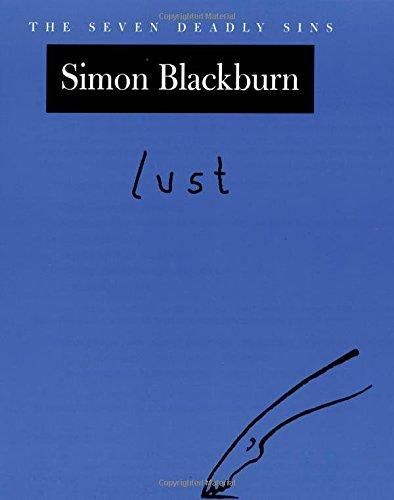
Lust, says Simon Blackburn, is furtive, headlong, always sizing up opportunities. It is a trail of clothing in the hallway, the trashy cousin of love. But be that as it may, the aim of this delightful book is to rescue lust “from the denunciations of old men of the deserts, to deliver it from the pallid and envious confessor and the stocks and pillories of the Puritans, to drag it from the category of sin to that of virtue.” Blackburn, author of such popular philosophy books as Think and Being Good, here offers a sharp-edged probe into the heart of lust, blending together insight from some of the world’s greatest thinkers on sex, human nature, and our common cultural foibles. Blackburn takes a wide ranging, historical approach, discussing lust as viewed by Aristophanes and Plato, lust in the light of the Stoic mistrust of emotion, and the Christian fear of the flesh that catapulted lust to the level of deadly sin. He describes how philosophical pessimists like Schopenhauer and Sartre contributed to our thinking about lust and explores the false starts in understanding lust represented by Freud, Kinsey, and modern “evolutionary psychology.” But most important, Blackburn reminds us that lust is also life-affirming, invigorating, fun. He points to the work of David Hume (Blackburn’s favorite philosopher) who saw lust not only as a sensual delight but also “a joy of the mind.” Written by one of the most eminent living philosophers, attractively illustrated and colorfully packaged, Lust is a book that anyone would lust over.
ما از اخلاق چه انتظاری داریم؟ این سوال شاید تاحدودی برای عموم مردم و یا متخصصان این رشته قابل پاسخ باشد؛ اینکه خوب بودن را به ما بیاموزد و در تنظیم روابط فردی م...

جشن کتاب تهران به ایستگاه سی و یکم رسیده است. حال و احوال نشر کتاب خوب نیست و باید فرهنگدوستان را به خرید و هدیه دادن کتاب ترغیب نمود. خانه اخلاقپژوهان جوان ب...

بنیاد کتابهای اخلاق اسلامی عمدتا پالایش جان از آلودگیها و آراستن آن به زیباییها است. اندیشه محوری این قبیل کتابها آن است که انسان فعلی آنی نیست که باید باشد...

-
0 Comments