

Notice: تابع WP_Block_Type_Registry::register به طورنادرست فراخوانی شد. نامهای نوع بلوک نباید حروف بزرگ داشته باشند. لطفاً برای اطلاعات بیشتر، اشکال زدایی در وردپرس را مشاهده کنید. (این پیام در نگارش 5.0.0 افزوده شده است.) in /home/ethicsho/public_html/wp-includes/functions.php on line 5313
Warning: Use of undefined constant TDC_PATH_LEGACY - assumed 'TDC_PATH_LEGACY' (this will throw an Error in a future version of PHP) in /home/ethicsho/public_html/wp-content/plugins/td-composer/td-composer.php on line 109
Warning: Use of undefined constant TDSP_THEME_PATH - assumed 'TDSP_THEME_PATH' (this will throw an Error in a future version of PHP) in /home/ethicsho/public_html/wp-content/plugins/td-composer/td-composer.php on line 113 بایگانیهای Computers - خانه اخلاق پژوهان جوان Notice: Trying to access array offset on value of type bool in /home/ethicsho/public_html/wp-content/plugins/wp-ulike/inc/general-functions.php on line 807
If globalization is to be a benefit and not a burden to humankind, it must be governed by global institutions that are perceived by all people to be democratic and just. But before we can create such institutions, we must imagine them, and that requires a rethinking and extension of normative political theory. Global Justice and Transnational Politics encourages and advances that work.The book’s first part, “Weak Universalism,” contains essays by Amartya Sen and Leif Wenar that offer constructive developments of John Rawls’s statement of the principles a liberal polity might reasonably propose to govern its relations with other peoples. The second part, “Strong Universalism and Transnational Commitments,” contains essays by Jurgen Habermas, David Luban, Martha Nussbaum, and Thomas Pogge examining the normative sources and possible types of cross-border commitments. In the third part, “Transnational Politics and National Identities,” Habermas discusses the possibility of a democratic political order developing within the institutional framework of the European Union; Thomas McCarthy draws on Kant to show how cosmopolitanism might be reconciled with the legacy of nationalism; and Craig Calhoun tries to retrieve a positive aspect of the tradition of nationalism, namely that it provides large populations with a powerful way of imagining political community across space and time.
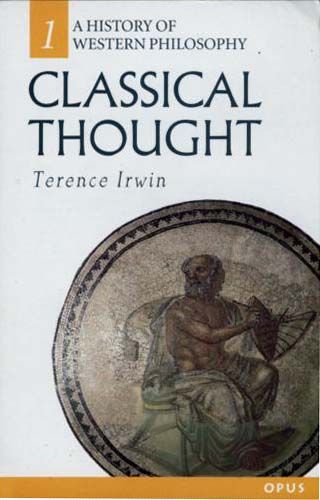
Covering over 1000 years of classical philosophy from Homer to Saint Augustine, this accessible, comprehensive study details the major philosophies and philosophers of the period–the Pre-Socratics, Socrates, Plato, Aristotle, Stoicism, Epicureanism, and Neoplatonism. Though the emphasis is on questions of philosophical interest, particularly ethics, the theory of knowledge, philosophy of mind, and philosophical theology, Irwin includes discussions of the literary and historical background to classical philosophy as well as the work of other important thinkers–Greek tragedians, historians, medical writers, and early Christian writers. The most complete one-volume introduction to ancient philosophy available, the book will be an invaluable survey for students of philosophy and classics and general readers.
What motivates us to be altruistic? How did an altruistic trait evolve in humans, given that evolutionary theory assumes we are self-interested? What sorts of people are altruistic and in what circumstances? Is the welfare state a channel for altruism or does it crowd out people’s altruistic motivations? This accessible book is the first introduction to the idea of altruism. It explores how we have come to be altruistic, and considers why it is important to remain altruistic, not just for the sake of others, but in order maintain the fragile fabric of human society. The book surveys the history of the concept of altruism and examines it from a variety of disciplinary perspectives, including moral philosophy, evolutionary biology, psychology, economics and political science. It then attempts to bring together the distinct issues and concerns of these disciplines to arrive at a unified understanding of altruism. The rational self-interested individual of economics is compared with the altruist who exhibits the virtues of empathy, compassion and benevolence. The book also discusses heroic altruism, such as that displayed by rescuers of Jews in Nazi-occupied Europe, and psychological experiments which seek to identify the altruistic trait. Scott and Seglow argue that altruism is easily extinguished and hard to nourish, but vital for a fundamentally human future. Academics and students in social sciences and philosophy will find Altruism of great interest. So too will professionals in the voluntary and charitable sectors and journalists involved in communicating social scientific and philosophical ideas to the public.
This book is an interpretation of Alexis de Tocqueville’s moral and political thought and sheds new light on his ideas concerning the relationship between liberalism and democracy. This study is highly innovative as it portrays Tocqueville’s liberalism as a synthesis between modern thought and Christian apology. Tocqueville remains an important figure sociology, politics, and philosophy, and the themes addressed in his work — religion, the press, racism, the role of government — are highly relevant today.This book discusses a wide range of Tocqueville’s writings, including many that are unavailable or not readily available in English thus providing a new, much-needed understanding of the centrality of religion in Tocqueville’s work.
ما از اخلاق چه انتظاری داریم؟ این سوال شاید تاحدودی برای عموم مردم و یا متخصصان این رشته قابل پاسخ باشد؛ اینکه خوب بودن را به ما بیاموزد و در تنظیم روابط فردی م...

جشن کتاب تهران به ایستگاه سی و یکم رسیده است. حال و احوال نشر کتاب خوب نیست و باید فرهنگدوستان را به خرید و هدیه دادن کتاب ترغیب نمود. خانه اخلاقپژوهان جوان ب...

بنیاد کتابهای اخلاق اسلامی عمدتا پالایش جان از آلودگیها و آراستن آن به زیباییها است. اندیشه محوری این قبیل کتابها آن است که انسان فعلی آنی نیست که باید باشد...

-
0 Comments