Notice: تابع WP_Block_Type_Registry::register به طورنادرست فراخوانی شد. نامهای نوع بلوک نباید حروف بزرگ داشته باشند. لطفاً برای اطلاعات بیشتر، اشکال زدایی در وردپرس را مشاهده کنید. (این پیام در نگارش 5.0.0 افزوده شده است.) in /home/ethicsho/public_html/wp-includes/functions.php on line 5313
Warning: Use of undefined constant TDC_PATH_LEGACY - assumed 'TDC_PATH_LEGACY' (this will throw an Error in a future version of PHP) in /home/ethicsho/public_html/wp-content/plugins/td-composer/td-composer.php on line 109
Warning: Use of undefined constant TDSP_THEME_PATH - assumed 'TDSP_THEME_PATH' (this will throw an Error in a future version of PHP) in /home/ethicsho/public_html/wp-content/plugins/td-composer/td-composer.php on line 113 بایگانیهای Brain Death - خانه اخلاق پژوهان جوان Notice: Trying to access array offset on value of type bool in /home/ethicsho/public_html/wp-content/plugins/wp-ulike/inc/general-functions.php on line 807
Criminal proceedings in which people can lose life, liberty, or reputation tell us a great deal about the character of any society. In Japan, it is prosecutors who wield the greatest control over these values and who therefore reveal most clearly the character of the Japanese way of justice. In this book, David T. Johnson portrays Japanese prosecutors at work; the social, political, and legal contexts that enable and constrain their actions; and the content of the justice thereby delivered. Johnson is the first researcher, Japanese or foreign, to gain access to the frontline prosecutors who charge cases and the backstage prosecutors who manage and direct them. He shows that prosecutors in Japan frequently harmonize to imperlatives of justice that Americans often regard as irreconcilable: the need to individualize cases alike. However, their capacity to correct offenders and to obtain contrite, complete confessions from criminal suspects. Johnson argues that this extreme reliance on confessions occasionally leads to extreme efforts to extract them. Indeed, much of the most disturbing prosecutor behavior springs directly or indirectly from the system’s inordinate dependence on admissions of guilt. The major achievements of Japanese criminal justice are thus inextricably intertwined with its most notable defects, and efforts to fix the defects threaten to undermine the accomplishments. Clearly written and skillfully argued, this comparative analysis will be of interest to students of Japan, criminology, and law and society. It illuminates unexplored realms in Japan’s criminal justice system while challenging readers to examine their assumptions about how crime should be prosecuted in their own systems of criminal justice.
Bonnie Steinbock presents The Oxford Handbook of Bioethics –an authoritative, state-of-the-art guide to current issues in bioethics. Thirty-four contributors reflect the interdisciplinarity that is characteristic of bioethics, and its increasingly international character. Thirty topics are covered in original essays written by some of the world’s leading figures in the field, as well as by some newer “up-and-comers.” The essays address both perennial issues, such as the methodology of bioethics, autonomy, justice, death, and moral status, and newer issues, such as biobanking, stem cell research, cloning, pharmacogenomics, and bioterrorism. Other topics concern mental illness and moral agency, the rule of double effect, justice and the elderly, the definition of death, organ transplantation, feminist approaches to commodification of the body, life extension, advance directives, physician-assisted death, abortion, genetic research, population screening, enhancement, research ethics, and the implications of public and global health for bioethics. Anyone who wants to know how the central debates in bioethics have developed in recent years, and where the debates are going, will want to consult this book. It will be an invaluable resource not only for scholars and graduate students in bioethics, but also for those in philosophy, medicine, law, theology, social science, public policy, and public health who wish to keep abreast of developments in bioethics.
The capability approach to social justice construes a person’s well-being in terms of the substantive freedoms people have reason to value beyond mere utility or access to resources. In this book John Alexander engages with the rapidly growing body of literature on the capability approach in economics, inequality and poverty measurement, and development studies, paying particular attention to Amartya Sen and Martha Nussbaum’s collaborative work on the capability approach in normative economics, social ethics and political philosophy. Through a critical discussion of Sen and Nussbaum’s literature, the book develops a unified vision of the capability approach embodied in the ideal of creating the greatest possible condition for the realization of basic capabilities for all and assesses it as a political theory arguing that capabilities are necessary but not sufficient for overcoming conditions of domination and concluding that the freedom as non-domination calls for a reinforcement of certain basic capabilities under ‘constitutional provisions’ and for envisioning a more intimate relationship between individual liberty and the freedom of the political community as a whole.
Sinnott-Armstrong here provides an extensive survey of the difficult subject of moral beliefs. He covers theories that grapple with questions of morality such as naturalism, normativism, intuitionism, and coherentism. He then defends his own theory that he calls “moderate moral skepticism,” which is that moral beliefs can be justified, but not extremely justified.
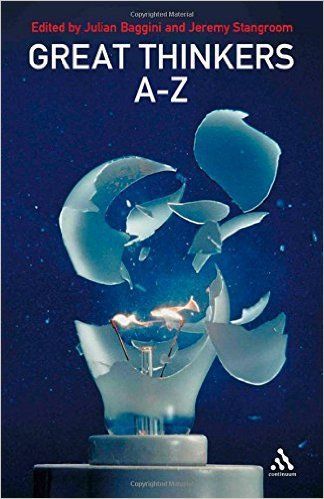
Great Thinkers, A-Z brings together 100 short, accessible snapshots of the people who have shaped Western thought from the ancient Greeks to today. The snapshots, written by the world’s leading experts, describe a major thinker’s life and work with suggestions for further reading on each one. Covering philosophers as well as cultural and scientific thinkers–such as Foucault, Darwin, Einstein and Freud–who have had a major impact on philosophy, Great Thinkers, A-Z is the ideal book for anyone interested in the history of ideas and in contemporary thought.
ما از اخلاق چه انتظاری داریم؟ این سوال شاید تاحدودی برای عموم مردم و یا متخصصان این رشته قابل پاسخ باشد؛ اینکه خوب بودن را به ما بیاموزد و در تنظیم روابط فردی م...

جشن کتاب تهران به ایستگاه سی و یکم رسیده است. حال و احوال نشر کتاب خوب نیست و باید فرهنگدوستان را به خرید و هدیه دادن کتاب ترغیب نمود. خانه اخلاقپژوهان جوان ب...

بنیاد کتابهای اخلاق اسلامی عمدتا پالایش جان از آلودگیها و آراستن آن به زیباییها است. اندیشه محوری این قبیل کتابها آن است که انسان فعلی آنی نیست که باید باشد...

-
0 Comments