
Notice: تابع WP_Block_Type_Registry::register به طورنادرست فراخوانی شد. نامهای نوع بلوک نباید حروف بزرگ داشته باشند. لطفاً برای اطلاعات بیشتر، اشکال زدایی در وردپرس را مشاهده کنید. (این پیام در نگارش 5.0.0 افزوده شده است.) in /home/ethicsho/public_html/wp-includes/functions.php on line 5313
Warning: Use of undefined constant TDC_PATH_LEGACY - assumed 'TDC_PATH_LEGACY' (this will throw an Error in a future version of PHP) in /home/ethicsho/public_html/wp-content/plugins/td-composer/td-composer.php on line 109
Warning: Use of undefined constant TDSP_THEME_PATH - assumed 'TDSP_THEME_PATH' (this will throw an Error in a future version of PHP) in /home/ethicsho/public_html/wp-content/plugins/td-composer/td-composer.php on line 113 بایگانیهای Blame - خانه اخلاق پژوهان جوان Notice: Trying to access array offset on value of type bool in /home/ethicsho/public_html/wp-content/plugins/wp-ulike/inc/general-functions.php on line 807
This book establishes the necessary integration of theological knowledge with theological ethics. It does this as a response to the postmodern critique of Christianity, as exemplified in Rorty and Lyotard. They argue that any claim to know God is necessarily tyrannical. Contemporary responses to such postmodern thinking often fail to address adequately the ethical critique that is made. This book redresses that balance by suggesting that our knowedge of God and love of the Other are so intimately connected that we cannot have one without the other. In the absence of love, then, we simply do not know God. Justin Thacker proposes that an effective theological response to postmodernity must address both knowledge and ethics in an integrated fashion as presented in this book.
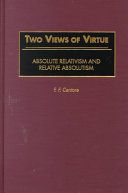
Centore’s work is an inquiry into the weaknesses and strengths of the two basic positions in ethics: the man-centered model and the God-centered model for deciding between right and wrong behavior. The philosophical paradigm for the man-centered approach is absolute relativism, while the paradigm for the God-centered approach is relative absolutism. Centore argues that the man-centered model in actual practice proves not to be realistic as an ethical guide, while the God-centered model, if properly understood, is the most useful approach. This work penetrates difficult ethical issues by examining human experience and reasoning in conjunction with actual choices of action. Although the God-centered approach is shown to be the most practical, Centore argues for a natural moral law that avoids any specific theology. Each chapter discusses the historical and theoretical background of the approaches and two possible compromises. The work is enlivened with examples of possible contexts in which moral decisions must take place. Various ethical dilemmas are presented with an examination of the potential consequences of applying either the atheistic or the theistic ethical approach. Centore’s argument is complex, but he explains the elements clearly and his conclusion is strengthened by real-life cases and an extensive Bibliography.
We live in a ‘bimoral’ society, in which people govern their lives by two contrasting sets of principles. On the one hand there are the principles associated with traditional morality. Although these allow a modicum of self-interest, their emphasis is on our duties and obligations to others: to treat people honestly and with respect, to treat them fairly and without prejudice, to help and are for them when needed, and ultimately, to put their needs above their own. On the other hand there are the principles associated with the entrepreneurial self-interest. These also impose obligations, but of a much more limited kind. Their emphasis is competitive rather than cooperative: to advance our own interests rather than to meet the needs of others. Both sets of principles have always been present in society but in recent years, traditional moral authorities have lost much of their force and the morality of self-interest has acquired a much greater social legitimacy, over a much wider field of behavior, than ever before. The result of this is that in many situations it is no longer at all apparent which set of principles should take precedence. In this book, John Hendry traces the cultural and historical origins of the ‘bimoral’ society have also led to new, more flexible forms of organizing, which have released people’s entrepreneurial energies and significantly enhanced the creative capacities of business. Working within these organizations, however is fraught with moral tensions as obligations and self-interest conflict and managers are pulled in all sorts of different directions. Managing them successfully poses major new challenges of leadership, and ‘moral’ management, as the technical problem-solving that previously characterized managerial work is increasingly accomplished by technology and market mechanisms. The key role of management becomes the political and moral one of determining purposes and priorities, reconciling divergent interests, and nurturing trust in interpersonal relationships. Exploring these tensions and challenges, Hendry identifies new issues of contemporary management and puts recognized issues into context. He also explores the challenges posed for a post-traditional society as it seeks to regulate and govern an increasingly powerful and global business sector.
“It’s the animal in us,” we often hear when we’ve been bad. But why not when we’re good? Primates and Philosophers tackles this question by exploring the biological foundations of one of humanity’s most valued traits: morality. In this provocative book, primatologist Frans de Waal argues that modern-day evolutionary biology takes far too dim a view of the natural world, emphasizing our “selfish” genes. Science has thus exacerbated our reciprocal habits of blaming nature when we act badly and labeling the good things we do as “humane.” Seeking the origin of human morality not in evolution but in human culture, science insists that we are moral by choice, not by nature. Citing remarkable evidence based on his extensive research of primate behavior, de Waal attacks “Veneer Theory,” which posits morality as a thin overlay on an otherwise nasty nature. He explains how we evolved from a long line of animals that care for the weak and build cooperation with reciprocal transactions. Drawing on both Darwin and recent scientific advances, de Waal demonstrates a strong continuity between human and animal behavior. In the process, he also probes issues such as anthropomorphism and human responsibilities toward animals. Based on the Tanner Lectures de Waal delivered at Princeton University’s Center for Human Values in 2004, Primates and Philosophers includes responses by the philosophers Peter Singer, Christine M. Korsgaard, and Philip Kitcher and the science writer Robert Wright. They press de Waal to clarify the differences between humans and other animals, yielding a lively debate that will fascinate all those who wonder about the origins and reach of human goodness.
ما از اخلاق چه انتظاری داریم؟ این سوال شاید تاحدودی برای عموم مردم و یا متخصصان این رشته قابل پاسخ باشد؛ اینکه خوب بودن را به ما بیاموزد و در تنظیم روابط فردی م...

جشن کتاب تهران به ایستگاه سی و یکم رسیده است. حال و احوال نشر کتاب خوب نیست و باید فرهنگدوستان را به خرید و هدیه دادن کتاب ترغیب نمود. خانه اخلاقپژوهان جوان ب...

بنیاد کتابهای اخلاق اسلامی عمدتا پالایش جان از آلودگیها و آراستن آن به زیباییها است. اندیشه محوری این قبیل کتابها آن است که انسان فعلی آنی نیست که باید باشد...

-
0 Comments