Notice: تابع WP_Block_Type_Registry::register به طورنادرست فراخوانی شد. نامهای نوع بلوک نباید حروف بزرگ داشته باشند. لطفاً برای اطلاعات بیشتر، اشکال زدایی در وردپرس را مشاهده کنید. (این پیام در نگارش 5.0.0 افزوده شده است.) in /home/ethicsho/public_html/wp-includes/functions.php on line 5313
Warning: Use of undefined constant TDC_PATH_LEGACY - assumed 'TDC_PATH_LEGACY' (this will throw an Error in a future version of PHP) in /home/ethicsho/public_html/wp-content/plugins/td-composer/td-composer.php on line 109
Warning: Use of undefined constant TDSP_THEME_PATH - assumed 'TDSP_THEME_PATH' (this will throw an Error in a future version of PHP) in /home/ethicsho/public_html/wp-content/plugins/td-composer/td-composer.php on line 113 بایگانیهای VDM Verlag - خانه اخلاق پژوهان جوان Notice: Trying to access array offset on value of type bool in /home/ethicsho/public_html/wp-content/plugins/wp-ulike/inc/general-functions.php on line 807
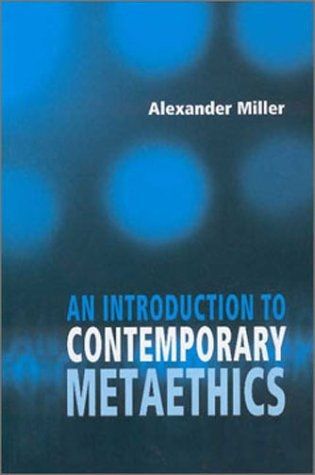
This introduction provides a highly readable critical overview of the main arguments and themes in twentieth-century and contemporary metaethics. It traces the development of contemporary debates in metaethics from their beginnings in the work of G. E. Moore up to the most recent arguments between naturalism and non-naturalism, cognitivism and non-cognitivism. * A highly readable critical overview of the main arguments and themes in twentieth century and contemporary metaethics. * Asks: Are there moral facts? Is there such a thing as moral truth? Is moral knowledge possible? * Traces the development of contemporary debates in metaethics from their beginnings in the work of G. E. Moore up to the most recent debates between naturalism and non-naturalism, cognitivism and noncognitivism. * Provides for the first time a critical survey of famous figures in twentieth century metaethics such as Moore, Ayer and Mackie together with in-depth discussions of contemporary philosophers such as Blackburn, Gibbard, Wright, Harman, Railton, Sturgeon, McDowell and Wiggins.
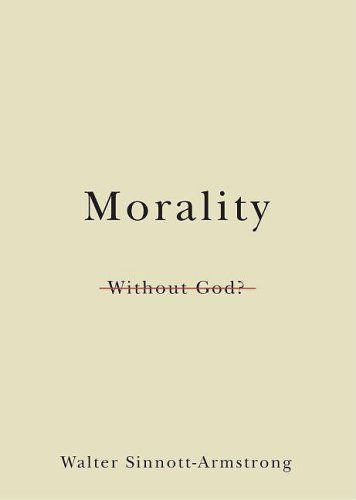
Some argue that atheism must be false, since without God, no values are possible, and thus “everything is permitted.” Walter Sinnott-Armstrong argues that God is not only not essential to morality, but that our moral behavior should be utterly independent of religion. He attacks several core ideas: that atheists are inherently immoral people; that any society will sink into chaos if it is becomes too secular; that without morality, we have no reason to be moral; that absolute moral standards require the existence of God; and that without religion, we simply couldn’t know what is wrong and what is right. Sinnott-Armstrong brings to bear convincing examples and data, as well as a lucid, elegant, and easy to understand writing style. This book should fit well with the debates raging over issues like evolution and intelligent design, atheism, and religion and public life as an example of a pithy, tightly-constructed argument on an issue of great social importance.
To what extent should parents be allowed to use reproductive technologies to determine the characteristics of their future children? And is there something morally wrong with parents who wish to do this? Choosing Tomorrow’s Children provides answers to these (and related) questions. In particular, the book looks at issues raised by selective reproduction, the practice of choosing between different possible future persons by selecting or deselecting (for example) embryos, eggs, and sperm. Wilkinson offers answers to questions including the following. Do children have a ‘right to an open future’ and, if they do, what moral constraints does this place upon selective reproduction? Should parents be allowed to choose their future children’s sex? Should we ‘screen out’ as much disease and disability as possible before birth, or would that be an objectionable form of eugenics? Is it acceptable to create or select a future person in order to provide lifesaving tissue for an existing relative? Is there a moral difference between selecting to avoid disease and selecting to produce an ‘enhanced’ child? Should we allow deaf parents to use reproductive technologies to ensure that they have a deaf child?
From the relative obscurity in which Levinas’s work languished until very recently, Emmanuel Levinas must now be judged as one of the most influential figures in contemporary Continental philosophy. There is no better guide than John Lewelyn to lead one through the thickets of Levinas’s prose. Bursting with questions, multiple references, cascading citations and multilingual puns and nuances, this book is the compelling record of intellectual obsession. Taking as its guiding thre the theme of genealogy, the book gives a broadly chronological and impressively manageable presentation of the whole sweep of the Levinas’s work. Balanced and finely grained, Llewelyn confronts questions of method, Heidegger, phenomenology, the theme of sensibility, religion, enjoyment, feminity, eros, justice and the political. The book reaches a stunning climax in a series of chapters that give a hestitant but tolerant discussion of the question of God in Levinas, the relation to Levinasian ethics to Nietzscheangenealogy, and an extraordinary discussion of metaphor that leads into a wholly original analysis of Levinas’s poetics and metaphorics. The book concludes with a sensitive reading of the autobiographical epigraphs to Levinas’sOtherwise than Being…and a consideration of the Holocaust.
ما از اخلاق چه انتظاری داریم؟ این سوال شاید تاحدودی برای عموم مردم و یا متخصصان این رشته قابل پاسخ باشد؛ اینکه خوب بودن را به ما بیاموزد و در تنظیم روابط فردی م...

جشن کتاب تهران به ایستگاه سی و یکم رسیده است. حال و احوال نشر کتاب خوب نیست و باید فرهنگدوستان را به خرید و هدیه دادن کتاب ترغیب نمود. خانه اخلاقپژوهان جوان ب...

بنیاد کتابهای اخلاق اسلامی عمدتا پالایش جان از آلودگیها و آراستن آن به زیباییها است. اندیشه محوری این قبیل کتابها آن است که انسان فعلی آنی نیست که باید باشد...

-
0 Comments