Notice: تابع WP_Block_Type_Registry::register به طورنادرست فراخوانی شد. نامهای نوع بلوک نباید حروف بزرگ داشته باشند. لطفاً برای اطلاعات بیشتر، اشکال زدایی در وردپرس را مشاهده کنید. (این پیام در نگارش 5.0.0 افزوده شده است.) in /home/ethicsho/public_html/wp-includes/functions.php on line 5313
Warning: Use of undefined constant TDC_PATH_LEGACY - assumed 'TDC_PATH_LEGACY' (this will throw an Error in a future version of PHP) in /home/ethicsho/public_html/wp-content/plugins/td-composer/td-composer.php on line 109
Warning: Use of undefined constant TDSP_THEME_PATH - assumed 'TDSP_THEME_PATH' (this will throw an Error in a future version of PHP) in /home/ethicsho/public_html/wp-content/plugins/td-composer/td-composer.php on line 113 بایگانیهای University Press of Kansas - خانه اخلاق پژوهان جوان Notice: Trying to access array offset on value of type bool in /home/ethicsho/public_html/wp-content/plugins/wp-ulike/inc/general-functions.php on line 807
“This book addressing an emerging field of study, ethics and gamesand answers how we can better design and use games to foster ethical thinking and discourse in classrooms”–Provided by publisher.
The contributions to Law and Art address the interaction between law, justice, the ethical and the aesthetic. The exercise of the legal role and the scholarly understanding of legal texts were classically defined as ars iuris – an art of law – which drew on the panoply of humanist disciplines, from philology to fine art. That tradition has fallen by the wayside, particularly in the wake of modernism. But, as this book demonstrates, a consideration of the relationship between law and art can still bring jurisprudence, and particularly critical jurisprudence, to life. In its attention to the inexpressible, art can contribute to the liberation of legal doctrine from its own self-imposed limits. It can inform the ethics of a legal theory that is concerned to address how theoretical abstractions and concrete oppressions overlook the singularity and spontaneity to which art attests. The contributors to this volume – and their engagement with the full range of ‘the arts’ – seek, therefore, to disturb and to supplement conventional accounts of justice: raising the difficulty, but also the promise, of that surplus which art reveals: of life over legal formalisation.
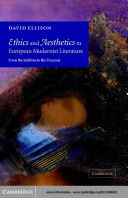
David Ellison’s book is an investigation into the historical origins and textual practice of European literary Modernism. Ellison’s study traces the origins of Modernism to the emergence of early German Romanticism from the philosophy of Immanuel Kant, and emphasizes how the passage from Romanticism to Modernism can be followed in the gradual transition from the sublime to the uncanny. Arguing that what we call High Modernism cannot be reduced to a religion of beauty, an experimentation with narrative form, or even a reflection on time and consciousness, Ellison demonstrates that Modernist textuality is characterized by the intersection, overlapping, and crossing of aesthetic and ethical issues. Beauty and morality relate to each other as antagonists struggling for dominance within the related fields of philosophy and theory on the one hand (Kant, Kierkegaard, Nietzsche, Freud) and imaginative literature on the other (Baudelaire, Proust, Gide, Conrad, Woolf, Kafka).
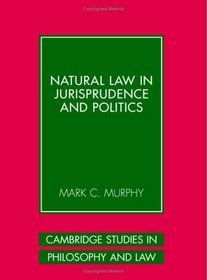
“In this book, Mark C. Murphy argues that the central thesis of natural law jurisprudence – that law is backed by decisive reasons for compliance – sets the agenda for natural law political philosophy, which demonstrates how law gains its binding force by way of the common good of the political community. Murphy’s presentation in this book ranges over the central questions of natural law jurisprudence and political philosophy, including the formulation and defense of the natural law jurisprudential thesis, the nature of the common good, the connection between the promotion of the common good and requirement of obedience to law, and the justification of punishment.”–BOOK JACKET.
ما از اخلاق چه انتظاری داریم؟ این سوال شاید تاحدودی برای عموم مردم و یا متخصصان این رشته قابل پاسخ باشد؛ اینکه خوب بودن را به ما بیاموزد و در تنظیم روابط فردی م...

جشن کتاب تهران به ایستگاه سی و یکم رسیده است. حال و احوال نشر کتاب خوب نیست و باید فرهنگدوستان را به خرید و هدیه دادن کتاب ترغیب نمود. خانه اخلاقپژوهان جوان ب...

بنیاد کتابهای اخلاق اسلامی عمدتا پالایش جان از آلودگیها و آراستن آن به زیباییها است. اندیشه محوری این قبیل کتابها آن است که انسان فعلی آنی نیست که باید باشد...

-
0 Comments